avatarEric Simpson

Free AI web copilot to create summaries, insights and extended knowledge, download it at here

2885

Abstract

st’s advanced concurrency features provide excellent tooling for efficient and safe multi-threaded programming, maximizing your LLM’s throughput potential.</li><li><b>Web Ecosystem:</b> While Rust may be newer relative to languages like Python and JavaScript, its web development ecosystem is growing rapidly. Frameworks like Actix Web and Rocket offer mature solutions for building high-performance REST APIs.</li><li><b>Cross-Platform Compatibility:</b> Applications built with Rust can easily compile to run on virtually any operating system (Windows, Linux, macOS, etc.). This versatility is a tremendous advantage in deployment scenarios.</li></ol><h1 id="0df0">Let’s set the stage</h1><figure id="d2d7"><img src="https://cdn-images-1.readmedium.com/v2/resize:fit:800/1*AcpA4MkKboaPY0ONHHsN2g.jpeg"><figcaption></figcaption></figure><p id="4fe8">To interact with LLMs from Rust programs, there are a few primary methods:</p><ol><li><b>API Clients:</b> Many LLM services provide readily available REST APIs. Rust offers excellent HTTP client libraries, such as <code>reqwest</code>, to facilitate seamless communication with these APIs.</li><li><b>Model Hosting:</b> If you need low-latency or offline access, consider hosting language models directly within your Rust server. Rust bindings exist for popular frameworks like ONNX Runtime, allowing you to load and execute models locally.</li><li><b>Hybrid Approaches:</b> In some cases, a combination of the above approaches might be optimal. Your Rust server could interact with an external API when dealing with larger, more computationally intensive LLMs, while hosting smaller models locally for real-time tasks.</li></ol><h1 id="39fa">Our approach</h1><figure id="5b02"><img src="https://cdn-images-1.readmedium.com/v2/resize:fit:800/1*yxk1qTnQ9WfTTwKl-p20lg.jpeg"><figcaption></figcaption></figure><p id="c74d">In this design brainstorming session, we’ll outline the conceptual framework and key components for building a Rust-based REST server aimed at serving Language Model (LM) requests efficiently. Our goal is to design a scalable and performant server architecture that can handle various LM-related functionalities such as chat interactions, health checks, and version information retrieval.</p><h1 id="c75f">Problem Definition</h1><p id="8384"><b>Goal:</b> Establish a clear objective for our server. Possibilities include:</p><ul><li>Providing a central point of access and control for one or more large language models.</li><li>Offering an API layer for other applications to leverage LLM capabilities easily.</li><li>Abstracting away platform-specific LLM details behind a simple REST interface.</li></ul><h1 id="93e8">Target Users:</h1><p id="822d">Who are we building this server for?</p><ul><li>Developers building LLM-powered applications.</li><li>Data scientists conducting experiments with LLMs.</li><li>Int

Options

ernal services within an organization that need LLM functionality.</li></ul><h1 id="40ab">Design Thinking for a Rust LLM REST Server</h1><ol><li>Project Structure:</li></ol><p id="692a">We’ll start by defining the overall project structure, including modules, dependencies, and project organization. This involves setting up a Cargo-based project with appropriate dependencies for handling HTTP requests, JSON serialization, and any required LM-related functionality.</p><p id="08d8">2. Endpoint Design:</p><p id="347b">Next, we’ll design the REST API endpoints that our server will expose. Key endpoints may include:</p><ul><li><code>/api/query</code>: Endpoint for handling chat interactions with the Language Model.</li><li><code>/api/health</code>: Endpoint for performing health checks to ensure the server is running smoothly.</li><li><code>/api/app/version</code>: Endpoint for retrieving version information of the server application.</li></ul><p id="7e21">Each endpoint will have specific request/response formats and logic for handling incoming requests and generating appropriate responses.</p><p id="5660">3. Language Model Integration:</p><p id="cfb7">We’ll integrate the Language Model functionality into our server to handle chat interactions. This may involve leveraging existing LM libraries or implementing custom logic to interact with the LM backend.</p><p id="7166">4. Error Handling:</p><p id="51e4">Error handling is crucial for ensuring the reliability of our server. We’ll design robust error handling mechanisms to gracefully handle errors and return meaningful error responses to clients.</p><p id="4375">5. Concurrency and Performance:</p><p id="2b52">Rust’s concurrency features will be leveraged to ensure our server can handle multiple requests concurrently without compromising performance or safety. We’ll design our server to efficiently utilize system resources and minimize latency.</p><p id="b4f6">6. Configuration and Deployment:</p><p id="ee30">We’ll design our server to be configurable and deployable in various environments. This involves defining configuration options for server settings such as port number, log levels, and any other relevant parameters.</p><p id="e1e2">7. Testing and Quality Assurance:</p><p id="0a99">Comprehensive testing will be an integral part of our design process. We’ll plan for unit tests, integration tests, and possibly end-to-end tests to ensure the reliability and correctness of our server implementation.</p><p id="647b">Conclusion:</p><p id="860d">This design brainstorming session provides a high-level overview of the key components and considerations involved in building a Rust-based REST server for serving Language Model requests. By carefully planning and designing our server architecture, we can create a robust and scalable platform for handling LM interactions effectively.</p></article></body>

Conspiracy Unveiled: The Truth Behind the JFK Assassination - Part 1
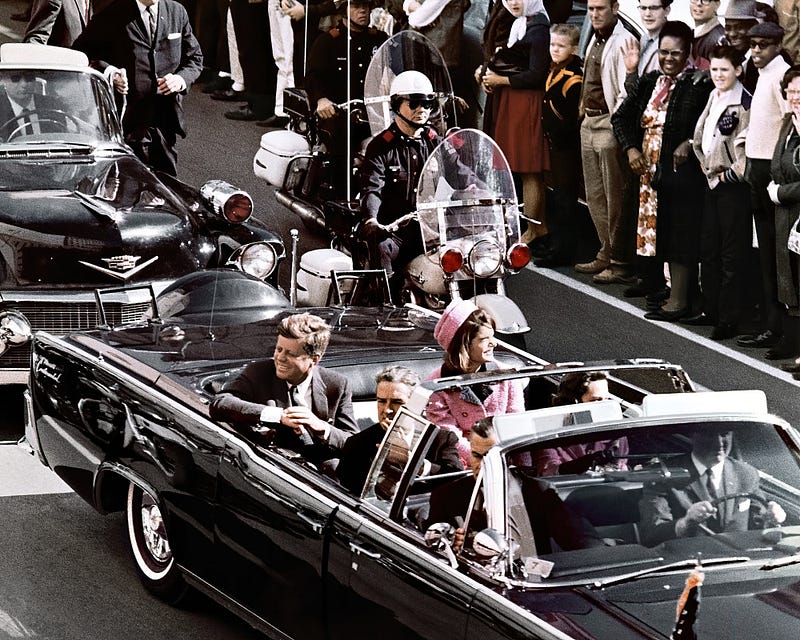
Part 1

Unraveling the Magic: A Critical Analysis of Hidden Realities

The Assassination of John F Kennedy who was best known as the 35th president of the United States, has been riddled with skepticism ever since the moment it happened. To this day studies show that the majority of Americans still do not believe that Lee Harvey Oswald either acted alone or was even the one who killed the president that day.

Some of the notable people who share this idea include Roger Stone, Dr. Robert McClelland, Joe Rogan, Leroy Fletcher Prouty, Tucker Carlson, Michael Franzese, Oliver stone, Sammy the Bull, Jesse Ventura, and Dr. Cyril Wecht. But none I feel is more important than his own nephew and current presidential candidate for the 2024 election Robert Kennedy Jr.

There are many reasons for why most people would think the government isn’t telling us the complete truth about the assassination of president Kennedy, while I’m not going to discuss hypothetical things like some of the notable suspects E. Howard Hunt, Clay Shaw, and Malcom Wallace. I am going to discuss some of the facts and reasons that I think are the most crucial regarding the truth behind his death.

The first one that comes to mind is the absurd single/magic bullet theory that has been proposed by the Warren Commission. They assert that the “magic bullet” does something very interesting, which is why it has been given that name by the American public.

They claim that three shots were fired at the president. The first bullet missed the car entirely, the second bullet they claim hit the president in the back, which proceeded to exit through his chest, it then entered through the governors back, went through his ribs, and then exited through his chest, it then enters his wrist shattering the wrist bone, exited the wrist and went partially into the governors leg. And last but not least the third shot that went straight through the presidents head.
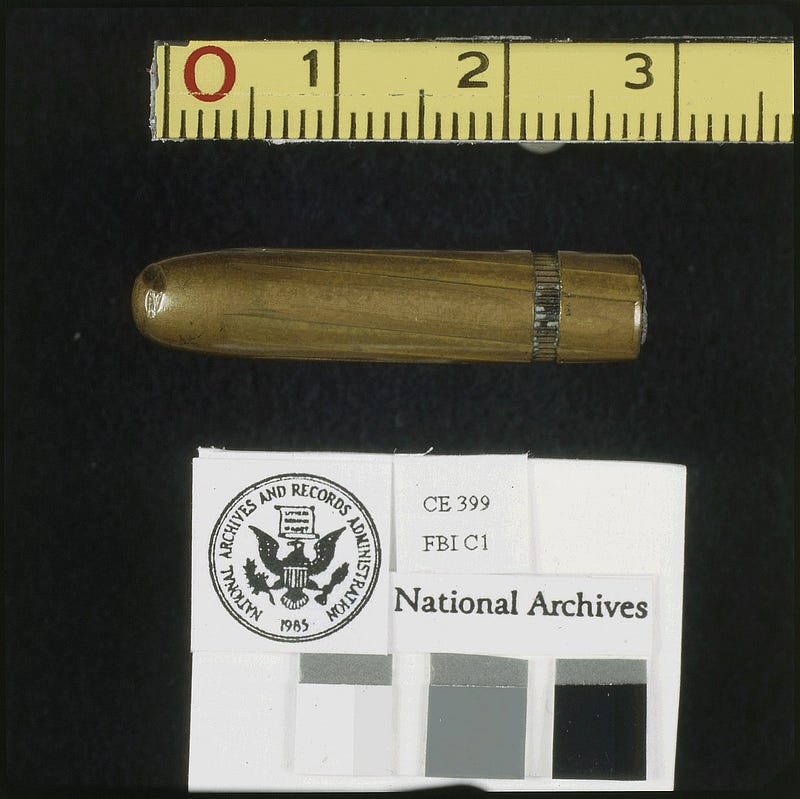
Now you might be able to see the problem with that idea. The governments theory that a single bullet which looks relatively unscathed as you can see with the picture above. Caused two chest wounds, two back wounds, a rib wound, a leg wound, and two wrist wounds. That’s seven to eight confirmed wounds and they account all that damage to one bullet.

Now if you ask me personally I don’t think that’s the truth. My opinion doesn’t really matter though, but Governor John Connally who was the only surviving victim who was shot that day, and was just feet away from Kennedy at the time. His opinion does matter and he doesn’t believe it either.

There’s a reason why he doesn’t believe it and it’s not because he’s some crazy person or anything like that. It’s actually the quite opposite of that, it’s because of how incredibly self aware he was of the very enigmatic and potentially dangerous situation that he had found himself in.

I remember watching an interview with him that first aired back on July 15th 1991, you can find it online and I suggest you do. He said that “a lot of strange things happened surrounding the assassination that there’s no good explanation for” as he smirks and gives the same look as somebody that’s telling some sort of insider trading information to a fellow colleague, or somebody inconspicuously telling a criminal partner that they’re under surveillance and he’s wearing a wire.

As if he was trying to tell us something else but he knew he couldn’t do it, so he did the best he could to convey the message via context clues and facial expressions.

I found it to be an extremely telling interaction and I think a lot of you would too.

Part 2

Writing
Education
Politics
History
Life
Recommended from ReadMedium