
Conspiracy Theories Are Killing Us, But We Love It
Who (Or What…) Is To Blame?
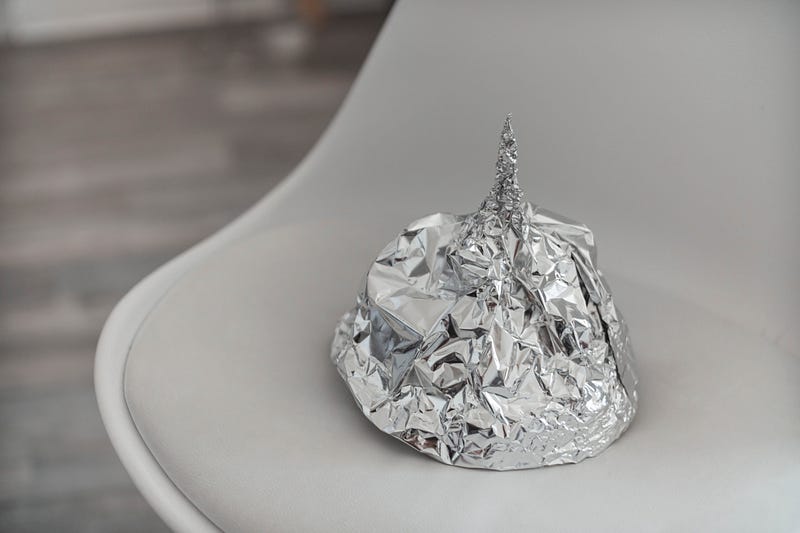
Who really killed JFK? Was the moon landing faked? Where is Bigfoot? And what the f*** is actually in Area 51?
Conspiracy theories are some of the most polarizing topics among human beings, and for good reason. They can fundamentally disrupt our lives in thought and influence our decisions. I have always been kind of captivated with conspiracy theories and the excitement of the what if? scenario.
It turns out, though, that this may actually be more dangerous than simply a sharing of information or thought experiments. I decided to look into them a little more and found some things I think people should know.
The Cold Hard Facts
Shannon Odell discusses why some people may be more inclined to believe in wild theories about things like the earth being flat or the illuminati. It has to do with the development of our brains. More importantly, the presence or absence of dopamine might be a significant factor.
Dopamine is responsible for our emotion, but also decision-making, which I found interesting and illuminating. I suppose this makes sense, considering when we “feel good” our decisions may be based on the chemicals being released by the brain, one being dopamine.
Regardless, dopamine also helps us to find patterns, which is exactly what conspiracy theories are when you break them down.
It is incredible to me, actually, to see results of this study that shows that the more dopamine an individual has (in this case, when given a drug to increase dopamine), the more likely they are to show affirmation of beliefs that might be considered conspiracy theories.
Origins
When we find patterns in things that are (for the most part) unrelated, conspiracy theories are born. Wild ideas are spread that may not be true, even if logically they make sense.
This is called illusory pattern detection, and while not necessarily the cause of all of these kinds of theories, it sheds some light on their origin, even if actually random.
It’s quite confusing actually, because these things are, in themselves, random. However, the complexity of the human brain ends up finding patterns in them.
How does one find these patterns if they aren’t the ones making the theory’s original connections?
The answer lies in confirmation bias, which is a subtle, powerful, dangerous, and almost undetectable force that reinforces beliefs by the simple fact that others believe them, too.
The biggest example here would be political theories and partisan issues where no one really knows what is going on, they just find themselves agreeing, so each must be right.
Deeper
If we look deeper, I think that the chaos of the world actually contributes to this. Like I said, no one really knows what is going on, so within this, they create meaning for themselves.
Fear of the unknown gives them a motive, and their own brain gives them the means.
Sometimes, this just happens to be in outlandish ways.
Sometimes, the problem is that logic almost affirms them, and without a deeper knowledge or understanding, a conspiracy theory may 1) be the easiest answer to accept, or 2) captivate someone enough to search in such a way that they “go down the rabbit hole” and end up entrenched in false beliefs.
My Thoughts
I have written that Medium can be an echo chamber when no unique perspective is provided, and I still think this.
Hence, the following:
I think conspiracy theories are dangerous but interesting. It is fun, sometimes, to sit and think on or discuss them. As with anything, moderation is necessary. The internet and social media have eliminated moderation for a lot of things for humanity, though.
Because of this, I believe that the more wild conspiracy theories (i.e., aliens and flat earth) are not what threaten us. It is those that are polarizing in ways that show up in the real world.
Politics and public shows of belief and affirmation that affect more than those directly involved are a direct attack on the freedom we all so desperately think we have.
If someone has little knowledge of something, I would urge that person to keep in mind that other people are not a reliable source, no matter how many of those other people believe something.
Unfortunately, this problem does not seem to be going away (only seems to be getting worse, actually).
People are making money and sharing information based on these, but we all know these theories are crazy. Yet a surprising amount of people believe in them anyway.
…I may believe in a few myself…👽
Let’s not get rid of conspiracy theories, but maybe we (yes, you with the “Bush → 9/11” shirt) should take them a little less seriously.
Thank you so much for reading! I was just today accepted into the Partner Program and am excited to continue my journey!
If you aren’t subscribed to Medium yet, you should be. Use my referral link and support writers like myself! :)
Find out more about me below!
I greatly appreciate every single person who has clicked on any of my stories and taken the time to read and respond. Shout out to David West and PJ Kaplan for being two of the most engaging people I’ve met on Medium!
Some fellow writers and/or followers I’d like to mention: Sara Burdick, Megan Llorente, Linda Ng, Justin Andrews, Robert Ralph, Gabby Gabs, Chris Duarte, Leslie Auerbach, Mark Hackett, Gökhan Şengün, The Sober Vegan Yogi, Valentin, Ali Kurtulmus, … I could go on, appreciate everyone here!
References:


