
Consent Education Should Be Gender-Inclusive
Don’t assume every student is heterosexual or cisgender
As a teenager, I felt invisible during our middle school sex education unit. Being gay and autistic, there was no useful information shared in class about same-sex dating or how to approach courtship if you’re neurodiverse. I had to try my best to figure it out for myself, all on my own.
Too often, our schools apply a stark binary when attempting to teach students about consent. Whether it’s in middle school, high school, or college — much of the modern narrative has been molded to say:
“We need to teach girls/women to be safe; we need to teach boys/men to make girls/women feel safe.”
Part of this belief is based on sordid truths of our world.
How do we dispel myths that suggest women who experience sexual abuse or harassment are “asking for it” (through their wardrobe or their behavior)?
How can we discourage “locker room talk” instigated by the men who strive to emulate an alpha male archetype?
I believe that character education is the most prudent path to get our children there. I’d argue that dress codes and standards for physical/interpersonal conduct should be consistent across gender lines.
Alas…there are still those voices out there peddling the explicit duality that men/boys are the ones who need to be educated on consent. Women/girls, they would claim, automatically learn it.
Well, obviously they don’t — since, given how young girls are sexualized at such early ages, they often receive inaccurate messages of what boys actually desire. Or what sexual options are available to any individual at any point during their life.
Boys aren’t a monolith; we seek different things from romantic or sexual relationships. So do girls. There’s more than just one way to have sex. And there are a multitude of ways in which sexual desire may intersect with gender.
Now, let’s delve into how these dynamics can translate to America’s classrooms.
Myths & Misconceptions
Last summer, Jenny Mundy-Castle wrote a pretty good Medium piece recapping the strength that the #MeToo movement has brought to survivors. While expressing support for abused people to take back our power, she pointed out how the January 2018 Aziz Ansari controversy muddied the waters by placing consensual sexual activity on par with sexual assault, harassment, molestation, and rape.
Ms. Mundy-Castle spotlighted the following quotation from tech mogul Lucia Brawley:
When we do that, we trivialize the brave victims who are coming forward about actual sex crimes.
She redirects the reader’s focus to more egalitarian policies, such as eliminating double standards that target girls when it comes to school dress codes. Her commentary probes at how the dispute over whether #MeToo has gone too far is something that often breaks down along ideological or partisan lines. She draws from the public testimony of multiple leaders instrumental in consent education.
One of those voices is that of Tarana Burke, the founder of #MeToo, reiterating how essential it is for the movement to relate to ordinary people who have no real institutional power. As Burke puts it:
What we need to be talking about is the everyday woman, man, trans person, child, and disabled person. All the people who are not rich, [W]hite, and famous, who deal with sexual violence on an everyday basis…If Alyssa Milano didn’t say: ‘Wait a minute, I didn’t start this [movement]. This [B]lack woman named Tarana Burke started this [movement],’ people would not know my name.
Another of those voices belongs to Laurie Halse Anderson, who, in a Time magazine piece, highlights the importance of educators leading conversations and modeling consent. Anderson predicates the need for expanded consent education curriculums on her experience with guest speakers; in schools, she has observed how girls are usually the ones who visibly express empathy with the speakers, and openly converse with them afterward. By contrast, boys’ reactions tend to be much more factionalized: there are those who deny the definition of rape, those who want to be allies to survivors, and those who have been on the receiving end of rape and sexual violence (but are too uneasy about sharing their own experiences publicly).
In a separate Medium piece, Judson Vereen explores another side of the debate. Many parents feel wary about sex ed curriculums in schools, says Mr. Vereen, due to what he describes as “the activist teacher.” These are individual educators who take it upon themselves to instruct students by sharing details of their own private sex lives, detailing masturbatory techniques, analyzing pornographic imagery, and encouraging covert gender-transitions (aka “The Transition Closet”).
Mr. Vereen brings up a pivotal sticking-point: how does a school district obtain widespread buy-in from parents? While a complex matter, it is possible. Cheryl Phillips, the District Health Educator of Florida’s Palm Beach School District, offers this firsthand quotation to the Gender Spectrum (an organization I’ll discuss further, in a moment) handbook:
When a parent wanted to opt their children out of a puberty education class, I would call them to discuss their concerns and explain what we teach. Usually[,] they don’t opt out. In my 20-plus years of teaching, only two did.
Writing for The Good Men Project, Andrew Smiler seems to tie together these points made by Mundy-Castle and Vereen. He points to how society has begun empowering young girls with lessons about how artificial and unrealistic the media-driven glorification of female beauty can be. Yet, as Smiler points out, there’s been no real corresponding societal effort to help boys understand and cope with the way in which artificial male beauty becomes glorified. Smiler advocates that we should guide teenagers of all gender identities in deconstructing how every gender is unsoundly idealized.
People who disagree about these narratives — on all different sides of them — tend to miss the point. They are operating under the premise that students will identify as either boys or girls — and thus, students must be educated according to this rigid binary.
But such an assumption trivializes the complexity of human sexuality itself.
Challenging Assumptions
A set of guidelines released by the Healthy Teen Network in 2016 reminds us to avoid the snap judgment that every teenager is necessarily heterosexual or cisgender. Due to this reality, those categories shouldn’t be treated by educators as the default. We also shouldn’t draw conclusions about people’s sexuality based on their physical appearance or mannerisms.
Making students aware of the objective reality pertaining to sexual diversity is the preferable method. It allows the individual teenager to take ownership of their identity. Also, children and adults can both stand to learn how to navigate uncomfortable discussions — such as appropriately handling an honest mistake of misgendering someone else.
A set of sexual education guidelines from the Canadian-based Alberta Health Services identifies common values that are beneficial to relate to sexual activity. These include: safety, boundaries, communication, respect, sovereignty, and comfort. When applying those values, key adjectives describe how such behavior must be voluntary, affirmative, conscious, sober, mutual, proactive, and legal.
As far as coaching our educators on how to be mindful of their words, Alberta Health Services highlights:
It’s important to use gender[-]neutral language when talking about sexual assault. Not only does it reinforce unhealthy stereotypes, [but also] language that is gendered discourages men and boys and people who’ve been assaulted by women from disclosing the assault and getting help.
In 2018, the Vermont Agency of Education released a set of “exclusionary vs. inclusive” sex ed guidelines for teachers. Some of the agency’s recommendations for the classroom include:
- Nongendered language for condoms, group activities, or paired activities
- Usage of they/them when a person’s preferred pronouns aren’t otherwise provided or known
- Inclusion of homosexual, bisexual, asexual, aromatic, transgender, nonbinary, and intersex people when outlining scenarios involving birth control, pregnancy, intercourse, outercourse, domestic violence, and sexual assault
- Accurate depictions of all ways in which HIV or STIs can be transmitted, prevented, and treated
- Body-first language
- Examination of what allyship means insofar as standing up for victimized persons
For schools that are still stuck peddling antiquated educational narratives when teaching sex ed to students — some even more pointed guidance is in order.
What Such a Curriculum Might Look Like
Gender Spectrum is an organization focused on providing resources through which educators can empower students with quality sex ed. In its handbook for PHE (Puberty & Health Education), Gender Spectrum defines five core principles for teaching young people about consent and sexual sovereignty:
- Gender literacy
- Contrast between observable patterns versus rules
- Physiological science
- Developmental variations of the human body
- Multiple pathways to family-creation
One illustrative example of delving into gender dynamics is an open-source model created by author/activist Sam Killermann. Christened as “The Genderbread Person,” this visual aid offers sort of a “learning tree” for differentiating between the concepts of biological sex, gender identity, and gender expression. In addition, Killermann’s motif emphasizes a distinction between sexual and romantic forms of attraction.
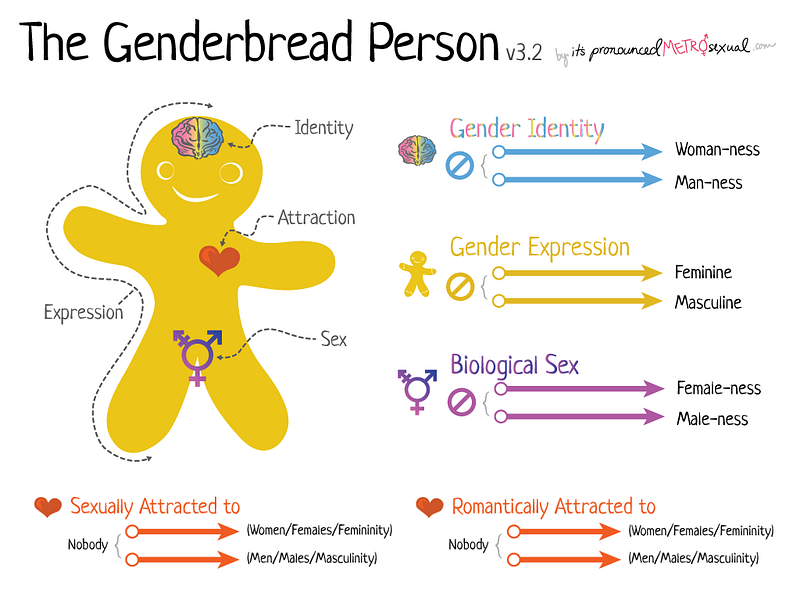
Gender Spectrum reminds us how girls and boys are showing signs of puberty at increasingly earlier ages. If we begin teaching these concepts earlier than later, even those who develop later in their adolescence will have a clearer idea of what to expect. By seeing oneself represented in the curriculum, preteens and teens will become better equipped to excel academically. The odds will be greater that they’ll develop healthier intimate relationships.
Along with gender diversity, these types of learning materials would include lessons on body diversity as well as experiential diversity.
Their PHE handbook explores the question of whether to segregate boys and girls based on their perceived gender when teaching sexual education in the classroom. Gender Spectrum makes a powerful case against teaching separate lesson plans to girls and boys:
Segregated instruction conveys to students that bodies unlike their own are taboo and should remain mysterious. The effect is to stigmatize bodies that are different. Separating instruction based on assumed physiology also serves to reinforce notions of a rigid binary based solely on genitals. We have already seen the impact this has on all students’ understanding of gender’s complexity.
When separated, students do not have the guided experience of communicating about potentially sensitive topics with peers whose bodies and gender differ from their own. This is a key skill they will need as they enter into relationships, whether in the context of friendship, dating, sex, or parenting. Without carefully[-]structured spaces in which students can hear firsthand about the diversity of experiences individuals have, they miss an opportunity to build knowledge and develop empathy across differences. The net result not only leaves them unprepared for important interactions, it also reinforces many of the stereotypes they will carry into adulthood.
Yet, even well-meaning efforts can fall painfully short of upholding gender inclusivity. For example, the Obama/Biden Administration’s “It’s On Us” campaign insisted it wasn’t intending to be exclusive of any sexual violence survivors. It preemptively claimed to reject a one-size-fits-all approach.
But the campaign’s marketing suggested otherwise. In a public service announcement, President Obama, Vice-President Biden, and celebrity spokespersons used the tag of:
“If she doesn’t consent — or can’t consent — it’s a crime.”
This framing was inherently heteronormative and cisnormative. It essentially marginalized and erased same-sex relationships, transgender people, nonbinary people, and cisgender boys (as survivors) from the discussion. A better choice of phrasing would have been…
“If THEY don’t consent — or can’t consent — it’s a crime.”
Rather than shifting disproportionate burden onto youth and authority figures who have penises, the moniker of “It’s on us” should mean:
“It’s on EVERYONE (All of Us) to protect ONE ANOTHER…”
Otherwise, we’re programming children with what I’ve dubbed as “The Chivalry Fallacy” — where society proceeds to take away one’s agency over their gender identity.
Consent Must Be Universal
When I attended the University of Wisconsin — Eau Claire, I distinctly remember reading our Code of Conduct pamphlet. It blatantly stated how female students should be reminded never to let themselves be pressured into unwanted sexual situations; whereas, on the same section of the same page, male students were lectured as to how we never had the right to pressure or coerce anyone into any sexual activity.
I was utterly disgusted. Even in my early-twenties, I could immediately see how heteronormative and cissexist such language was.
And, at that age, I myself was largely uneducated as to obstacles faced by the nonbinary and transgender communities.
My K-12 school district had failed me.
Five years ago, Jeanne Sager authored a piece in The Atlantic profiling several of the states where teachers could be punished — or lose their careers entirely — for mentioning LGBT issues in the classroom. Today, we’ve witnessed specific politicians escalating that dogma under the guise of “family values.”
True family values would be those which teach every young person the benefits of self-respect and having a healthy respect for the bodies of all people around us. Such analysis of sexual freedom will lift each individual toward maximum carnal pleasure and amorous leadership well into adulthood.


