
Consciousness: Concepts, Theories, and Neural Networks
How can we tell if AI ever becomes conscious?
Consciousness is a heavy quest that has puzzled philosophers for over two thousand years. Because of its subjectivity and elusiveness, it was not a subject for scientific study until recent decades. With the unprecedented advances of artificial intelligence (AI), in particular, the remarkable performance of large language models (LLM), understanding consciousness becomes pragmatic and pressing beyond the philosophical and academic debates — how can we tell if ChatGPT has consciousness, and how can humankind be prepared if “artificial” consciousness arises in the foreseeable future?
For the last three decades, neuroscientists have made initial strides in theorizing the inner workings of consciousness in human brains based on vast experimental data, as triggered primarily by two factors.
First, the advances in scientific methods have empowered scientists to study the activities of neural cell assemblies in awake-behaving primates and humans. These techniques include brain imaging technologies, neurophysiological recording of hundreds of neurons simultaneously, and neural network modeling propelled by AI.
Second, a group of distinguished scientists made the initial bold move to study consciousness with scientific rigor. The field has thrived ever since, attracting many more talented scientists and students. The leaders include the Nobel laureates Francis Crick and Gerald Edelman. Crick won the Nobel Prize in Physiology or Medicine in 1962 for his groundwork in DNA structure and functions. Edelman won the same prize in 1972 for discovering antibody molecules in the immunological system. They both dedicated their later life to studying the mind, particularly the neurobiological mechanisms underlying consciousness.
This article reviews what scientists have understood about human consciousness and what predictions their theories of consciousness have made. With this knowledge and clarity, we can examine AI models and their architecture to determine whether and when they can be conscious.
Before delving into neuroscience about consciousness, it is necessary first to understand consciousness from psychological and behavioral perspectives. There are many philosophical debates on the definition of consciousness, which are far beyond the scope of this article.
What is Consciousness?
In 1890, William James published his monumental book “The Principle of Psychology,” which took him 12 years to finish. It was not a conventional psychological textbook, but the first work in history to systematically describe the functions of the mind by tapping into the inner workings of human brains. Remarkably, James had thought through almost every aspect of consciousness in his book, as revealed by the chapter titles: The Stream of Thought, The Consciousness of Self, Attention, Conception, The Perception of Time, Imagination, Will, Emotions, etc. As of today, scientists still constantly reference his work when studying consciousness.
By standing on James’s shoulder, we can describe consciousness from three angles. These aspects are not mutually exclusive, but each provides a different perspective on its nature.
Continuity of Consciousness
A fundamental aspect of consciousness is being present or a state of being. When I say I am conscious, it means at the given moment, I am aware of what is in my mind and my surroundings, including my thoughts, perceptions, and feelings. The consciousness of the present continues from moment to moment. This is the famous “stream of consciousness” as first raised by James:
“consciousness, then, does not appear to itself as chopped up in bits … it is nothing joined; it flows. A ‘river’ or a ‘stream’ are the metaphors by which it is most naturally described. In talking of it hereafter, let’s call it the stream of thought, consciousness, or subjective life.”
Beneath this continuity are the distinct instances or snapshots of experience, succeeding one after another. The memories of previous experiences and imaginations of what could happen next are brought into the present experience or thought effortlessly, weaving our cohesive awareness of the world with the continuous time frame of past, present, and future.
Several global states interrupt or adjust the continuity of consciousness. We are conscious when awake and lose consciousness in pathological conditions (e.g., coma) or during general anesthesia. The level of consciousness also changes when we sleep, particularly during dreaming. Similarly, during hypnosis or meditation, our consciousness state is modulated by focusing on the internal of our mind and detaching from the external environment.
Experience (Qualia)
Experience is the central phenomenon of consciousness. Each instance of “thought” in James’s “stream of thought” is an instance of experience. One typical example is the color we experience. When I see red, it is a conscious perception generated many steps away in my brain from the physical world, where only light wavelengths are physically present. In addition, seeing red at this moment becomes a unique experience that only I have, which is not observable by others. Similarly, we cannot experience others’ perception of red, even though we think our perceptions are similar by calling it red.
Privacy is one of the essential features of consciousness, as Crick and Koch stated in their landmark paper “A framework for consciousness”:
“By ‘private’, we mean that it is accessible exclusively to the owner of the brain; it is impossible for me to convey to you the exact nature of my conscious percept of the color red, though I can convey information about it, such as whether two shades of red appear to me to be the same or different. “
Because experience is such a general term, researchers sometimes use the Latin word “qualia” — the word was first introduced by American philosopher Charles Peirce in 1866 — to define instances of subjective, conscious experience specifically. Besides privacy, another critical feature of experience is the unity of each instance. Once formed, the experience is not reducible and becomes a coherent entity highly integrated with multimodal sensory information and context. While each instance of qualia is unique, qualia is highly coherent across each experience, which is essential to the individual self.
Conscious Self
The human self is very complicated. James described four constituents of the self: the material self, the social self, the spiritual self, and the pure ego. Agreeing with James’ definitions, the neuroscientist Antonio Damasio groups them into two categories:
- Core self: represents the self’s body and internal state, corresponding to the material self in James’s definition.
- Autobiographical self: represents all aspects of one’s social self, spiritual self, and ego, all of which face outward.
When alone, we are aware of our inner self, namely our existence and being in the world, with the core self. The core self unites our mind and body with the consciousness of embodiment, where we feel ourselves anchored in our own bodies.
The autobiographical self is socially embedded and is the fundamental unit of human culture and society. Remarkably, most emotions, such as love, anger, jealousy, hubris, pity, ambition, arrogance, and gratitude, are related to other people. Furthermore, language and culture are critical elements for the evolution and building of the autobiographical self.
The conscious self comes with free will, the sense of choosing between alternative courses of action based on our own beliefs and judgments. Different selves within an individual tend to possess different values and motivations, driving different outcomes and potential mental conflicts. In other words, human free will is a conscious process, which signifies our ability to control our emotions, manage our attentions, predict through mental imagination, and act by overriding our intuitions and automatic reflexes. Is consciousness the same as intelligence? Probably not. Then why do we need consciousness? The answers become apparent because consciousness enables free will and rational decision-making.
Easy vs. Hard Problems
Before solving any problem, we should first define it. This has been a challenging task for the field of consciousness from the beginning. In 1995, philosopher and cognitive scientist David Chalmers took a stab at defining how neuroscience should tackle the problem of consciousness. He categorized the problem into two groups: easy and hard.
The hard problem is private experience (or qualia), which is the unity of perceptions, feelings, memories, and actions. And it is not deducible. In addition, experience is the basic phenomenon of consciousness, which could be the starting point for scientists to study before moving to the conscious self.
Conversely, the easy problems are our cognitive functions, as listed by Chalmers:
- the ability to discriminate, categorize, and react to environmental stimuli;
- the integration of information by a cognitive system;
- the reportability of mental states;
- the ability of a system to access its own internal states;
- the focus of attention;
- the deliberate control of behavior;
- the difference between wakefulness and sleep.
In Chalmer’s view, even when these easy problems are fully explained, the hard problem still remains. Experience has the features that these functions do not have. In other words, consciousness is not cognition nor equivalent to intelligence. It is the self-awareness that constitutes the hard problem.
Another intriguing aspect of the problem is the relationship between consciousness and unconsciousness. Most of our survival and daily functions do not require consciousness. In addition, most of our cognitive functions, including learning, memory, and even decision-making, can operate without conscious awareness. In Thinking, Fast and Slow, Daniel Kahneman describes the conflicts between System 1 and System 2. The former is autonomous and provides quick solutions, and the latter is slow and requires effort and resources. System 1 appears pre-wired and follows a fixed order of steps, whereas System 2 has the flexibility to make choices through conscious deliberations. Discovering what leads to the differences between the two systems could shed light on the underlying mechanisms of consciousness.
Brain Anatomy of Consciousness
With modern imaging technologies and behavioral experiments on humans and primates, neuroscientists have made significant discoveries in the brain areas involved in consciousness. First, the neocortex gives rise to consciousness. Second, the thalamus, a structure in the center of the brain, is responsible for the global states of consciousness. It also acts as a hub to relay information bidirectionally between the body and the neocortex. The integration of these two areas is the first and foremost evidence for the theories of consciousness.
Neocortex
The neocortex, the corrugated mantle covering the brain’s surface, is the largest structure in the human brain and makes up over 40% of the brain mass. Because it comprises 90% of the cortex, the names of the neocortex and the cerebral cortex are often interchangeable. The other 10% sits beneath the neocortex, called the allocortex, which includes the hippocampus, the brain region essential for learning and memory (as described in the article How the Brain and AI Overcome Forgetting).
From the evolution perspective, the neocortex becomes prominent in mammals. It grows significantly larger in primates and humans, as manifested by its highly folded structure consisting of gyri (ridges) and sulci (grooves).
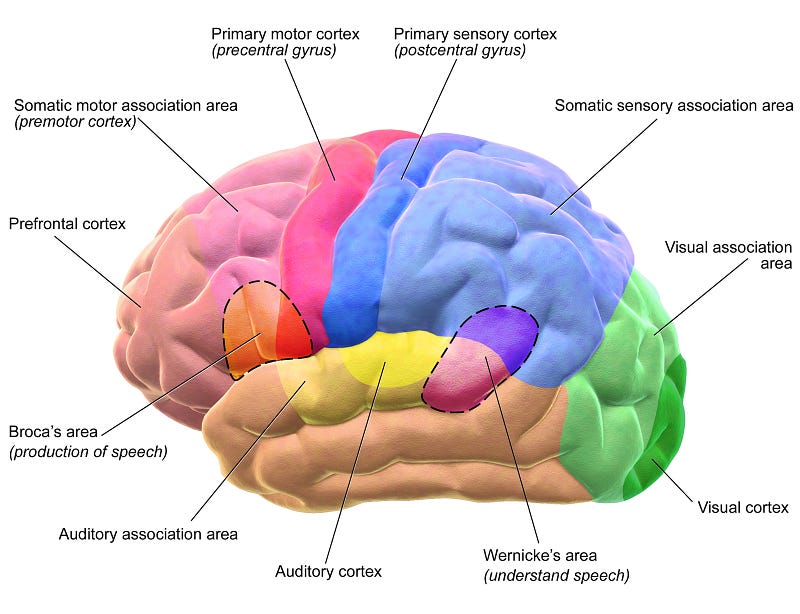
Generally speaking, there is a distinction between the front and back of the neocortex. The front includes the prefrontal and motor cortices. The prefrontal cortex is vital for cognitive functions, including attention, working memory, planning, and language articulation. Not surprisingly, humans have an immense prefrontal cortex compared to other animals. The back part of the cortex is responsible for sensory information processing and integration (see the picture below).
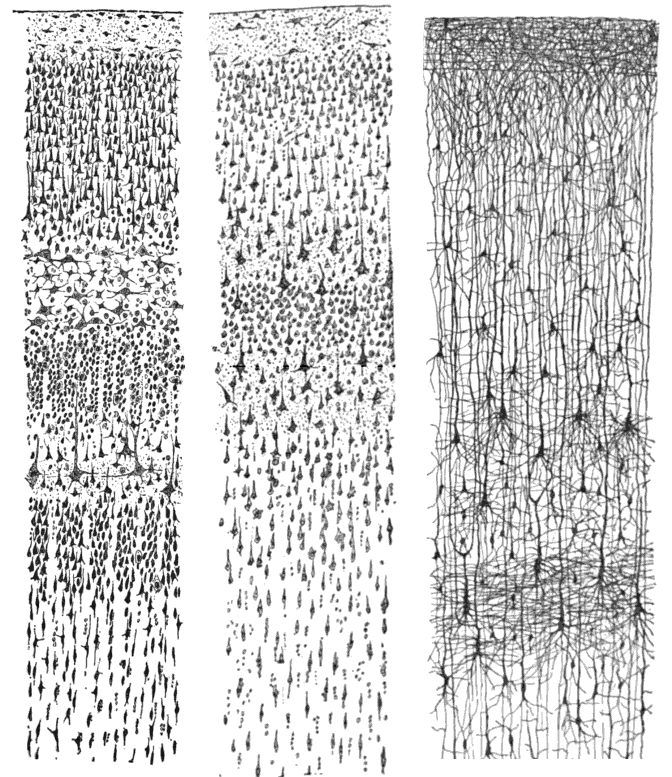
Interestingly, the cellular structure of the neocortex is universal across all regions. It has about six layers of densely packed neurons and rich connections in humans and mammals, but only 3 or 4 layers in reptiles and birds. The layers are named by the Roman numbers from I to VI from the surface inward. The Layers I to III are responsible for communications across various regions, including both hemispheres, within the cerebral cortex. Layer V has large neurons sending long axons to the brain regions outside the cortex, such as the brain stem, spinal cord, and thalamus.
In contrast to the homogenous nature of its six-layered dense mesh structure, the neocortex consists of hundreds of specialized areas for higher brain functions, which provide the content of experience. For example, in the back, dozens of local areas are responsible for various visual perception specialties, including color, shape, motion, etc. Closer to the upper middle, the somatosensory cortex has the map for every part of our body surface. Next to it is the motor cortex that controls every part of our muscle movements. For language, the area in the back, called Wernicke’s, is responsible for word comprehension, and the Broca’s area in the front for articulation.
Damage of a local cortex area (e.g., by stroke) mutes the specific function the area is responsible for and the awareness of its output. However, the overall consciousness still exists, and the experience remains united with the content produced by the remaining brain functions. For example, if the fusiform and lingual gyri cortex is damaged, the perception of color and the capability to imagine or remember color are lost. The patient’s experience is still coherent, but the awareness becomes color monotonous, and so are the dreams.
Thalamocortical System
The thalamus is a paired structure of gray matter located near the center of the brain. It is an information relay system for the cerebral cortex, with extensive nerve fibers projecting to and receiving from the cerebral cortex. Specifically, layer IV of the neocortex gets input from the thalamus, and the neuronal fibers in layer VI project back to the thalamus. The extensive reciprocal connectivity between the two areas leads to the so-called thalamocortical system.
Mounting evidence suggests that the thalamocortical system is essential for consciousness. The thalamus conveys the top-down signals of our predictions and planning from the cortex, and the bottom-up body’s sensory and motor signals back to the neocortex. The latter plays an essential role in embodying our core self. Furthermore, the thalamus regulates the wakefulness and sleep cycles, which impact the level of consciousness with differences in conscious sensation and self-awareness. If the thalamus is damaged, humans would lose consciousness and enter into a coma.
In summary, no single region in the brain is responsible for consciousness. Instead, consciousness results from a process involving distributed activities across multiple brain areas.
Theories of Consciousness
In contrast to other scientific disciplines, such as physics or economics, neuroscience has been driven mainly by empirical studies instead of theories. It is unsurprising considering that biological organisms, including the brain, have evolved with variation and natural selection over millions of years, resulting in various versions of similar functions across species.
However, there are over 20 theories of consciousness today, and the trend is not expected to go down soon. The large number is primarily due to three reasons:
- Some theories are related and can be categorized into the same group. After empirical tests of the differing details, they have the potential to be integrated into one theory in the future.
- Most theories are not yet comprehensive enough to explain the whole phenomenon of consciousness, but mainly focus on specific aspects.
- Existing empirical data is not strong enough to support one theory against another.
Ultimately, the aim is to provide guidance and hypotheses for scientists to test and refine the theories, and fasten the pace to fully understand neural mechanisms underlying consciousness. Neuroscientists Anil Seth and Tim Bayne published a comprehensive review paper in Nature magazine and summarized the theories into the following four groups:
- Higher Order Theories (HOT): HOT theories propose that thoughts become conscious when basic perceptions (e.g., “lower-order” representations) are re-represented as higher-order representations in the neocortex, specifically in the prefrontal cortex.
- Global Workspace Theories (GWT): GWT proposes that consciousness arises when information (e.g., perceptions, thoughts, emotions) is broadcasted and accessed across a “global workspace.” Specifically, it emphasizes the role of the prefrontal cortex in orchestrating the broadcast and the importance of attention and working memory to make conscious content available.
- Integrated Information Theory (IIT): IIT is a mathematical model suggesting that consciousness arises from information integration in a complex system. The theory emphasizes that consciousness is a network’s property when the level of interconnectedness and integration of information, as measured by the parameter theta, reaches a threshold. It treats consciousness as a direct causal effect from the underlying system.
- Re-entry and Predictive Processing Theories: These theories emphasize the importance of top-down neural controls in shaping and enabling consciousness. The top-down control is where the neocortex sends information (e.g., predictions, planning, or motion controls) to lower-level brain regions (primarily via the thalamus). Specifically, instead of passively perceiving, the brain’s role in making expectations in perception could underline the conscious experience.
Each theory group has its own merits and controversies. Many debates have centered on which brain region is doing what — for example, whether consciousness arises from the back of the brain or depends on the frontal cortex. Moreover, the distinction between easy and hard problems Chalmers advocated becomes somewhat blurred in many theories.
Conversely, from a neural network perspective, by treating the neocortex as a whole, these theories have offered deep insights that are testable in artificial neural networks (ANN) and allow us to assess the possibility of AI consciousness. These insights can be summarized into four aspects:
- Neural network architecture: reciprocal and recurrent connections across multiple modules
- Orchestrated and Distributed Activities across Multiple Networks
- Multi-dimensional and High-Order Conscious Content
- Information and Probability
Neural network architecture: reciprocal and recurrent connections across multiple modules
Various neurophysiological and brain imaging experiments show that neuronal processes underlying conscious experience involve widely distributed and interconnected groups of neurons. Every conscious task involves activating or deactivating those widely distributed areas in the neocortex.
All the theories agree that the rich recurrent and reciprocal connections across many subnetworks in the thalamocortical system build the substrate for consciousness. Those connections are necessary to integrate multimodal outputs in a complex system and simultaneously send top-down signals to influence input modules. A feed-forward-only network or a single module or network with task-specific inputs and outputs cannot generate consciousness.
Orchestrated and Distributed Activities across Multiple Networks
As stated earlier, William James predicted consciousness as a stream of distinct thoughts. Most modern studies support this notion, revealing a variable time window from 10s to hundreds of milliseconds when the robust and sustained activities of distributed areas in the thalamocortical system correlate to the conscious experience at a given moment.
Most theories agree that the orchestrated, reverberant activities sustained in a brief time window underlie the conscious experience.
Specifically, the GWT theory emphasizes that a sudden “ignition” of rapid communications across multiple modules leads to the wide accessibility of information, which, in turn, constitutes the conscious experience. Moreover, attention modulates the ignition by acting as a spotlight to enhance the relevant content at the center of the consciousness.
The IIT and Re-entry theories also emphasize that the fast but sustained, orchestrated activities — including both reverberating activations and deactivations — from the specific groups of neurons contribute to the conscious experience. In contrast to the need for broadcasting and assistance of attention and working memory for the content access in GWT, IIT predicts that consciousness is the direct property of the thalamocortical system and arises as an intrinsic cause-effect power.
Multi-dimensional and High-Order Conscious Content
Not everything makes it into our consciousness. For example, red is represented in a local area in the visual cortex, the output of which is available for awareness. We are unaware of the light wavelength signals hitting our retina and how we perceive red in the first place. It indicates that the content available for consciousness is already a higher dimensional representation (e.g., color, shape, motion, face, etc.) resulting from complex neural processing. It also explains why our declarative (or explicit) memories for awareness have been highly consolidated and integrated with feelings and the most salient multimodal features.
The HOT theory predicts another meta-representational state that may underlie self-awareness. For example, the perception of color may arise unconsciously as a “first-order” representation. It becomes part of the experience when projecting to a “high-order” meta-representation.
The IIT theory emphasizes that an experience is an irreducible conceptual structure resulting from the composition of distinct elements (e.g., perception, thoughts, memories, context) in a higher-dimensional space.
Accordingly, the content available for consciousness is already integrated, consolidated, and possibly meta-represented. The detailed operations that generate those higher dimensional contents are never bought into our awareness. The high-order multimodal representations are stored permanently (i.e., long-lasting memory), which can be retrieved and updated in later experience.
A typical analogy is the function of an organization’s CEO and the executive team. Any materials and topics discussed in the CEO meeting have been highly summarized, categorized, and consolidated, which are made accessible or presented to the members. If any question arises, it is up to the related department heads to work with their teams and come back with the right level of information for the executive team to consume. Similarly, after the committee makes the final decision, they give top-down high-level orders without being aware of the detailed executions of each department or subdepartment.
Information and Probability
While most theories of consciousness are, in fact, frameworks of hypothesis, IIT is the theory with a mathematical model. It uses a parameter theta to measure the information integration, the magnitude of which is related to the amount of information the network can offer. Neuroscientist Giulio Tononi explained, in their paper published in Nature magazine, that the parameter pertains to a complex neural network:
“A set of elements in a state that specifies a conceptual structure corresponding to a maximum of integrated information (Φmax). A complex is thus a physical substrate of consciousness.”
According to IIT, an instance of conscious experience has the maximum integrated information to reach an irreducible state, which is highly differentiated from other alternatives. The higher the theta, the richer the experience. Multiple modalities (e.g., visual, auditory, tactile, movement, memories, emotions, contexts, and thoughts) all contribute to the vast number of possibilities for generating qualia. Remarkably, while humans face an explosive amount of information in the world every moment, our experience is unified and coherent and arises effortlessly from moment to moment.
In 1948, Claude Shannon published his famous information theory, a mathematical model to measure information transmitted in a system. The amount of information in bits is the weighted sum of logarithmic probabilities (A brief introduction here). For a given communication, the higher the total probable outcomes, the more information it conveys. Shanon once said, “Information can be considered as order wrenched from disorder.” In other words, information is a measure of unexpectedness and surprise. IIT implies a critical requirement for consciousness to emerge when the amount of complex information that needs to be integrated reaches a threshold. It also explains why consciousness has different states. We lose consciousness during anesthesia or deep sleep because the amount of information drops to a minimum or the breakdown of connections prevents integration across brain regions.
If each experience has a probability, so is our knowledge and belief. As discussed in a previous article, Bayesian inference has successfully explained human perception, cognition, and reasoning processes. Our past experiences resulted in our beliefs and expectations, the probability of which is related to our confidence level. When novel information comes in, we make predictions through Bayesian inference. The Predictive Processing Theories predict that a process approximating Bayesian inference, which involves reciprocal signaling between higher-order mental states and sensory inputs, underlies conscious deliberations.
On the contrary, a learned reflex or skill, such as riding a bicycle or playing an instrument, produces a fixed sequence of motor outputs. Because the outcome has only one possibility, the amount of information becomes 0 (log1 = 0). Based on the IIT, it does not involve consciousness because it lacks information integration. Neither does it require Bayesian inference because the output is certain once the routine is triggered.
Does AI have consciousness?
Finally, we come back to the question: does AI have consciousness? Based on the above theories, the answer is no. Current AI models are all trained to perform specific tasks. Although they exhibit fantastic performance that even surpasses humans, they execute as our unconscious brain does to take specific inputs and produce the expected output.
As mentioned earlier, several theories of consciousness theories have explained why many motor and even higher perception and cognitive functions are unconscious. Typical examples include pattern recognition, playing instruments, driving a car, and finding the right words with the correct syntax. The outputs from these modules enter our consciousness, but we are unaware of the underlying processing that produces those outputs. And we do not need to. These modules are sufficient to produce their outputs independently without the need to engage in cross-talk with other modules. Accordingly, the current deep learning architectures, including convolutional neural networks (CNN), reinforcement learning (RL), and large language models (LLM), are the artificial counterparts of those insulated unconscious neural routines and sub-routines in human brains.
Will AI eventually reach the stage of being conscious? It is the question everyone is concerned about. From functional aspects, it seems possible. Based on those theories, consciousness could arise when AI reaches the level of system complexity and information integration comparable to the brain. In addition, these theories of consciousness will continue to provide possible criteria for AI researchers to test, assess, and eventually be able to predict how and when artificial consciousness might emerge.
Considering the embodiment of consciousness, however, it is unclear what type of AI consciousness will arise and whether it will eventually appear. As James states in The Principles of Psychology: in the stream of consciousness, “the nucleus of the ‘me’ is always the bodily existence felt to be present at the time.”
The IIT theory predicts that AI can never have consciousness as long as it is a virtual simulation executed by software. Based on the theory, consciousness is a property of specific physical systems and, therefore, a direct effect caused by the brain material, including neurons, synapses, and their connections. A computational model running on a computer is, at most, a virtual simulation of a brain, and the computer hardware itself is not comparable to the neuronal substrate. Other theories reach a similar conclusion — for example, the Beast Machine Theory by Anil Seth and the Somatic Marker Hypothesis by Antonio Damasio — that the alignment of our mind and body is the basis of our core self.
Conclusion
Neuroscientists are making remarkable progress in understanding consciousness. At the same time, AI offers powerful and indispensable tools to complement their research and fasten their discoveries. Research on possible artificial consciousness will undoubtedly benefit from the research on human consciousness. With the close collaboration between the two fields, it is promising that humans will be ahead of the curve in developing strategies to assess and tackle potential risks that artificial consciousness might bring if it arises in the foreseeable future.
Consciousness is a broad and heavy topic. With the emergence of AI, humankind is accelerating their understanding of consciousness. During the annual Association for the Scientific Study of Consciousness (ASSC) conference held in 1998, the renowned cognitive neuroscientist Christof Koch made a bet with David Chalmers that the neural correlates of consciousness would be identified in 25 years. In the 2023 conference, Koch acknowledged he had lost the bet and offered a case of 1978 Madeira wine to Chalmers. Optimistically, the destination is on the horizon, and we see the journey ahead of us.


