
Connection and Despair
The Walls of Yad Vashem are purposefully made to resemble a prison. Where the city that surrounds it is colorful and cultured, The World Holocaust Remembrance Center is drab, stark and institutional. The building is a prism-shaped concrete structure that juts sharply outward from the Jerusalem mountainside.
We line up quietly outside of the somber monolith. We’re all exhausted, but in our exhaustion we look more like contemplative mourners than zealous travelers. Today it’s for the best.
Entering the building, there’s a gentle slope downward. We’re guided from room to room and exhibit to exhibit. We watch through artwork and news clippings and film reels as the Holocaust begins. We see as propaganda intensifies and conditions worsen and genocides start. With each new exhibit, we descend further down into the depths of the depraved museum.
Our tour guide is a skinny woman with black hair and a face that’s pointed but kind. She speaks quickly, seriously and passionately as she ushers us through colorless corridors. She’s inextricably mired in her work and her work is to keep people informed of one of humanity’s darkest chapters. When one tour group leaves, she commences anew with another. To spend each day waist deep in such despair seems like an almost christlike burden to bear.
We’re told about the opening of the first concentration camps and we’re told about the unfathomable suffering that took place in each. For most of us, it’s information we’re already familiar with. In history class, we’d all learned about World War II and most of the surrounding atrocities. But we’re standing here now captivated by the presentation. For many of us, it’s the first time that all of the suffering feels palpable. Misery hangs thick in the air of this impossibly bleak confinement.
One room is adorned from wall to wall in Nazi memorabilia. Swastikas and propaganda images and symbols of hate tower their way up toward a narrow ceiling. Skylights illuminate the concave walls in an eery white glow. It’s a heavenly gleam but it’s distant enough to be almost despairing.
One room contains a meticulous miniaturized recreation of one of the war’s most prolific concentration camps. Even in its scaled down size it exudes an unmistakable solemnity.
One room contains a collection of the shoes that had been confiscated from the Jews that had died in concentration camps. Together they form a colossal mound of worn fabric and tattered leather. They’re encased beneath glass that’s built into the floor. It’s a macabre little bridge between exhibits. Walking across it inspires feelings both of loose connection and supreme violation.
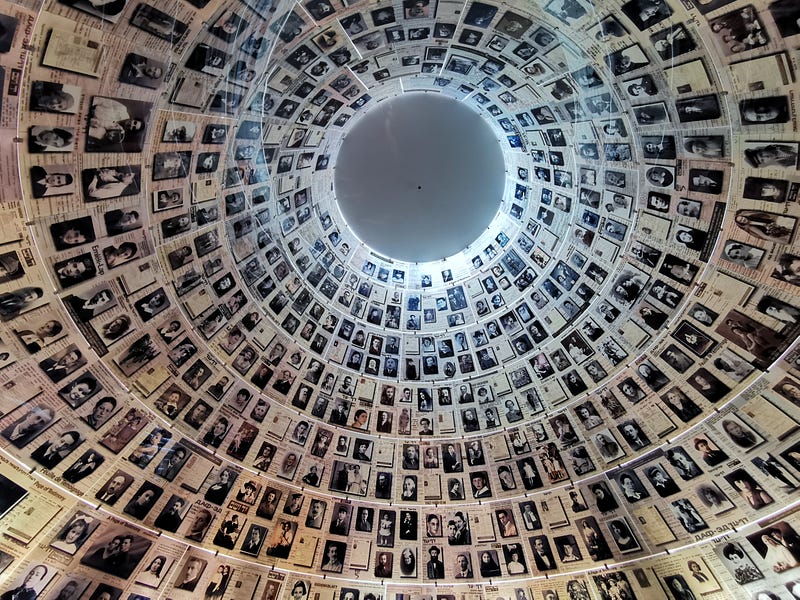
We descend deeper and deeper into twisted tragedy as we weave our way gingerly through the museum. We find ourselves in a circular room that’s covered wall to wall with photos and text. They wrap panoramically around the chamber and cover every surface. They’re the pictures and testimonies of people who died during the Holocaust. Circling the confinement are 2.2 million pages of testimony. It’s an overwhelming sight to take in. It’s awe-inspiring in its magnitude and nauseating in its graveness. It’s stultifying in its brutal, unrelenting sobriety.
Afterward, we make our way numbly onto a balcony. It looks out onto the quiet Jerusalem mountainside. There are flowerpots placed delicately and symmetrically on both sides of the overlook. The abrasive concrete walls of the building stretch out ahead and stop as jarringly as they first began. They protrude precariously over the mountainside before allowing the facade to fall. The overbearing shackles of the enclosure loosen now before an open sky. A few minutes pass in thoughtful silence.
“I want you guys to share what emotions you felt as you were walking through. Did anyone feel sadness?” asks Isaac warmly.
“Did anyone feel anger?” There’s another punctuated pause.
“Hopelessness?”
“Connection,” emerges a tentative voice.
“Shock,” posits a second person from the group.
“Disbelief,” a third person adds before another pronounced pause.
“Because we experienced the Holocaust and we know the horrors that people can suffer… we also have the choice to make sure it doesn’t happen to anyone else. We can’t just stick our head in the ground and pretend that we only care about ourselves,” continues Isaac now.
“And you know… it’s quite apparent that the world doesn’t learn these lessons because there have been numerous genocides since WWII. There have been genocides in Africa and Europe. Recently Sudan and China.”
“There’s a lot going on in the world,” he says kindly but importantly. “There are doers and there are bystanders. Don’t be a bystander.” His words are airy and undemanding but inspiring; his conviction is apparent but unimposing.
“Now the question is what can you do,” he returns again congenially but matter-of-factly. Birds chirp quietly in the background as he pauses for a moment. “You can try to figure out what’s going on in the world. The internet… news… be connected. Don’t ignore it. When you see injustices, don’t be quiet.” His voice is light and zen but there’s a measured gravity that colors his every word.
“Now, we didn’t just come here to be sad for three hours. We came here to take something from it. Be proud of your heritage and defend it. Don’t accept prejudice. People are allowed to hate on Israel a little bit in certain ways… that’s okay. But antisemitism is a problem. Don’t stand idly by. Raise your voice when you see injustices in your neighborhood or in China or in Sedan. Don’t stand idly by when there are tragedies and massacres going on in the world.”
His tone takes a gentle shift. “Now I know that you guys are all hot and hungry… and tired and so am I, so we are going to make our way to a little shopping center so that we can all get food.”


