
Congruence of State Capitalism in America and China
Is State Capitalism inevitable?
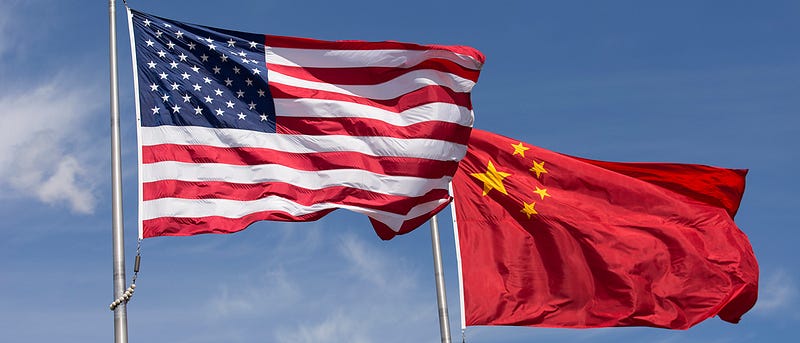
America is viewed as the bastion of free-market capitalism. But to what extent is this really true? And what are the implications for the future? The Subprime Mortgage Crisis leading to the Great Financial Crisis of 2007–2008 caused the entire financial system to experience such turmoil that its very sustainability was in question as it was in jeopardy of collapse.
This crisis lead to the Emergency Economic Stabilization Act of 2008 that provided various bailouts involving capital injections, buying out toxic assets, free credit, and government equity stakes in financial institutions and large corporations.
“I’ve abandoned free market principles to save the free market system.” — George W. Bush, 2008
One particular problem is that most of the assets the government bought from private corporations were difficult or impossible to properly value. Thus, to hedge the overpaying for these toxic assets, the government would take an equity position that would rise and make up a possible overpayment for the toxic assets. Now if the government takes a stake in financial, manufacturing, or automobile corporations, how is that different from government outright owning the means of production? How is this different from China’s Socialism, more aptly Capitalism with Chinese characteristics? Or Socialism in general? I will consider some congruences between American and Chinese Capitalism and show that they may be different in degree, rather than in kind.
Stability
Both the American and Chinese government may consider the stability of the financial markets and the macroeconomy as important goals for their overall economic policies, in order to achieve goals for the nation as a whole. The mechanisms for and actions towards may differ more on degree rather than kind. We focus now on government direct equity investment, but will turn later to consider the role of Central Banks.
Reactive Nature of the American Government
As we saw in the financial bailouts of 2008, the US government did not act until the damaging effects of a crisis were apparent, a crisis that might’ve been an existential crisis threatening the very sustainability of the financial system. As part of the plan to restore stability, the government purchased toxic assets in exchange for equity. As stated above, taking an equity stake in the very companies that were offloading toxic assets ensured the government participated in the upside in case they overpaid for the assets they bought.
- During the bailouts of 2008 onwards, the Department of Treasury through the Troubled Asset Relief Program (TARP) invested $245 billion into troubled banks, and about another $230 billion across the automobile industry, credit market restarting, American International Group, and to help struggling families dealing with foreclosure.
A corporation is an entity that controls the means of production, with an equity stake representating partial ownership of that corporation. Thus when the American government takes partial ownership, it is taking a part of the means of production, an action that can be construed as socialist. Although it was not the intention of the American state to take over the means of production, it was an inevitable and temporary side effect for the purpose of ensuring stability.
State Capitalism here is a temporary and coincidental outcome. Although the institutions did end up paying back the government to buy back the equity stakes, it was only through government intervention that they were able to be a solvent and ongoing concern.
Chinese State Corporation Structure
The Chinese system has both private companies and state-owned enterprises (SOEs) where the state itself is a partner in the ownership of the means of production. Although these SOEs existed in multiple industries across the economy, they’ve receded in influence from less vital industry such as transportation, construction, and raw materials, and are now more concentrated in higher-profit industries like power, energy, telecoms, and particularly defense manufacturing and finance. The combined assets of these SOEs are on a scale of $10 trillion.
The question is how is this ongoing Chinese State Capitalism really different from the brand of State Capitalism practiced by the American government during the great 2008 financial crisis?
The main difference is that these Chinese State equity stakes are baked into the very core of these state-owned corporations, and do not require a calamitous event like in 2008. This provides some precautionary or beneficial measures related to access to some state resources, but at the risk and cost of an overly bureaucratic or centrally-planned set of instructions that may have political or even ideological objectives negatively affecting a well-functioning corporation such as labor rights, taxation, and the priority of market-oriented initiatives that must be pursued opportunistically.
However, they Chinese SEOs are similar in the sense that there’s a target group of corporations that can get fast-tracked to government money or credit when necessary. It’s just that this may occur continuously, instead be driven by a calamitous event.
Comparison
In both the American and Chinese case, the intent of the government is to ensure stability where the market alone may not suffice, or because the large abrupt nature of corrections typical of the markets may affect so many people. Either way, there is State capitalism involved, with the main difference being in degree and not in kind.
- The main difference is that American government intervention proceeds reactively to restore stability, whereas the Chinese government is built into the very nature of State capitalism.
How do we judge whether State Capitalism itself is desirable? Ideology provides some standards on which to judge, but ideology is only a map of the world and is not the real world itself.
In both America and the Chinese, both governments do function on ideology, but practical needs prevail. Thus, the American capitalists are willing to suspend strict capitalist principles in order to preserve the stability or even viability of the capitalist system, whereas the Chinese system is willing to suspend strict Socialist principles and use the power of market mechanisms. And thus, starting from different ideological beliefs and historical origins, the American and Chinese systems may start to come close together in a way that is barely distinguishable.
Scale and Human Welfare
Assuming that stability can be achieved, whether proactively with the State baked in or reactively with the State entering later, the question then becomes what are the scales, volatility, and risks involved?
Population, Scale, and Volatility
At 1.4 billion people, China contains over a billion more people than America at about 330 million people. Thus, any shortcomings of ideological biases are amplified in the Chinese implementation of economic policy for stability, particurlarly importantly in the issue of volatility. Even assuming a proper course of action that causes long-term natural stability on the order of multiple years or decades, it’s still necessary to address the problem of handling short-term crashes on the order months or years that can damage the lives of many people.
In this case, scale matters. The number of people in China affected by a recession as a natural cycle of economics can be enormous pain that can affect up to four times as the population of the United States. Thus, in the Chinese case, it’s important to for State Capitalist policies that favor more stability and less volatility.
In effect, China cannot pursue and cannot withstand large fluctuations even if they are more beneficial long-term, since it has such vast and dire consequences short term. In the American case, the human scale is still very large, but not as large, so the government can afford to pursue policies that may not be constrained as much for the aims of stability. Some questions:
- How much can severe free-market movements be tolerated before government intervention?
- We know that in extremely bad times government intervention is necessary, but what is the correct amount of bakek-in government intervention?
China works under the belief of ongoing state involvement in corporations, whereas America may believe that they enter only as the last resort. Accounting for market and economic cycles considering the sheer scale of the Chinese population may be far trickiers since they need to account for the devastating effects on so many human lives at stake.
Central Banks
Powerful Influence
Although we can consider the amount of the State baked into corporations or the role of government capital availability and injections, that is only one facet to consider when it comes to state intervention. The other concerns the actions of the Central Banks, which can perform three vital actions in pursuit of monetary policy:
- Set reserve requirements This is the amount of cash banks must hold overnight and affects how much banks can lend to each other.
- Perform open market operations Buy and sell securities such as bonds and mortgage-backed securities from member banks.
- Set target interest rates Affects rates that banks may charge for mortgages, loans, and bonds.
Furthermore,
- Central Banks can control the very supply of money itself by simply printing more money
Because corporations depend so much on access to capital and the rates that they can get for it, arguably the very capital itself may be vastly more than the amount of state direct investment in a corporation. This influence may be viewed as more powerful than the government controlling the means of production.
America can be construed already as Socialist
The unelected Governors of the Federal Reserve can control the supply and circulation of money through the monetary policy above, and simply through printing money.
America prides itself of free-market capitalism, but how do we reconcile free market capitalism with:
- The Government taking an equity stake in companies and thereby controlling the means of production
- The Federal Reserve can control capital itself in all forms, ranging from credit to the supply of money
Is State Capitalism Inevitable?
The usual conception is that Democracies and Free Markets go together, but it appears from the above examples in America that it’s really Democracies under State Capitalism instead. The difference between America and China may not necessarily be their form of Capitalism, but rather their forms of government: Representative Democratic Republic vs. Party State, and even more so in their traditions and outlooks towards Civil Liberties.
I believe that the correct question is no longer whether state capitalism is bad or good because it has the potential to be both, but whether it is inevitable.
Moral Hazard Precedent
In future financial crises, there will be an existing precedent of the State bailing out private corporations and taking an equity stake. All market participants know this ranging from the representatives of the government, to the owners of corporations, to the taxpayer. It worked once, so why not have it again, especially if the government was able to make a profit off of the TARP funds?
It seems the issue here is not whether it is possible, but to what extent there is popular support and commitment of key decisionmakers when the next big crash comes? I’m not optimistic since it seems when the world is ending, decisive centralized actions will be what most people to favor in the panic.
Federal Reserve
What is even more crucial to consider is that those who control monetary policy and availability of capital itself are the unelected Governors of the Federal Reserve. They make decisions that may be even more powerful that the Treasury department in spending that money.
But how is this different from the system that exists in China, where there are the unelected members forming Central Leading Group for Financial and Economic Affairs? The unelected Fed Board Governors are appointed and confirmed by elected representatives, who express the will of the people. But after that, they have great autonomy to act independently, even of the President.
State Capitalism May Be Inevitable
Thus if we strip the propaganda about Socialism espoused by the Chinese government and free-market Capitalism espoused by the American government, it would appear that they converge on State Capitalism as an inevitable endpoint. This may be more so going into the future as businesses may consolidate into larger conglomerates, and the influence of Central Banks are taken as inevitable.
How would we address this? No clear answers, but perhaps
- Limit the size of large corporations Especially financial institutions so that no single one is “too big to fail” or “too important to fail”.
- Outright abolish Central Banks This may be the true solution overall, but we probably may have insurmountable historical inertial and not even close to sufficient political will, which is a result of the difficult to understand the nature of macroeconomics and monetary policy without the proper training.