
Congratulations, You Won… Trouble: The Evolution of the Internet’s 1 Millionth Visitor Deception
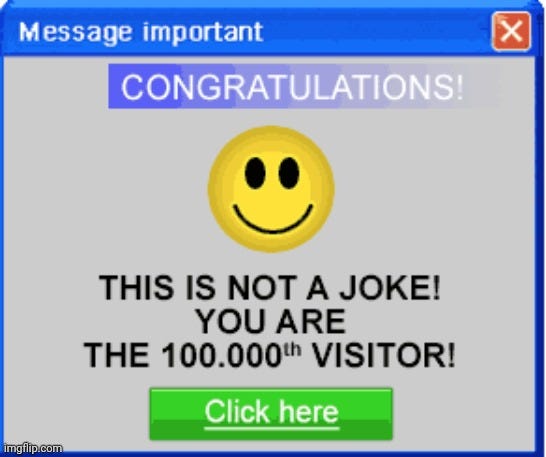
There may have been a point in your life where you felt like the luckiest person in the world. The odds of such a moment happening seemed incredible. In that instance, you found yourself precisely where you needed to be, and congratulations, you emerged victorious. However, a more cynical side of you begins to creep in, whispering that if something seems too good to be true, it probably is. Perhaps you’re not truly the one-millionth visitor, and a sense of caution urges you to leave before it’s too late.
The rapid expansion of the internet in the 2000s naturally led to the proliferation of internet scams, facilitated further by continuous advancements in online technology. Suddenly, people worldwide visiting various websites started receiving the same message from the same voice, claiming they were the 1 millionth visitor, enticing them to click to claim their prize. Congratulations, you won. Yet, as we now know, there was never a prize; instead, it was an open invitation to download malware onto their computers.
This particular malware, universally recognized, exploited the unsuspecting victims of internet users. Despite its seemingly obvious nature as a scam, many people fell for it, and this trend persists today. The origins of the “1 millionth visitor” pop-up, or similar scams, are challenging to trace. The question isn’t merely about where it came from but about understanding its true origins.
A commonality among malware like this and others, such as “You are an idiot” in Goggle.com, is that both their creators and initial appearances remain unknown. Yet, the “1 millionth visitor” stands out by continually evolving and adapting to the internet’s technological advancements, unlike its frozen-in-time counterparts.
Unraveling the origins of these pop-ups proves challenging. The repeating pattern suggests that their creators and first appearances remain mysterious. The “1 millionth visitor” pop-ups emerged in the mid-1990s, a time when online technology was primitive, and people’s understanding of the internet was limited. Ethan Zuckerman, an employee at Tripod.com, inadvertently created the pop-up ad to address financial challenges. Little did he know that this invention would be exploited by malware developers.
The rapid spread of pop-up malware can be attributed to people’s lack of awareness and protection while online. Discovering the origins of the “1 millionth visitor” pop-ups becomes difficult not because of a lack of information but due to the obscure nature of its creation.
The story behind Ethan Zuckerman’s creation takes an ironic twist. His intention was to separate ads from the web page, allowing more revenue for Tripod.com. However, this invention was quickly seized upon by malware developers, leading Ethan to regret inadvertently contributing to the creation of the pop-up ad.
Javascript, HTML, and CSS further empowered developers, allowing them to create visually and audibly captivating pop-ups. The “1 millionth visitor” malware, born from the pop-up ad, exploited the uncertainty of internet users in the 1990s. The internet’s rapid growth blurred the lines between legitimate and dishonest content, making people vulnerable to scams.
The pop-up’s mystique and uncertainty aided its longevity. Users didn’t know or care about the source of the ads, making it challenging to make informed decisions. The notorious soundbite, “Congratulations, you won,” added to the enigma, and its origin remains unknown to this day.
Despite the apparent scam, people fell victim to these pop-ups, especially impressionable children who were less likely to recognize scams. The malware preyed on the gullible and the ignorant, making it somewhat ahead of its time.
The “1 millionth visitor” pop-ups not only downloaded malware but also had various versions with different functionalities. Some redirected users to strange websites, while others posed survey questions to collect user information or wasted their time with deceptive tactics.
As the internet evolved, so did the malware. The pop-ups became ingrained in online culture, with remixes appearing on platforms like YouTube. By 2012, “1 millionth visitor” became the most popular online scam.
Nevertheless, the gradual obsolescence of Adobe Flash, which lost support in 2020, dealt a substantial blow to pop-ups. Yet, unlike other malware that became obsolete with outdated technology, the ‘1 millionth visitor’ persisted. Malware developers adapted it to new technologies, like HTML5, ensuring its continued relevance and introducing new methods to deceive people.
The uncertain origins and the lack of concrete information about its creators contribute to the ongoing prevalence of the “1 millionth visitor” pop-ups. In the absence of a clear solution, raising awareness and fostering a responsible online community remains crucial to minimizing the damage caused by such programs.
Dear readers, let’s remain vigilant against potential scams that lurk in the digital shadows. The story of the 1 Millionth Visitor Pop-Up serves as a stark reminder of how easily one can fall prey to online deception. Let’s prioritize our online safety by exercising caution, questioning unexpected offers, and being skeptical of too-good-to-be-true claims. Remember, a moment of hesitation can save us from potential harm. Share your insights and experiences to spread awareness, and let’s work together to create a safer online community. Stay safe, stay informed!
That’s all for today, thank you for reading.


