Confessions of an Entrepreneur: From $105,000 in debt to selling my company for $16.5 million by 25.
Our story was stereotypical. A group of young people start a business in a garage basement and turn it into a hyper growth story with no funding.
In 2019, I turned 25 and sold one of my companies for a combined value of $16,500,000 in a cash and stock options deal to a publicly traded company. Right before we sold we had just reached $2 million in monthly revenue and we were netting roughly 40% of that in profit. At the point of sale we had not raised any capital and my ownership of the company sat around 34%.
The following list is comprised of lessons I learned while building and growing a successful multimillion dollar enterprise. My hope is that by sharing this brief list I can add value and save time for others in their various pursuits.
1.Avoid VC Money at all Costs — When I used to work in software, I can’t tell you how many entrepreneur friends I had who used the amount of money they raised as a badge of success. Avoid this type of false logic. The only metric you should care about when building a business is whether it is profitable. As the VC bubble bursts and funds dry up, the long term winners will be the slow and steady value businesses with strong fundamentals. Hearing about how someone raised $50 million may sound appealing, but the real question you should be asking is why they needed to raise $50 million in the first place and how much equity they have left over. The bootstrapping philosophy of entrepreneurship may not be enticing, but it’s certainly lucrative.
2.Diversity is Key — It seems like a cliche, but entrepreneurs still frequently make this mistake. Diversity offers up fresh ideas and directions that could have been overlooked. If you’re in a situation where everyone in your office is male, younger than 25 and graduated from top universities you could be making a mistake.
3.Your money’s value depreciates the older you become — When you’re in your early 20’s the capital you produce is more valuable than at any other point in your lifetime. Understanding compounding interest is absolutely essential to build serious value over the long term. The scenario below illustrates compounding interest and the difference between saving/investing when you’re young compared to when you’re older:
$10,000.00 invested at 20 with standard 7% annual growth = $579,464.27 by the time you’re 80.
$10,000.00 invested at 40 with standard 7% annual growth = $149,744.58 by the time you’re 80.
Respect your money and the power it has while you’re young. If there’s any truth to people taking risks at a young age, the validity can be supported from compounding interest. Succeeding and investing young is helpful if you want to build substantial wealth.
You can see for yourself by using this compounding interest calculator.
4.Think With Abundance in Mind, but apply Discipline — Never hoard your resources and or think with a mindset of scarcity. This thought process will only limit your ability to grow your business. Simultaneously, be disciplined with your financial resources. The essence of this concept in practice is simple: invest your personal funds and your company’s into your business and don’t leave too much room for yourself.


5.Kill your Ego, before it kills you — In any business, your ego and the egos of your partners can become a challenge, especially when growth occurs. Overcoming this very subtle but potent problem is essential before it metastasizes throughout everyday business interactions. As you begin to achieve success, managing and remaining humble becomes absolutely paramount. I’ve seen countless entrepreneurs get a big head too soon only to get slammed back down by reality. Remember your roots, the universe will reward you.
6.Marketing is your protein, but sales is the work out — Too many startups nowadays overemphasize marketing and branding and underemphasize their sales efforts. Though telling a captivating story and having a ubiquitous brand is essential, it should not be your only focus. My partners and I always followed the analogy that marketing is analogous to protein, it’s a supplement that will help your company perform, but without the work out component, which is sales, your company will just get fat.
I think much of the recent emphasis on marketing is derived from the belief that building an online business is easier than building a real one. This isn’t necessarily the case as of recent. Despite the growth of e-commerce, 85% of sales transactions still occur in retail channels. To neglect physical retail is to limit yourself to 15% of the consumer market. Invest in real sales people.
7.Spend Time in Nature — Similar to business nature is a chaotic, unpredictable and paradoxically organized system. Going outdoors and placing yourself in unpredictable environments for a few days can encourage more adaptive thinking. In post industrial society, adaptive thinking is adversely impacted by quotidian routines. Spending time outdoors can broaden your perspective and help you view business decisions more acutely than when inside the metaphorical trenches of day to day business operations.
For thousands of years people have looked up at starry night skies to get a sense of direction and perspective. More than ever, I think it can be beneficial to take our eyes away from our LED lit microcosms of the digital world to peer up at the macrocosm that is our universe.
8.Read — It’s another cliche, but it’s true. Read as much as you can. Reading improves your syntax, communication and ability to recall. When I was in high school I would spend my summers devouring literary content. I averaged a book a day at one point. Don’t do yourself a disservice and limit yourself to nonfiction either. Consume a diverse pallet of ideas and concepts. They will prove useful. Similar to capital, knowledge is compounding. The sooner you can expand your knowledge base, the sooner you can outcompete others and better identify opportunities when they arise.
9.Consistency is Key — I used to run Track and Field. One lesson I derived from my experience doing so is that when you feel you are at your most exhausted, most lethargic point is precisely when you should speed up and start sprinting. The reason for this is because others are just as exhausted as you are. Don’t take your foot off the accelerator, eventually the universe will give in your favor.
10.Embrace Emotions — It’s essential to talk about how you feel with your business partners. Negating your emotions will only resolve in them emerging through other passive aggressive means. This can be harmful to your business. Being open and transparent about your feelings whether they pertain to jealousy, anger and or frustration will help you squash any animosity you have so that you can focus on growing the business. When something feels off, address those specific feelings and the potential roots of those feelings with your partners.
11.When you start out, your business should be the most important thing — A mentor of mine once told me that the key to building a business rapidly is to treat it like a religious experience. Meaning that all material, emotional and or personal possessions you may have should take a secondary role in your life. Your primary focal point in life needs to be the business in its incipient phases. Once the business blossoms you can pull back, but before that your focus and priorities need to be the business.
I spent a year sleeping on my co-founder’s couch and then another year sleeping in my second office’s conference room. To this day it was probably the most challenging, but interesting period of my life. Nothing fosters a more powerful meditative state than eliminating everything and building something from the ground up.
12.Run your business, don’t let your business run you — This may seem paradoxical given the aforementioned statement, but too many entrepreneurs have a habit of overworking to a point where it can adversely impact their venture. Initially, working hard will accelerate your business’s growth, but eventually you need to evolve from a startup entrepreneur to a business manager. Once your business is profitable, learning to delegate tasks to others and not allowing yourself to be bogged down by details will help you maintain a clear and dynamic perspective. Individuals who fail to do this are at risk of stagnating their business’s growth or being outgrown by their business.





13.Know when to fight the current and know when to go downstream — A company’s continued success can in many ways be analogous to sailing a ship. As a leader in your company you want to interpret the motions of an industry, and ultimately, adjust the sails and let the current guide you. I’ve seen countless entrepreneurs be demolished in changing industries, because they failed to adapt with new evolutions in their ecosystems.
There’s an old adage, which I think can be valuable to consider when dealing with any venture, “Change isn’t good or bad, it just is.” The lesson to be learned here is don’t be stubborn and or let preconceived biases affect your judgement.
14.Beware of Service Businesses — Nowadays service businesses are all the craze. Whether it be starting an agency and or a software platform that provides an existing service, people seem to think services are easier than products. Service businesses may require lower costs to start, but that also means a lower barrier to entry, which results in heightened competition. The other issue with a service sector company is that its success solely depends on the time you dedicate to it. As a result, service sector companies don’t produce capital for you while you sleep.
Since the venetian times those who were involved in the exchange of goods generated the most capital. To this day, offering up goods that others need will always be an easier path once the wheels get turning.
15.Fail and adapt or move on — I can’t even count how many skeletons there are of dead startups I have spent years working on. It’s important to get an idea off the ground and put it out into the market, but if the market doesn’t respond to it, adapt or move on. I know countless entrepreneurs who spent 10+ years on a company that simply wasn’t working. The Sunk Cost Theory is very real and very dangerous.
16.Don’t let your company waste time on politics — company politics slow down progress. It’s good to brainstorm, but at a certain point you have to start making decisions. A good rule of thumb is to ban meetings once a week. We decided to ban company meetings on Wednesdays. It did wonders for us.
17.Avoid Personal Debt like the plague — Pretty simple, debt is deadly and will hold you back. Try to avoid it at all costs. After graduating from college I had $105,000 in student loans at 8% interest. My monthly payments at one point exceeded $1,200. It was brutal. That being said, there are scenarios when debt can be valuable, just make sure the interest rate is low, the risk is weighted and the debt is being used to generate cashflow.






18.Strategic Incentives — When managing a business there are two mechanisms to drive company performance: revenue and profit. Typically, your sales and marketing divisions are focused on leveraging company cash flow to increase revenue. Simultaneously, warehouse, administrative and operations staff should be focused on finding ways to increase profit by cutting costs. Though these seem like contrasting strategies, together they can create a potent formula for financial success.
One common mistake made by entrepreneurs is to offer up commission based incentives for sales divisions and not offer up similar incentives for operations and administrative staff. In my businesses I always try to offer up incentives to operations and administrative staff in the form of “savings” commissions. For example, if you have a bookkeeper who manages your financials, offer them a 30% commission on all funds they save the business. This incentive will motivate them to negotiate with vendors and be more scrupulous of accounts payables. These types of incentives across your entire business will help maintain a lean enterprise with high profitability.
19.Don’t Micromanage — Give your people breathing room to operate. Don’t tell people what to do and or try to grind them out. It will only create a toxic environment. Trust me, you won’t enjoy it either.
20.It’s not about money — Obviously the financial gain of successful entrepreneurship is enticing, however that shouldn’t be your primary motivator. Innovating within an industry will always yield fruit and is a far more enticing self motivator over the long term. If money is why you’re pursuing entrepreneurship then you’d fair far better in investment banking and or consulting.
21.Always act like you have less than you do — Successful entrepreneurship is methodical and requires discipline to guarantee long term success. It’s easy to make money, it’s hard to retain and build it. If you’re spending patterns grow and or match your financial success you’ll get knocked back down to where you started when you face a downturn. As an entrepreneur you have to accept that you live in a world of peaks and valleys. As a result, your emotional and financial wavelength will oscillate far more aggressively. The safest solution is to minimize expenditure to guarantee that you can sustain any kind of deep valley. I have always been wary of high flying entrepreneurs who are loud and or who possess too many nice things. It shows where their priorities lie.
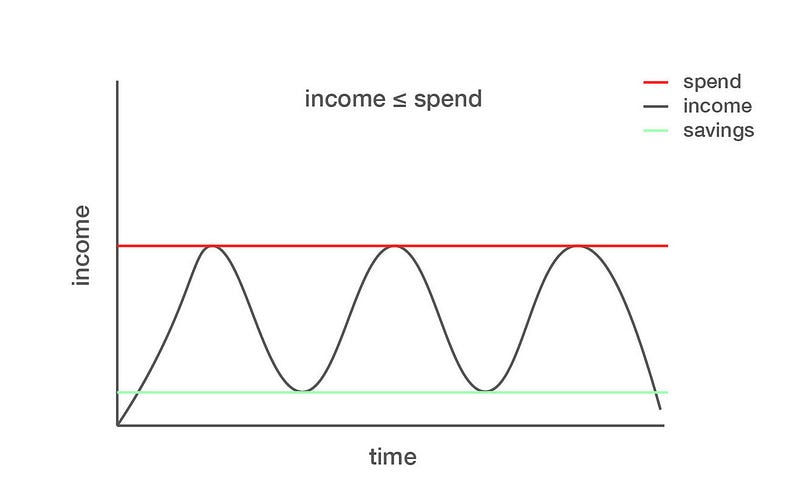
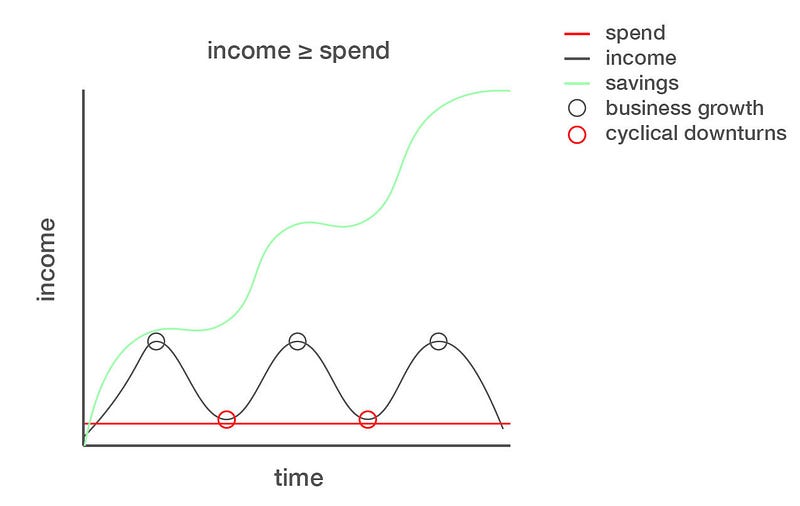
I’ve learned this lesson from first hand experience. By the time I was a senior in high school I had turned a $2,500.00 E-Trade account, which I started at 14, into a portfolio well north of $100,000.00 by 18 from investing in Macau casinos and tracking Corn indexes relative to ethanol demand. I began spending money aggressively around that time and by the end of my freshman year in College, I got cleaned out from one call options play on a trucking security. It took me a few years to recover from that mistake, I could have recovered faster had I been smarter with my capital.
To this day, I now only spend a tenth of what I make on a monthly basis.
22.It’s about the people stupid — Ultimately, amid the clutter and the rapturous environment of any startup are the people. They are the company and the company is them. Take care of your people, they are your greatest asset. At the company I sold, my partners and I gave every employee $1,000.00 for exclusively vacation purposes. We did this to force them to go on vacation. The money we spent was definitely returned to us via higher productivity.
23.Distill Complex Problems — In building a business you’re often faced with complex problems with unclear solutions. A valuable mental exercise is to focus and obsess on areas of “friction” in your business until they become “smoothed” out.
Many people will avoid aspects of their business that they find unattractive and or difficult. If there’s an aspect of your business that you find uncomfortable and or unappealing, focus on it. By focusing on the weaknesses of your business you will be able to find unique solutions that will strengthen your business’s core.
Distill your business into areas of strength and weakness and then aggressively attack the areas of weakness.
24.Have a Compass — It’s important to have a long term vision for your company and where you want it to go. This vision can adapt and evolve overtime as circumstances change, but maintaining a clear and grandiose vision is critical. Ensure that the rest of the company understands this vision as well. Nothing is more powerful than the combined energy of people with a shared vision. History is a testament to this.
25.Enjoy The Ride — If there’s one regret in the last few years, it was not taking enough moments to observe and appreciate my own experience and the growth we achieved.
What is success truly worth if you don’t share it with others?
It may be a cliche, but ultimately the satisfaction derived from shared experiences, risks, relationships and memories will always supersede any dollar you make.
The path of entrepreneurship can be a lonely road for anyone who treads down it. It will become difficult to relate to others as the ineffable aspects of your daily routine diverge from most people around you. It is during these times that having people to confide in becomes crucial.
In the end, family and friends are your most valuable asset…
If you’ve read this far I appreciate your time and I hope I haven’t sounded preachy. I’m an avid opponent of dogmatic thinking and would hate for this to come off as contrived.
My hope is that by sharing my experiences others could find some benefit in their respective journeys as well. Ultimately, there is no correct path, methodology and or silver bullet to building a successful business. At a certain point you simply have to take off your life jacket, jump into the abyss and learn to swim.
Solace Technologies was sold for $15.25 million in cash and stock with an additional cash sweep of approximately $1.25 million. The total deal value was approximately $16.5 million when we sold to Turning Point Brands (NYSE: TPB) in 2019. We sold the company so that we could spearhead Turning Point Brand’s Nu-X ventures division and create a product engine accelerator for their business.
Outside of the sale of my company I made most of my capital from investing in publicly traded securities as well as from my Accelerator / Agency DPGW.
Favorite Books: The Unbearable Lightness of Being, Old Man and the Sea, The Elegant Universe, The Intelligent Investor, Mass vs. Minorities, A Brief History of Time, The Corrections, Norwegian Wood, Beating the Street, Fountainhead, Zen and the Art of Motorcycle Maintenance, 1Q84, White Noise, Rendezvous with Rama, Good To Great, Animal Farm, Blue Ocean Strategy, Lean Startup Principle, Reminiscences of a Stock Operator, What We Talk About When We Talk About Love, Meditations.