
What has become of us?
Confessions of a Remoaner: What I Learned From Not Stopping Brexit
How I learned to find hope and resilience in a political defeat
When the UK voted to leave the European Union in 2016, I was heartbroken. I vividly remember the shape etched into the wall of my living room — from where I had thrown and broke a glass in anger. My partner joked that Boris Johnson now owes us a glass.
Throughout the weeks and months following the Brexit vote, I was itching to do something. I started going to protest marches. I was among the first people to join the Number 10 Vigil: we gathered several times a week on Richmond Terrace opposite Downing Street with EU flags and a ratty amp from which we blasted Ode to Joy in the general direction of Theresa May. After the Vigil came Steve Bray’s Stand of Defiance European Movement (SODEM), which was more of the same, but in front of Parliament, trying to edge our protest banner in the frames of broadcast news cameras. We hoped against all odds, we learned community organising on the fly, and we found community. In order to find each other and connect on social media, we started using the hashtag #FBPE- Follow Back pro-EU.
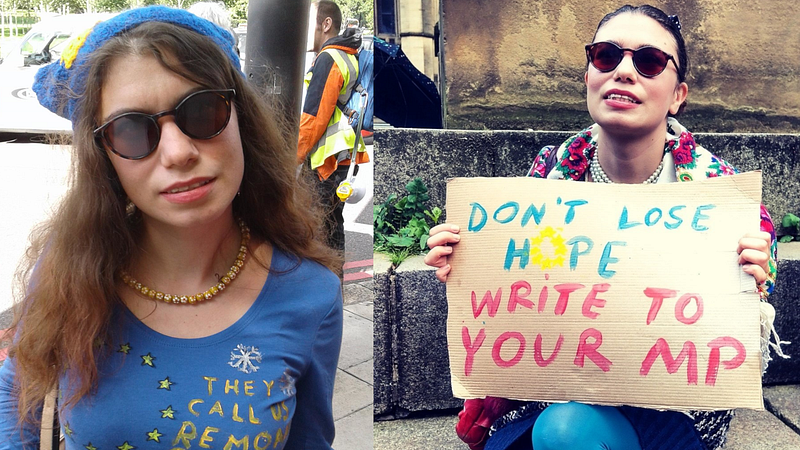
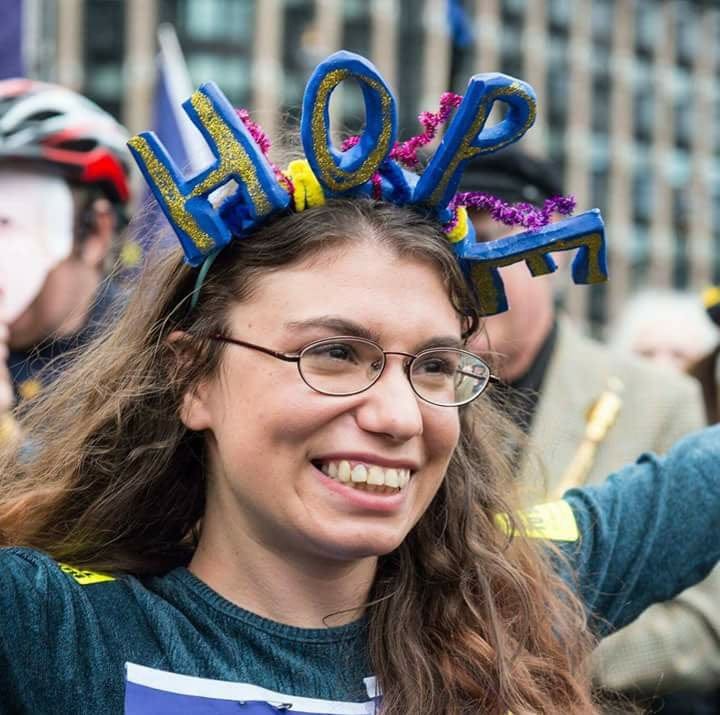
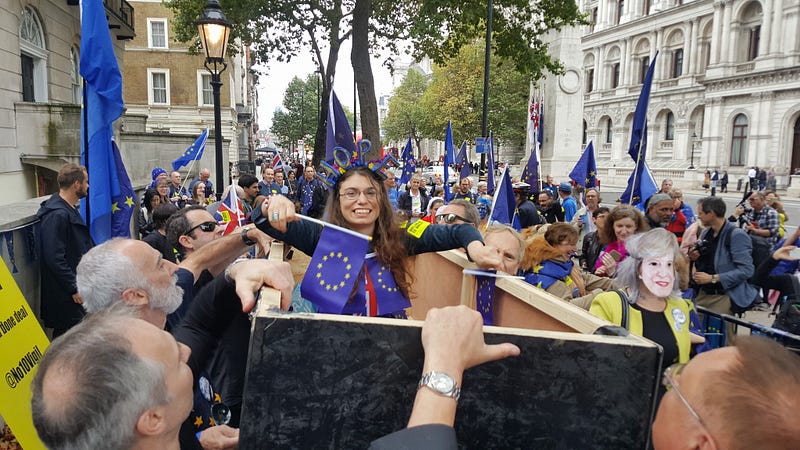
I taught the protesters how to make noisy rattles from plastic bottles filled with coins — a thing I had picked up from Romanian anti-corruption protests. I messaged hundreds of people on social media, urging them to sign petitions, to write to their MPs, to join the marches — until Facebook algorithms got sick of me and flagged me as spam. I set up Facebook groups for people like me to organise protests and campaigning. I took part in several protest stunts, including one in which I, representing Hope, was carried in a coffin from Downing Street then staged my rebirth in Parliament Square; the image of me with my Hope headband became, for a few weeks, the face of “The 48%”- a Facebook group with over 50 thousand users.
I took a part-time job with a campaigning organisation, and went to the European Parliament in Strasbourg to lobby for the rights of EU citizens in the UK and Brits in the EU — which resulted in the craziest week of my life.
I gave a speech in Parliament Square in front of about ten thousand people.
At the time, I used to think that in the midst of the protest movement we will find the leaders of tomorrow, who will get us out of this mess. This is a hope I still hold on to, and I see many of the people who stood next to me in the marches who have ran for public office in their local communities, got involved with civil society grassroots and continue to do their bit to make the world a better place.
But the #FBPE label itself… oof. There are times when I can’t help but ask myself :
What the hell happened to us?
Just a few weeks ago, in the run-up to the football European Cup finals, I kept noticing it from several of the #FBPE accounts I follow (because of course I do), and from others broadly on my side of the political compass: an uneasiness about expressing any level of support for the England team — because, don’t you know, football is so jingoistic and England supporters are awful racists and Boris will claim the victory as his own for political points. In some cases, there was also an underline of “Hey, we’re miserable and we have very good reasons to be, therefore no one else in this country should get to be happy”. An embittered desire to punish the whole country for having taken bad political decisions. And when England lost in the finals at the penalty stage, it still had to be the fault of our jingoistic press and of the nation’s very psyche.
In the months that have passed since Brexit came into effect, I caught myself, several times, unfollowing #FBPE accounts. In a two or three cases (the most prominent being Scottish Parliament member Joanna Cherry), it was because they tweeted horribly transphobic things. “Wait… how did I end up with TERFs and bigots on my list??? Oh… they were #FBPE and I didn’t do enough due diligence.”
But those were only a few. In most cases, I didn’t have any major disagreement of values or political goals with the people whose tweets decided I’d rather not keep reading. They were just… exhausting? Not particularly nice to be around? They were snide. They repeated themselves a lot. They made arguments elevating Britain to an impossibly unique and exceptional position — as a bad place. They shared conspiracy theories about Boris Johnson having faked the birth of his son, not because they believed them but because it felt good to say it. They made hyperbolic comparisons that made me want to quote Godwin’s Law:
As an online argument grows longer and more heated, it becomes increasingly likely that somebody will bring up Adolf Hitler or the Nazis. When such an event occurs, the person guilty of invoking Godwin’s Law has effectively forfeited the argument.
Fundamentally, I agreed with their core belief : that Brexit has been a huge mistake, with tragic consequences for the generations to come. But there are only so many variations of “Things are bad, things are bad and oh, did I mention things are bad?” that you can hear before you start feeling like you’ve had it all up to here. Even when you agree that things are, indeed, bad.
The story of Sue who shouted at tea
In February 2020, Tory Minister Rishi Sunak, the Chancellor at the time, tweeted a picture of himself making a cup of Yorkshire tea.
Cue a whole bunch of angry messages — directed at their brand.
The Yorkshire Tea comms team tried to explain that their brew is well-enjoyed by people of all professions and political leanings. But one Twitter user wasn’t laying off :
The Yorkshire Tea people responded :
And this is the story of how #SueYoureShoutingAtTea became a trending hashtag and a meme. There were even mugs :
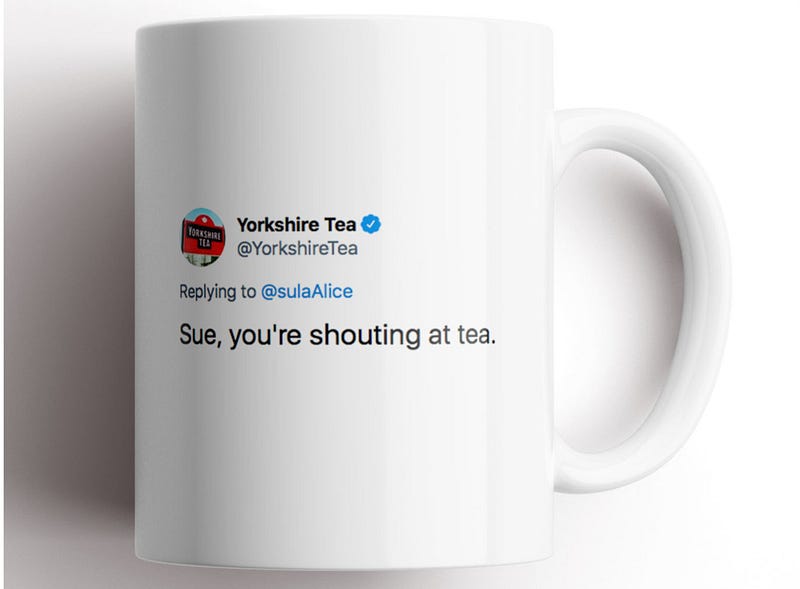
Looking at the entire track record of the Conservative Party for as long as they have been in power and especially since Brexit, I have to admit: Sue has a lot of valid reasons to be angry. Yet, when you find yourself taking it out on innocent bystanders and a pot of tea, you may be in need of a break.
I remembered Sue who was shouting at tea some months later, when I saw this:
Again: symbols are powerful and we’re burnt out on nationalist symbols, because this type of flag-waving rhetoric was heavily used to sell us into making the most unwise political decision of our generation. Mistrust is a very human and understandable reaction. And yes, British and English flags absolutely CAN be used aggressively - think "EDL hooligan waving one at immigrant neighbours". The Union Jack on a porridge box isn’t *like that*, but for those of us who have been racially abused those things can stay etched in our memories.
On the other hand, I also see how this is petty, counter-productive and does nothing more than set the pro-EU movement in opposition with “Britishness”; which from a PR perspective isn’t great when you are trying to campaign on the future of Britain. The fact that enough people were outraged at the original post for it to become A Thing is, in itself, telling: why do we care so much that someone found the packaging of a box of porridge distasteful?
So, how did we end up this way?
Our movement was never perfect, in terms of leadership or strategy. It has to be said, I’ve seen my fair share of campaigners acting like they were, at the same time, in the midst of saving the world and in middle school. They are in no way unique to #FBPE, the left of centre or the socially liberal — if you’ve been involved with supporting any political cause at all, you’ve met those types.
Beyond this, as it often happens with rallying around a shared vision, we had among us more people with big dreams and ideals than people who cared about the nitty-gritty of implementation. We’ve been expressive more times than we’ve been strategic. We’ve been stubborn, uncompromising and at times arrogant.
Yet, we muddled through because we were running on a mix of hope and anger that bound us together — until the 2019 election. The Conservative majority result meant that we had no way left to stop Brexit — and what’s more, it happened because we were divided.
In multiple constituencies across the country, the Tories got in because the anti-Tory vote was split. Throughout the election campaign Jeremy Corbyn managed to convince Brexiters that he is a Remainer and Remainers that he is a Brexiter. For her part, Lib Dem leader Jo Swinson convinced Corbynistas that she would prop the Tories, and everyone who disliked Corbyn that she would make him Prime Minister. Not unlike how it was after the Brexit referendum, we knew: our side made strategic mistakes. Thinking back, I now recognise that moment as the point in time when #FBPE ran out of hope, but not of anger. And when you have anger without hope, there’s much less reason to choose what’s wise, strategically sound and will win you allies over what’s satisfyingly, indulgently self-righteous. Nothing matters anyway, right? This is how you may end-up nursing your resentment until you end up shouting at tea.
But what did I do when hope ran out?
The day we left the EU, I ended-up sobbing in a stranger’s arms, at a vigil in Central London.
The very next day, I got out of bed, grabbed my bag, and like every single Saturday for more than a year, I went to the Manchester Central Library, where I held advice sessions for the charity Work Rights Centre.
I did two settled status applications for EU citizens. I helped two Romanian builders get the money owed for their hard work from a crook who refused to pay them. I taught a French clerk and an Italian plumber how to write CVs. I helped a young Roma family rent a flat. Then I went home and wrote about it on Facebook. “This is how we will resist. This is how we will rebuild this country, each and every one of us in our communities”, I had written at the time. At the end of my message, I asked people to donate to my project.
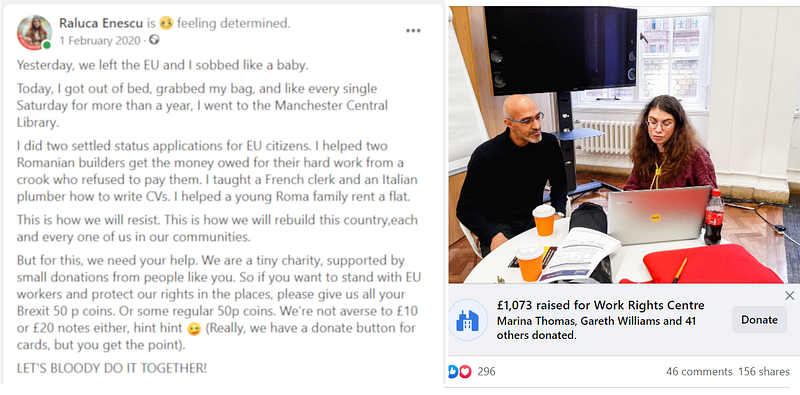
In less than a week, Work Rights Centre received more than £1000 in donations. The vast majority of these came from people I had met through #FBPE. Some of them I knew from rallies and marches, some of them I knew online, some were just in the same Facebook groups that I was. That day, it felt like we truly were a community; and that we still have the power to do a lot of good. Between then and now, the Manchester branch of Work Rights Centre has helped a few hundred people. We now have a second staff member, a small but perky team of volunteers. We have secured more stable funding to continue doing what we do.
For my part, I still believe the future of the UK is in the EU rather than outside of it, and that one day we shall rejoin. I do acknowledge, though, that this may well be several decades away; and in the meantime we have a lot more urgent work to do on our hands. So this is what I do now.
The biggest thing I have learned from not stopping Brexit is that when hope runs out, the only thing you can do is to find something else that gives you hope. You have to keep moving, keep putting one foot in front of the other, keep doing what’s in front of you instead of fixating on what you wish you could be doing.
Otherwise, you’ll end up shouting at tea.


