
Confessions of a Hopeless Night Owl
When your circadian rhythm mismatches the rest of the world
At a recent luncheon, an interior designer sitting next to me mentioned that she likes working late at night.
“Clients think I’m crazy if I send a proposal or contract at one o’clock in the morning,” she said.
I had met my kindred spirit.
I, too, have been admonished by friends and colleagues for staying up too late. The usual retort is: “Were you really up at 2:15 in the morning working?”
Many years ago, I went on a quest to give the illusion of conformance. By doing a “System Restore” in Windows XP on my PC, I could futz with the settings and turn the clock back six hours. The reset brought on a strange malfunction that created a Y2K-like nightmare. I had to get a new computer.
My next M.O. (on my Mac) was to write emails at night and save them in a “Draft” folder. This technique had my brilliant missives poised for sending first thing in the morning. Then came Boomerang, the Gmail app where you can control the exact time the message is sent. “9:05 a.m.” looks mighty fresh on an email.
I basked in the new tone from recipients: “Wow, you were up early this morning!!!! No more late-night emails? Are you okay?”
Were they being sarcastic? Is there hope for night owls who want to morph into morning larks?
Dr. Christoph Randler, a biology professor at the University of Education in Heidelberg, Germany, sheds light on the subject in his research that appears in the Harvard Business Review.
“Much of morningness and eveningness is changeable,” writes Professor Randler. “People can be trained to alter what we call their ‘chronotypes’ but only somewhat. In one study, about half of school pupils were able to shift their daily sleep-wake schedules by one hour. But significant change can be a challenge.”
“Morning people are very capable of understanding the value of chronotype diversity,” he continues. “This understanding probably originated far back in history, when groups comprising morning people, evening people, and various chronotypes in between, would have been better able to watch for danger at all hours. Evening types may no longer serve as our midnight lookouts, but their intelligence, creativity, humor and extroversion are huge potential benefits to the organization.”
I decided to contact the Z-Z-Z-Z maestro directly. I wanted to know whether he had any new research that might help reform people whose primetime is nighttime in a morning lark world.
“Some people are able to change their chronotype from an owl to a lark,” Professor Randler said. “If one wants to test to become an earlier type, try to go to bed earlier (e.g., one hour) and do this on a regular basis.”
“However, 50 percent of the time the genetics of owls and larks cannot be changed,” he continued. “Experiments with adolescents from Israel showed that some evening types were able to go to bed earlier and fall asleep earlier, while some could not sleep for hours.
“The best solution would be to have more flexible work hours and to be able to do more work from home. For example, one of my Ph.D. students often works at night from 2–5:00 a.m., so I sent him work for his ‘night shift’ in the evening and he returned it to me in the morning. I usually start my day at 7 a.m., so we met for lunch. It was an optimal time for both of us.”
This noon-ish rendez-vous is a perfect example of the magical overlap when nocturnal and diurnal chronotypes can work side-by-side. It is a blessed eclipse, indeed, when these circadian rhythms are in sync.
As a self-confessed nocturnal who can blame it on genetics, I proudly declare solace from the quiet of the night. I love hearing the whir of the refrigerator in the kitchen and the hoot of the Barn Owl in our fields. The clock on the piano chimes softly amidst the silence. The lingering laundry piled on the dryer can wait to be folded in the morning. (I’ve learned not to empty the dishwasher in the middle of the night. And to my children, I say, “Sorry, kids. Seriously, I didn’t think you’d hear me if you were asleep and I emptied it quietly.”)
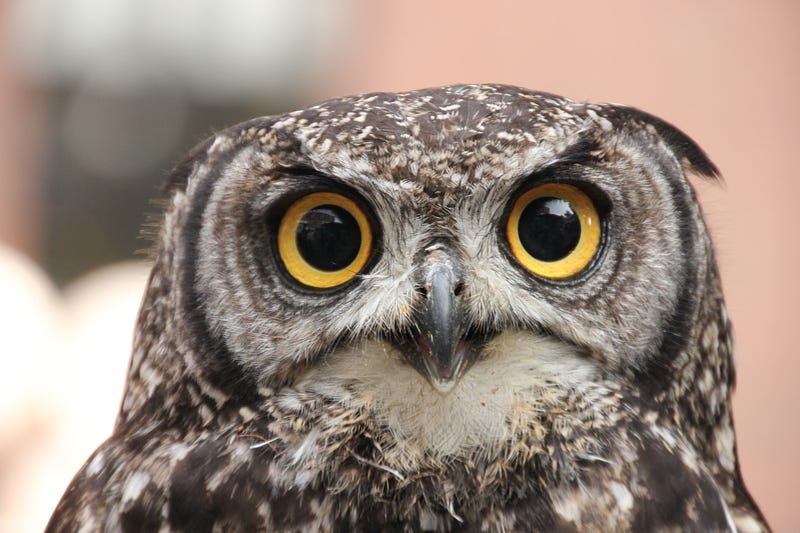
Let us midnight riders keep watch from dusk to dawn. Muzzle the cacophony of the starlings, larks, wrens, and robins. Harnass the annoying twills of the Eastern Whippoorwill and Budgie Parakeet. Let the Night Owls regale the darkness with nocturnal delight.
In his book, The Complete Insomniac, British author Hilary Rubenstein profoundly sets the record straight once and for all:
“Blessed are the owls, for they shall inherit the mystery and magic of the night.”
Bonni Brodnick is the author“My Stroke in the Fast Lane: A Journey to Recovery” and “Pound Ridge Past,” now in its second edition. Formerly with Condé Nast Publications’ Glamour and House & Garden magazines, Bonni has written scripts for Children’s Television Workshop, was a weekly newspaper columnist, and was editor of two academic magazines. She is an award-winning communications specialist, a member of Pound Ridge Authors Society, and blogs at bonnibrodnick.com. Bonni is also an ambassador for the American Heart Association and a proud Stroke Survivor.
Read more of my writing:
Read every story from Bonni Brodnick (and thousands of other writers on Medium).
Your membership fee directly supports Bonni Brodnick and other writers you read. You’ll also get full access to every story on Medium.


