
Confessions of A Balloon Popping, Bubble Bursting, Kill-Joy
A Tribute For The “Happy People” Who Love Rainbows, Lollipops and Life
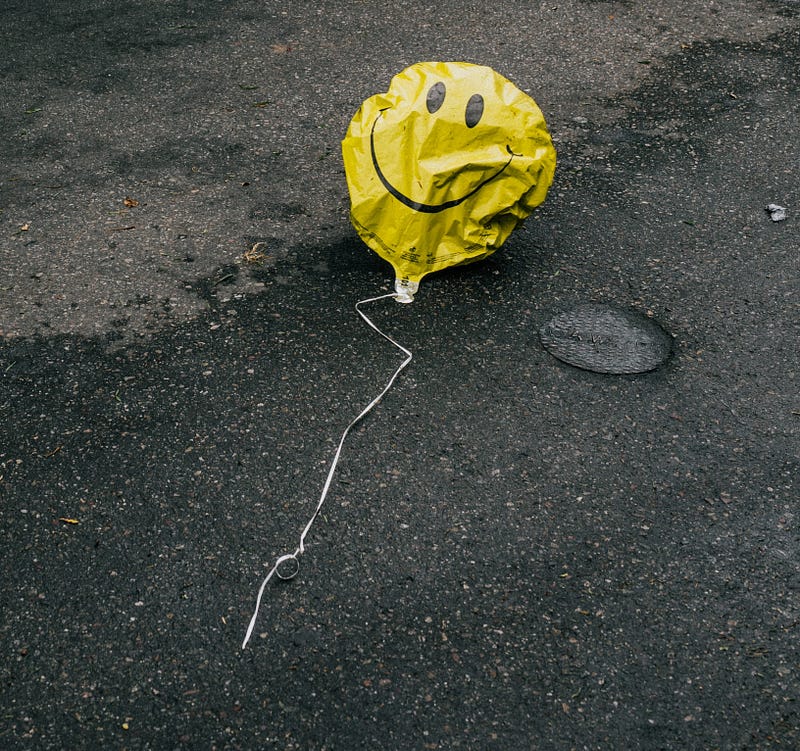
Can people be born with a happy disposition? As I think about what to write on this blank page, a part of me surfaces and admonishes, “I don’t want to be upbeat. Being cheery and positive feels inauthentic. Syrupy and candy-coated words leave a bad taste in my mouth. I am not one of those ‘happy-clappy’ types. Remember?”
Doesn’t everyone talk to themselves like that? No? Maybe I’m just weird. Perhaps I’m a wanna-be poet like Sylvia Plath or have listened to John Lennon’s lyrics of existential angst one too many times.
Dear Happy People, please don’t go skipping off just yet. I promise things will start looking up soon.
But for now, I will return to my well-lived-in overthink tank for another round of analysis of my not-so-positive personality. Followed by a pleading, “Why, why, oh why — can’t I be one of those happy-go-lucky ones???”
And once again, my tired-out question resurfaces, “Is happiness a product of nature or nurture?” I would love it if there were a tidy ‘either/or’ answer. I could then blame my personality on my genes! Sadly, reality wins; psychologists assert that happiness is a complex interaction of environment and genetics. (Well, at least I can put a little blame on my unfortunate inheritance.)
Here’s a brief sketch of my nature/nurture dilemma:
Nature — The Genetics
There have been many studies hypothesizing there is a genetic component linked to happiness. It is still unclear how large a part that genetics actually plays, but findings range somewhere between 30%-80%!
In 2020, Kira M. Newman reviewed some of the research done on the causation of happiness. She quotes and comments on well-known happiness researchers Sheldon and Lyubomirsky;
“Happiness can be successfully pursued, but it is not easy,” they write. In other words, happiness for many people will simply be something that is hard-won. For others, happiness may feel like a natural state.
What? — I had to read that twice to let it sink in. But it looks like I’m not entirely off the “blame my genetics” hook. Also, there is my upbringing to consider.
Nurture — My Family of Origin
Saturday Night Live has helped me understand another possible causation of my sourness. One of their skits is called The Loud Family. Another one, The Eggshell Family. (You can find them on YouTube, but I think you get the gist.) I wish they would write a script about my family and call it The Depressed Family. What? Too depressing?
My college roommate, Sue, said she rarely heard the word depressed until she met me. I didn’t believe her, and yet she assured me it was true. (Almost every Sue I have known seems to have a joyful nature. Time for a name change?)
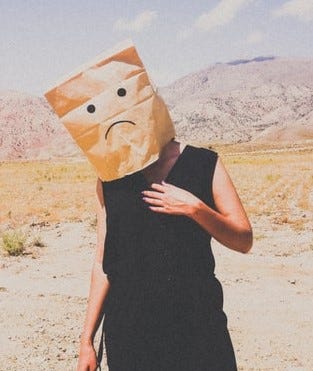
Joking aside, my mom suffered from depression for most of my young life. I remember feeling somehow wrong when I expressed any happy feelings or news. Conforming to the gloom was much more acceptable. Often she would label me as unruly or manic after I shared an explosion of unrequited enthusiasm. (I’ll stop here to avoid the no-win game of blame.)
And now — my Eeyore self would like to address all the Winnie-the-Pooh types in our audience.
Genuine Confessions —
- I envy you. How is it that you so effortlessly see the silver linings in every cloud, make lemonade out of lemons, and see the best in everyone? You ride on the wild rollercoaster of life with a fearlessness that baffles me.
- I am jealous of how you accept and enjoy each day, undaunted by any disarray.
- I am sorry for the many times I have attempted to rip off your rose-colored-glasses. By trying to change you, I disrespected you.
- I apologize for the times I have popped your bubble, casting my pragmatic viewpoints on a dream you dared to share with me.
And Now, A Happy Ending —
I may not possess a happy gene or a happy childhood but am blessed with many Winnie-the-Pooh-like friends.
And without sounding too sappy, I want to say thank you.
Thank you for helping me learn to love my inner Eeyore.
And as we carry on, may we continue to help each other grasp this wisdom:
All of our parts are welcome, and we are all much more than any part we play.


