
Concrete Creations…
We’ve been making artificial stone for thousands of years…
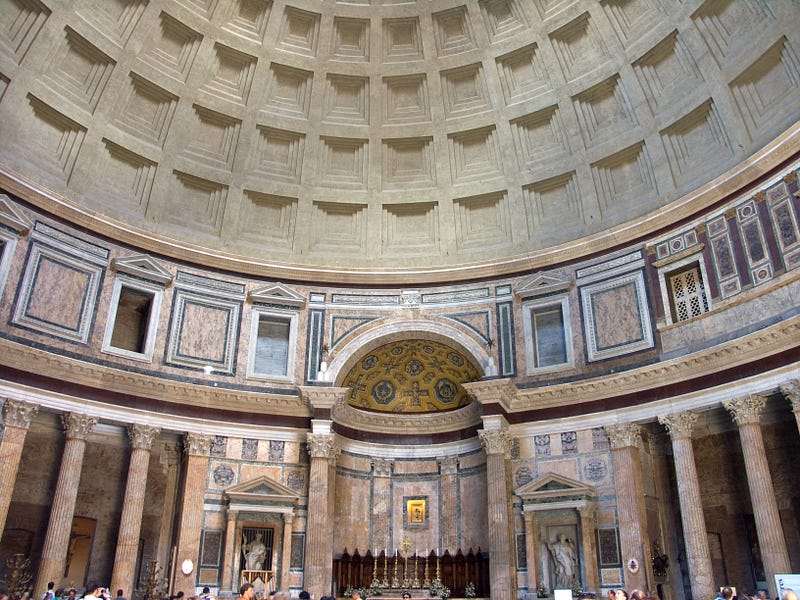
A tribute for the concrete gods…
Running and riding Chasing fun and friends and time Sometimes skinning knees
I have always hated concrete, even as a kid. I constantly lost skin and flesh to the concrete gods. Every stumble or crash of the bike demanded a tribute and I had to lay my offering of flesh and blood on the rasping tongue of the road or the patio or the parking lot.
Even without skinned knees, concrete has a bad name. Today, concrete is synonymous with ugly. Urban. Undignified. It even inspired a building style called Brutalist architecture which reveled in hulking, blocky concrete monstrosities. Synonymous with modern.
But concrete is actually ancient, with prehistoric roots.
And we should not disparage the material itself because we misuse it. Instead, we are the ones at fault who leave a concrete blight on the land. Our soulless designs and shoddy workmanship are solely at fault for a cityscape of crumbling concrete.
Concrete creations can be beautiful and soaring and timeless.
For all the faults of man, human hands still raise the most marvelous creations, like Icarus approaching the sun’s beauty and splendor.
The image above is of the Roman Pantheon, and the spacious concrete dome is a work of inspired brilliance. It is the largest unreinforced concrete dome in the world and has stood for two thousand years despite settling and earthquakes. Just one of many concrete wonders.
Roman concretes…
The gods create man Man creates things of beauty Time tears them all down
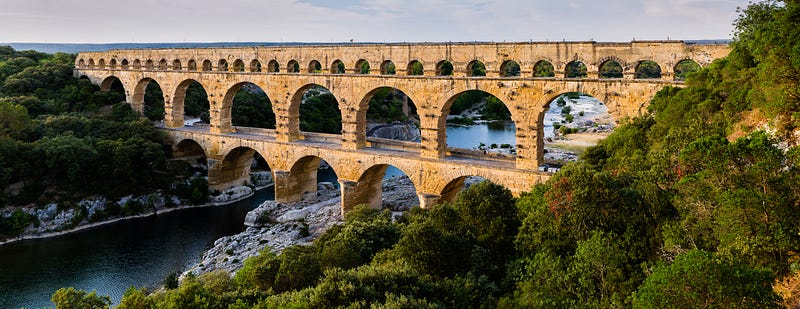
The mythology of Roman concrete includes a well-deserved reputation for durability. Modern concretes are lucky to last decades, while Roman concretes both on land and in the sea remain intact to this day, two millennia later.
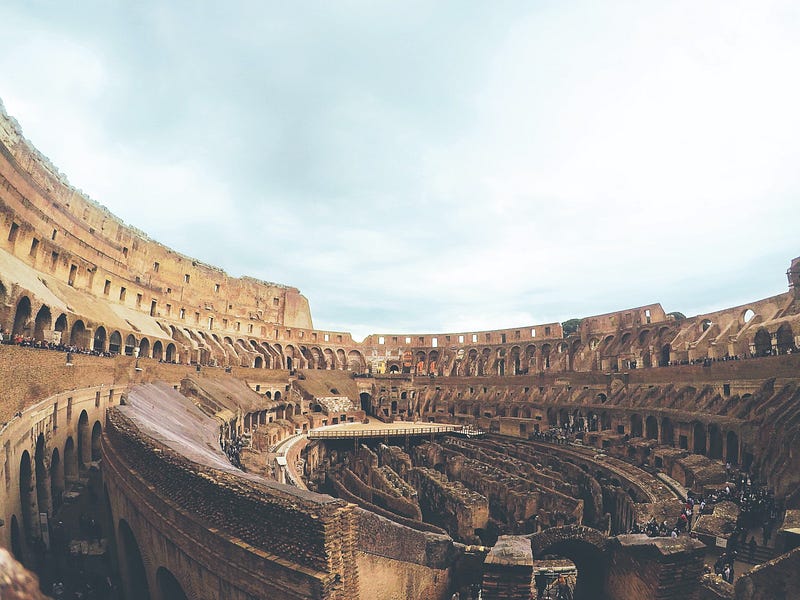
We know that the Romans built durable harbors from their concrete, and that their material gets stronger with age and exposure to sea-water, a notoriously harsh environment for man-made materials including concrete. The secret recipe for Roman concrete is a mixture of volcanic ash (which they called pozzolana), and lime (from kiln-fired limestone), in sea-water. This created a slurry which they used to bind volcanic rocks. This differs from modern recipes which use limestone and clay powder in water, known as Portland cement, to bind small rocks.
The 1st century BC Roman military engineer and architect Marcus Vitruvius is our original source for the concrete used in his time.
Vitruvius was a remarkable person who we unfortunately know little about. We know him mostly through his one surviving work, a book called De architectura where he proposed that all buildings be designed with the attributes of strength, utility, and beauty:
“…All these must be built with due reference to durability, convenience, and beauty. Durability will be assured when foundations are carried down to the solid ground and materials wisely and liberally selected; convenience, when the arrangement of the apartments is faultless and presents no hindrance to use, and when each class of building is assigned to its suitable and appropriate exposure; and beauty, when the appearance of the work is pleasing and in good taste, and when its members are in due proportion according to correct principles of symmetry…”
Leonardo da Vinci immortalized Vitruvius’s principles of perfect proportion in his drawing, the Vitruvian Man. Da Vinci based his drawing on the human proportions described in De architectura.

Vitruvius was also the original source for the story of Archimedes discovering the principle of volume displacement, stepping into his bath, watching water spill out and having his “eureka!” (“I have found it!’) moment. We still cry “eureka!” and some know that the cry is linked to Archimedes’ brilliant insight. But almost no one knows that we owe Vitruvius for writing Archimedes’ story for posterity.
The problem according to Vitruvius was whether a crown made for Syracuse’s King Hiero II was truly pure gold as specified, or whether a dishonest goldsmith adulterated the crown with silver. Weighing the crown was an easy matter. The question was density. Gold is denser than silver, so a given mass of gold should occupy a smaller volume than one with silver in it. So, how do we measure the volume without melting the crown? By the volume of water displaced by the irregular shape, like Archimedes stepping into his bath and sloshing out the water from the tub. Eureka!
Vitruvius documented many incredible insights in De architectura, including his suspicion that lead pipes were poisonous from witnessing the illnesses of lead foundry workers. He thus recommended clay pipes instead.
And it is Vitruvius we have to thank for his recipe for Roman concrete. In Chapter VI of De architectura, he says:
“…There is also a kind of powder which from natural causes produces astonishing results. It is found in the neighbourhood of Baiae and in the country belonging to the towns round about Mt. Vesuvius. This substance, when mixed with lime and rubble, not only lends strength to buildings of other kinds, but even when piers of it are constructed in the sea, they set hard under water…”
Pliny the Elder, a widely known Roman author and naturalist, wrote in his Naturalis Historia in the 1st century AD, about Roman concrete:
“…But there are other resources also, which are derived immediately from the earth. Who, indeed, cannot but be surprised 289at finding the most inferior constituent parts of it, known as “dust” only, on the hills about Puteoli, forming a barrier against the waves of the sea, becoming changed into stone the moment of its immersion, and increasing in hardness from day to day…”
Modern research confirms Vitruvius’s recipe and Pliny’s observations, and shows that ingress of sea-water into Roman concrete caused long-term chemical changes that did indeed result in stronger structures. The volcanic ash called pozzolana was essential for these chemical and structural reactions.
Ancient concretes…
All thoughts and problems Have passed through the minds of old Our days flutter by
But the Romans two thousand years ago were not the first to use concrete. It was old even then. The Greeks over a thousand years before the Romans used concrete.
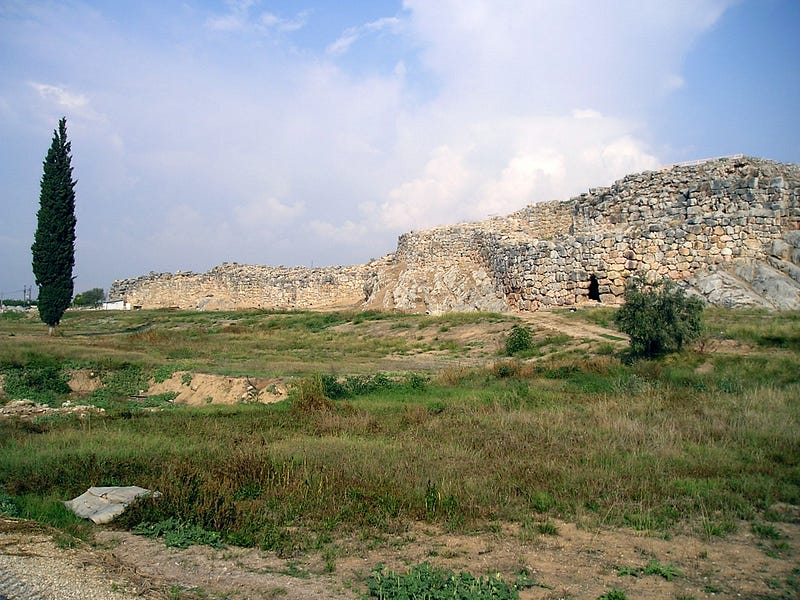
Heinrich Schliemann, the archaeologist who unearthed Troy, discovered concrete floors in the prehistoric royal palace of Tiryns, Greece. In 1885 Schliemann published his discoveries of this hill fort first occupied over 7,000 years ago:
“…The floor of the court is composed of a strong concrete of small pebbles and lime, and even now produces a very fine effect…”
“…In the east wall we still see a large stone-sill belonging to a side door, which led into the south portico of the court; in the gate wall itself there yet lies the great door-sill of breccia with two pivot-holes for the double folding-doors; the lime concrete floor of the back vestibule is almost completely preserved…”
Before the Greeks there was a small middle eastern kingdom of Nabatean traders near southern Syria and northern Jordan whose ancestors, around 6,500 BC, built what may be the earliest concrete structures. The later Nabateans around the 1st century AD built secret cisterns using waterproof concrete to cache water deep in the desert for emergencies.
The ancient Chinese made a mortar by mixing lime with sticky rice soup, but even older archaeological sites in the Gansu Province showed evidence of concrete-like materials used in the construction of temple floors 5,000 years ago.
The ancient Egyptians used cement-like materials since at least 2,500 BC. A long-standing and controversial modern hypothesis about the construction of the pyramids suggests that at least some of the stone block were cast in place rather than quarried, carved and moved to their final location.
Modern concretes…
Look out on the world The sun shines on a new day The old becomes new
With this history behind us, we can no longer look at concrete as a modern blight. We have made it cheap, and poured more of it onto the face of the earth than any other material.
Yet, we have managed to take some cues from the ancients, and produced some wonders of our own, echoing their brilliance.

But much of what we make is brutally ugly and oppressive.

And much of it is at an inhuman scale. We now dam massive river systems with immense plugs of concrete that threaten the integrity of the ground beneath, often triggering earthquakes as the reservoirs fill:
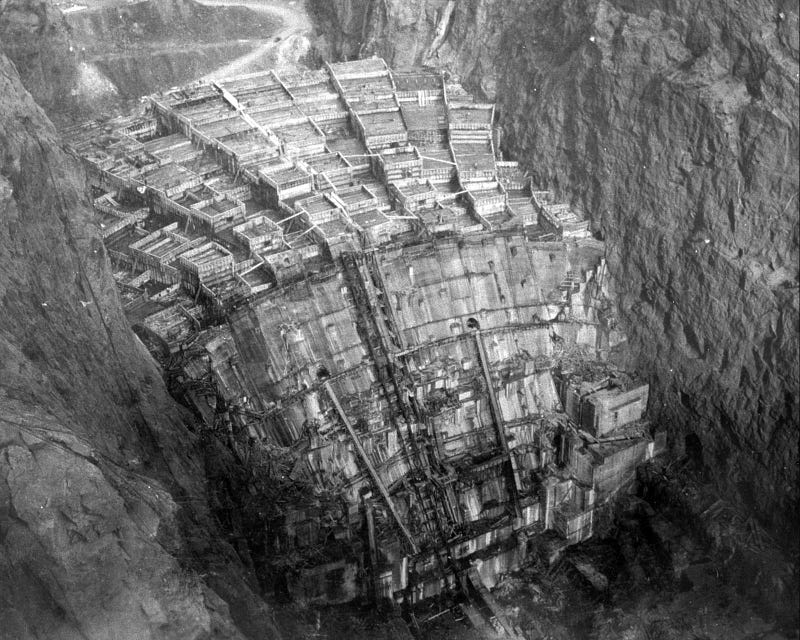
Our constructions have become inhuman because our own scale has become inhuman. Our population threatens the world’s health, because each of us lives our lives, and our wants and wastes are multiplied by billions. However unique we think we are, we all eat, breathe, procreate, and leave a mark upon our world as we move and act upon it.
Concrete is one of those marks.
Thank you…
Many thanks to R. Rangan PhD for her S&S Prompt of “Engineering Inspired Poetry” and her kind tags. Also, for her patience as I wander far off the track and the purpose of her prompt once I start writing:
I would like to tag WotWU’s wonderful writers to please check out R. Rangan PhD’s Science and Soul publication and her engineering prompt and give it a go:
John Griswold, Herr Jurke, Christopher Anderson, Walkey walkey, Tim Skellett, Matt Ray, Lee Ameka, Johnschlue, Donna L Roberts, PhD (Psych Pstuff), Dhan S, Dan Stout @boxyourbuddy, Venkat, Gerard Doorakkers, Bridget Webber, Madison Hunter, R. Rangan PhD, Frank Sturges, Lori Lamothe, Andrea Juillerat-Olvera, Susannah MacKinnie, Carlos Garbiras, Terry Mansfield, Puzi, kurt gasbarra, The Secret Aspirant, Panos Grigorakakis, Jonah Lightwhale, James G Brennan, Pablo Pereyra, Upasana Sharma, Genius Turner, Skanda Vivek, Anthi Psomiadou, Lucy The Eggcademic (she/her), Shrish Tariq, Jim Mason, Adelia Ritchie, PhD, Nuno Fabiao, JP Popham, William J Spirdione, Vincent Van Patten, Franco Amati, rsteiner, Rozalia Rafailidou, Robin Richey, Patrick M. Ohana, Joanna Vang, un p’tit je ne sais quoi, Paroma Sen, Cocoa Griot, Joseph Lieungh, Shalini C, Padma Bern, Robert Trakofler, SamaFathima, Synthia Satkuna, Jasmine Poulton, Mary Holden, Dandy Lioness, Trisha Traughber, Kevin Jahleel Ishimwe, John Levin, David Rudder, Dr. Jackie Greenwood, Daniel A. Teo, America Zed, Michele Thomas, Melissa Gouty, Mark Starlin, James Knight, Suntonu Bhadra, Gunnar De Winter, Imad, J.D. Harms, Hollie Petit, Ph.D., Alan Cope, Yve Laran, Jean Carfantan, Bill Abbate, R Tsambounieri Talarantas, Sarah Cords, Myriam Ben Salem, Bruce Noll, Amy Jasek, Rebecca Ruth Gould, Muhammad Nasrullah Khan, Christine Sander, Ana-Maria Schweitzer, r.j. quirk, Shanna Loga, Michael Stang, Mia Verita, Michael Burg, MD, James Goydos, MD, Kasun Ranasinghe, Grey Hen With A Pen, Citizen Upgrade, Joshua Gane, K. Barrett, Svetlana Smith, Rosy Gee, Anjali Samaraweera, Dr Ludovic Gros MD, Courtney Burry, Tom Belskie, Carolyn Hastings, Don Worsham, Rhonda Skinner, Rochelle Silva, Mario López-Goicoechea, Elle How, Don Be, Steve Williams, Liam Ireland, Simon Spichak, Matt Lillywhite, Bruce H. Cottman, Ph.D., David Andrew Wiebe, Audrey Malone, Gurpreet Dhariwal, J.C. Scull, Trista Ainsworth, Tom Hanratty, A. S. Deller, Jill Kelley, Vixen Lea, Gina L. Ryan, Christyl Rivers, Phd., Sylvia Wohlfarth, Carlyn Beccia, Grant Piper, Jamie Russo, Ms. Mary Ann, FILZA CHAUDHRY, Dr. Fatima Imam, Stuart Englander, Cooking at Home, Peggy Moss, Katie Michaelson, Michelle Berry Lane, Corinne Davis, SamanaQaseem, Diane Overcash, Princess Carrie Graham, Amanda Clark-Rudolph, Connie Song, Margie Pearl, Francesca Di Meglio, Chris Wojcik, Joe Luca, Peter Burns, Michael Ritoch, Dan Lee, Mark Tulin, J.J. Pryor, Phil Truman, Noorain Hassan, BMS, Terry Trueman, James Huffaker, MDSHall, ◦•●Christina M. Ward ●•◦, Michelle Renee Kidwell, Christina Meier Ph.D, Karen L. Jones, David Sales, Paul Smith, Roberto Quezada-Dardon, Harry Male, Kerstin Krause, Roberto C. Salvador, Claire Elaine, Adya Mantoo, Bruce Boswell
Referenced websites…
https://www.sciencemag.org/news/2017/07/why-modern-mortar-crumbles-roman-concrete-lasts-millennia
https://www.nature.com/news/seawater-is-the-secret-to-long-lasting-roman-concrete-1.22231
https://www.degruyter.com/document/doi/10.2138/am-2017-5993CCBY/html
https://archive.org/details/bub_gb_pw4BAAAAMAAJ
https://arxiv.org/pdf/1110.5230.pdf
https://www.nachi.org/history-of-concrete.htm
https://nabataea.net/explore/history/cement/
https://library.oapen.org/bitstream/handle/20.500.12657/45790/9789088902789.pdf?sequence=1#page=39
https://nabataea.net/explore/history/cement/
http://www.gutenberg.org/files/62704/62704-h/62704-h.htm
https://www.gutenberg.org/files/20239/20239-h/20239-h.htm#Page_46
https://www.nytimes.com/2008/04/23/world/africa/23iht-pyramid.1.12259608.html?_r=1&pagewanted=all


