
Concert Review: Huqin Recital by Wong hiu-ching, Eva(音樂會評論:黃曉晴胡琴演奏會)
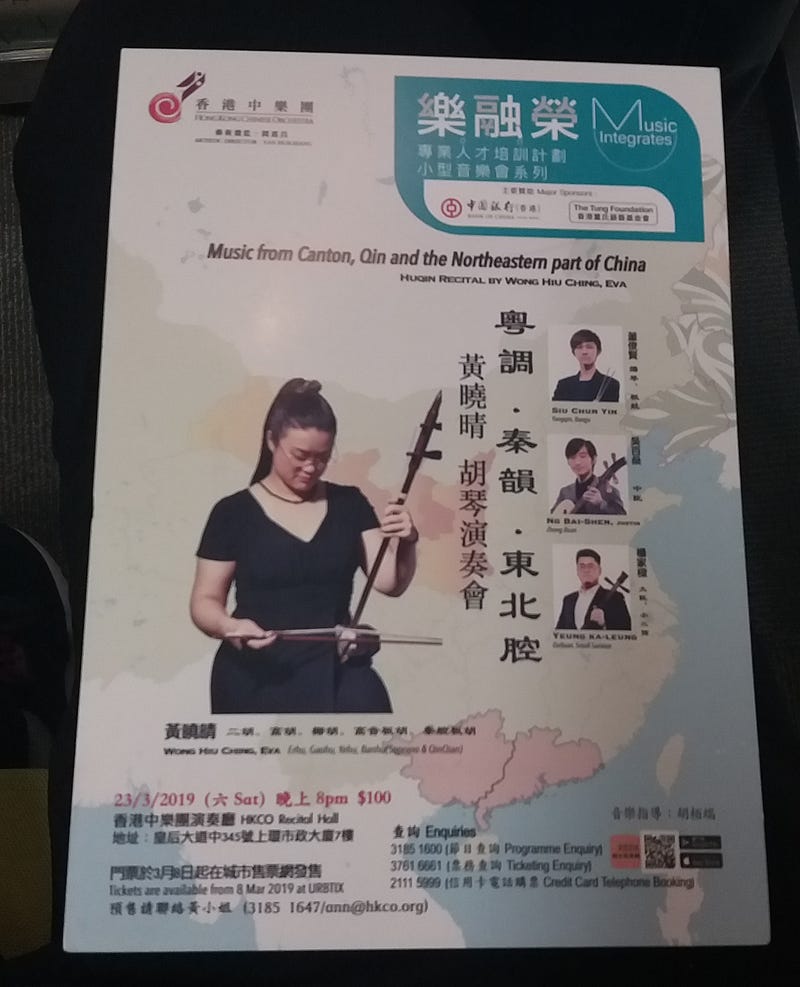
Besides erhu musicians from China, many Hong Kong erhu musicians perform in Hong Kong and Eva Wong hiu-ching(黃曉晴) is one of them. In 23rd March 2019, Eva Wong held her recital in HKCO recital hall(香港中樂團演奏廰) in Sheung Wan, Hong Kong.
Although the recital was supported by the Hong Kong Chinese Orchestra through the Music Integrates Programme(樂融樂:專業人才培訓計劃), almost everything has to be arranged by Eva. The programme note, the design of the programme note and the promotional cards were edited and designed by her. The following video was the description made by Eva before the recital:
Let me introduce the background of Eva Wong. Eva attained the master degree of Chinese music in the Academy of Performing Arts in Hong Kong(香港演藝學院,HKAPA). She specialized in the Chinese string instruments(Huqin), so in the programme she performed with erhu, banhu(板胡) and yehu(椰胡)in different regional styles. She had included 3 regional styles, namely the Qin style(秦音樂), the Cantonese style(廣東音樂) and the Northeastern style(東北音樂). Every piece was accompanied by yangqin(揚琴), ruan(阮) and sanxian(三弦).
Besides the performance, Eva explained the fingering techniques used in Huqin(胡琴) and the background information after the performance of every music pieces. More comments were included in the programme note. It was good to hear her explanation and to read her comments as I could improve my erhu techniques with such hints. However, it was disappointing to hear the first music piece as I could not hear any articulation and music style very clearly. Maybe Eva was very nervous in the beginning of the performance. The articulation was above standard in other pieces, but the regional style was not expressed as clearly as that done by the Huqin maestros in China. However, I like her playing Cantonese music which was the strength of the Huqin graduates in HKAPA. I also appreciated her bowing techniques, which were really her strengths to express the musical styles. It was commonly agreed that the bowing technique was the most crucial part to many musicians who played string instruments all over the world.
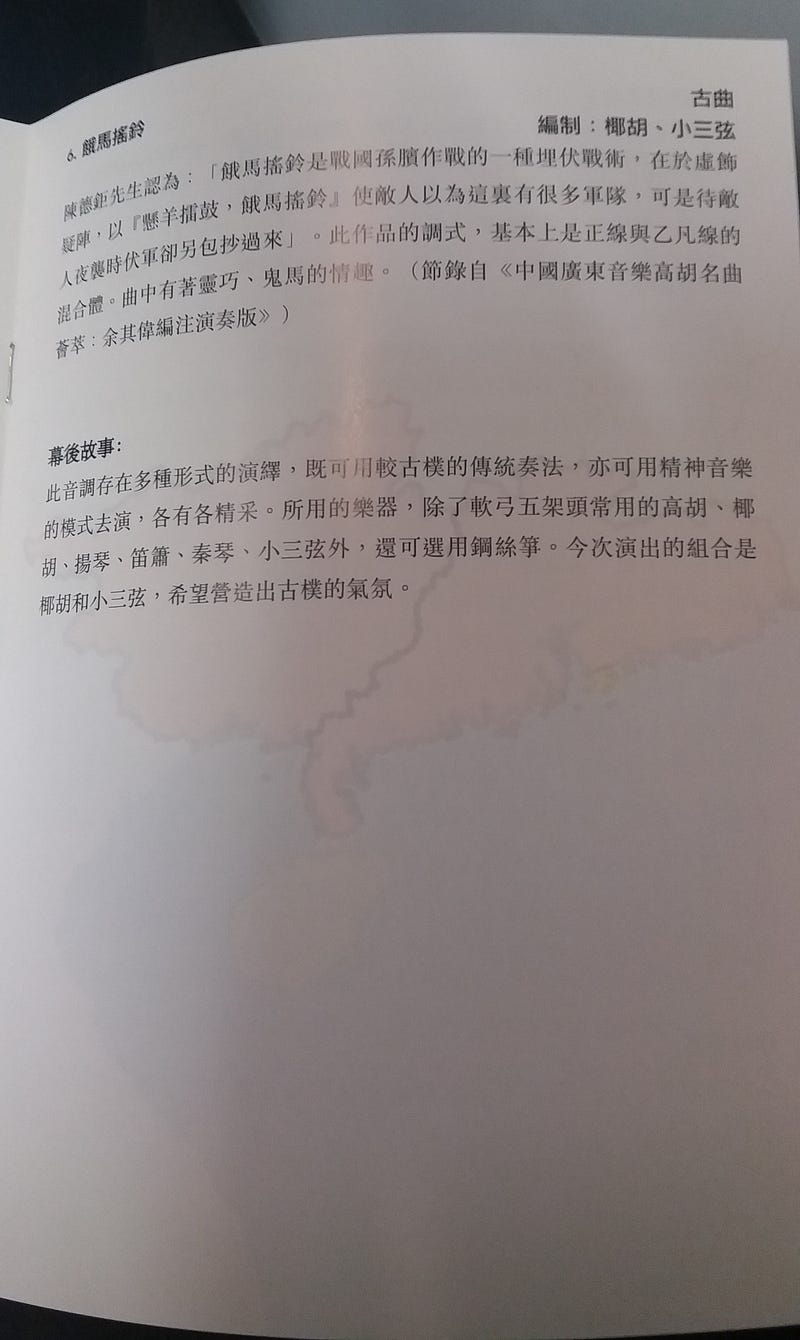
Moreover, Eva was lack of stage experience so she did not tune her Banhu well before the performance of the last 2 pieces. Hence she had to stop performing in the middle of the piece and tuned her Banhu and repeated the piece at the end of the recital. I feel bad, as it was not professional for her to do so. However, let this be her unforgettable experience and wish her perform better in her future performances!
Subscribe Sharon Erhu Channel: https://bit.ly/38loufR
訂閱小余二胡頻道:https://bit.ly/38loufR
For more information about erhu classes as well as erhu music , you are welcome to contact Sharon Yu with the following contact information:
如要查詢二胡課程和更多二胡資訊,歡迎使用以下聯絡方法和余小姐(小余老師)聯絡:
Sharon Erhu Workshop
淑汶二胡工作室
Address: Room 16, 3/F JC Tower, 91 Wai Yip Street, Kowloon, Hong Kong
地址:香港九龍偉業街91號JC Tower3樓16室
Email: [email protected]
網址:https://www.sharonerhu.com
Website: https://www.sharonerhu.com
Facebook: https://www.facebook.com/sharonyuerhu
Twitter: https://twitter.com/sharonerhu
Instagram: https://www.instagram.com/sharonerhu/