avatarDr. Jason L. Benskin

Free AI web copilot to create summaries, insights and extended knowledge, download it at here

3471

Abstract

microwaves, infrared radiation, visible light, ultraviolet radiation, X-rays, and gamma rays, manage to travel near and far, transmitting data across the globe?</p><p id="3ce6">Enter the realm of mathematics, the cornerstone of understanding the behavior of these waves. You see, every aspect of wave propagation — from the orientation of the magnetic and electric field vectors, to their complex interaction that generates sinusoidal variations — is captured by complex mathematical equations. It’s these mathematical models that help us predict how a wave might behave.</p><figure id="6a74"><img src="https://cdn-images-1.readmedium.com/v2/resize:fit:800/1*c6pR73EFvptNVDXY15CAoA.jpeg"><figcaption>Photo Credit: <a href="https://www.sciencefacts.net/wave-particle-duality.html">https://www.sciencefacts.net/wave-particle-duality.html</a></figcaption></figure><h1 id="f69a">The Electromagnetic Spectrum</h1><p id="b694">Let’s dive deeper into the subject, the propagation modes of electromagnetic waves: ground wave, sky wave, and space wave. Ground and sky waves are commonly used for long-distance communication, with the latter involving a direct or reflective journey from the transmitter to the receiver. Does this remind you of geometry yet? These phenomena and their predictable nature are modeled and understood via the principles of mathematics.</p><p id="c894">Now, keeping in mind the elements of frequency-related dispersion where different waves take different paths (or angles of refraction), we come across an interesting concept in wave theory. It’s here that mathematics throws an exciting twist: the development of quantum theory, which was introduced to resolve an anomaly in wave theory concerning thermal radiation.</p><p id="dde4">In essence, the science of electromagnetic propagation isn’t solely about physics. Instead, at its heart lies a complex framework of mathematical principles that paint a comprehensive picture of wave behavior. When you flip on the radio, stream a video, or heat your dinner in a microwave, it’s all made possible by the intricate dance of electromagnetic waves, governed by a symphony of mathematical equations.</p><p id="8e6e">In the end, isn’t it interesting that by peeking into the world of complex mathematics, we can better understand an aspect that impacts our day-to-day lives so profoundly? It’s a fascinating journey that links the abstract world of numbers with the very tangible, real-world phenomena of electromagnetic waves.</p><figure id="2ea8"><img src="https://cdn-images-1.readmedium.com/v2/resize:fit:800/1*ulzzXDu-OIumPHpyUZX0wA.jpeg"><figcaption></figcaption></figure><figure id="2fd4"><img src="https://cdn-images-1.readmedium.com/v2/resize:fit:800/1*ze1p-jhXvFzOHZ6IXsptiA.jpeg"><figcaption>Photo Credit: <a href="https://www.quora.com/Why-can-the-AM-stations-be-detected-only-at-night">https://www.quora.com/Why-can-the-AM-stations-be-detected-only-at-night</a></figcaption></figure><h1 id="e5ed">Maxwell’s Equations</h1><p id="8631">Let’s take an abstract journey, bringing math into the equation. Imagine we’re examining a hypothetical electromagnetic wave holding Maxwell’s equations as our guide.</p><p id="b308">Maxwell’s equations describe the behavior of electromagnetic waves. A simplified form of these equations for the case of an electromagnetic wave propagating in free space (that is, no charge or currents present), is as follows:</p><p id="62c0">div(E) = 0 / div(B) = 0</p><p i

Options

d="f519">curl(E) = — ∂B/∂t</p><p id="6d24">curl(B) = μ0ε0 ∂E/∂t</p><p id="35c8">Where E and B are the electric and magnetic field vectors, div(.) and curl(.) represent the divergence and curl operators, “∂./∂t” is the temporal partial derivative, and μ0 and ε0 are the vacuum permittivity and permeability, respectively.</p><figure id="a1c5"><img src="https://cdn-images-1.readmedium.com/v2/resize:fit:800/1*CWtUlTpa4pOI-jckmYBepg.jpeg"><figcaption></figcaption></figure><figure id="219a"><img src="https://cdn-images-1.readmedium.com/v2/resize:fit:800/1*k-FXffbxNx8vPGFeuqxDIA.jpeg"><figcaption></figcaption></figure><figure id="f3af"><img src="https://cdn-images-1.readmedium.com/v2/resize:fit:800/1*4FP1g1YuO1nvkaHrFuK1Bg.jpeg"><figcaption></figcaption></figure><figure id="4358"><img src="https://cdn-images-1.readmedium.com/v2/resize:fit:800/1*ByREwPP8-rCvblAqaF810g.jpeg"><figcaption></figcaption></figure><h1 id="144b">Characteristics of Electromagnetic Waves</h1><p id="2425">From these equations, we can understand how any changes in the electric field (E) generate a varying magnetic field (B), and vice versa. This interaction leads to the propagation of electromagnetic waves. The complex mathematics involved here predict the wave’s behavior and, excitingly, take us a step closer to understanding radio waves and other forms of EMR, like visible light.</p><p id="03ba">Ultimately, the beauty of mathematics gives us the tools to predict and interpret the natural world, which is nothing short of magical.</p><h1 id="390f">Applications and Predictions with Mathematics</h1><figure id="b27d"><img src="https://cdn-images-1.readmedium.com/v2/resize:fit:800/1*azZkmA5EAv-zOO8BklQUww.jpeg"><figcaption>Table Credit: Benskin, Jason <b>Characteristics and Application of Electromagnetic Waves, 2024 research</b></figcaption></figure><p id="c503">A framework for constructing quantum mechanical models of subatomic particles in particle physics and quantum field theory.</p><p id="4300">Aids in modeling systems that emissions and absorptions occur in, further helping in wave prediction.</p><p id="5140">Wave-Particle Duality — Confirms electromagnetic radiation has both wave-like and particle-like properties.</p><p id="9e76">Assists in the understanding of radio waves under different experimental setups.</p><h1 id="3bed">Conclusion</h1><p id="3d5b">In conclusion, complex mathematics truly underpins our ability to comprehend and anticipate radio wave behavior. Quantum electrodynamics, Maxwell’s equations, the quantum theory of fields, and wave-particle duality each offer unique lenses through which we can better understand these intriguing phenomena. Whether it’s probing the interactions between electromagnetic radiation and matter, describing waves of changing electric and magnetic fields, constructing quantum mechanical models of subatomic particles, or affirming that electromagnetic radiation simultaneously exhibits both wave and particle properties, each of these theories contributes significantly to our knowledge of radio waves.</p><p id="a113">Indeed, complexity within mathematics illuminates the fascinating, intricate world of radio waves and their behavior, providing us robust tools to predict and explore the invisible yet powerful world of electromagnetic radiation.</p><figure id="58bf"><img src="https://cdn-images-1.readmedium.com/v2/resize:fit:800/1*QCQqlZr6doDP-cszzpaSpw.png"><figcaption></figcaption></figure></article></body>

Decoding the Mathematics of Radio Wave Propagation

Complex Mathematics: The Secret behind Radio Waves Propagation

Unraveling Radio Waves: The Math Behind the Magic
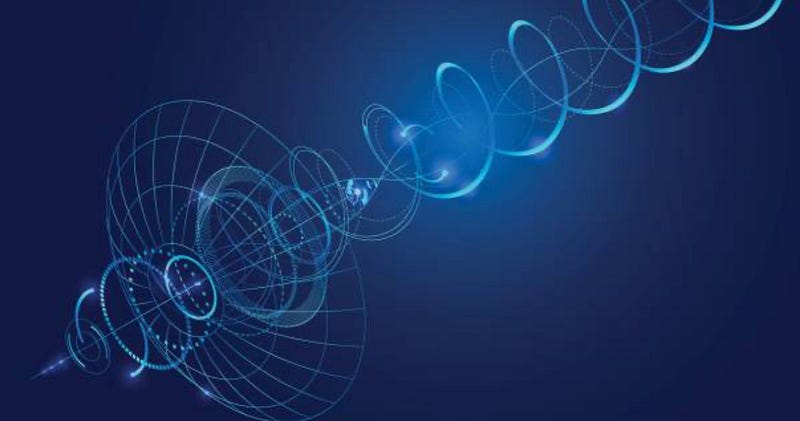
Photo Credit: https://www.istockphoto.com/it/immagine/radio-frequency

Table of Contents

  • Introduction to Electromagnetic Waves
  • Wave-Particle Duality
  • The Electromagnetic Spectrum
  • Maxwell’s Equations
  • Characteristics of Electromagnetic Waves
  • Applications and Predictions with Mathematics
  • Conclusion

Introduction to Electromagnetic Waves

Ever wondered how your car radio catches your favorite station, even when you’re on the move? Or how your Wi-Fi range extends up to a certain limit, beyond which it drops off significantly? The secret lies in understanding the behavior of radio waves, and believe it or not, it’s all about complex mathematics! In this article, you’ll discover how mathematicians and engineers team up to make our wireless world possible.

“Mathematics is the language that nature speaks in and this is no different for radio waves.”

  • Unraveling the mysteries of radio wave propagation.
  • Understanding the influence of mathematical equations on these invisible carriers of information.
  • Discovering why the role of complex mathematics is beyond just crunching numbers or solving puzzles.

Whether you’re a curious reader, a tech-nerd, or a math geek, you’re about to embark on an intriguing journey that will shed some light on the magic of radio waves, facilitated by the wonders of complex mathematics. Buckle up and let’s dive in!
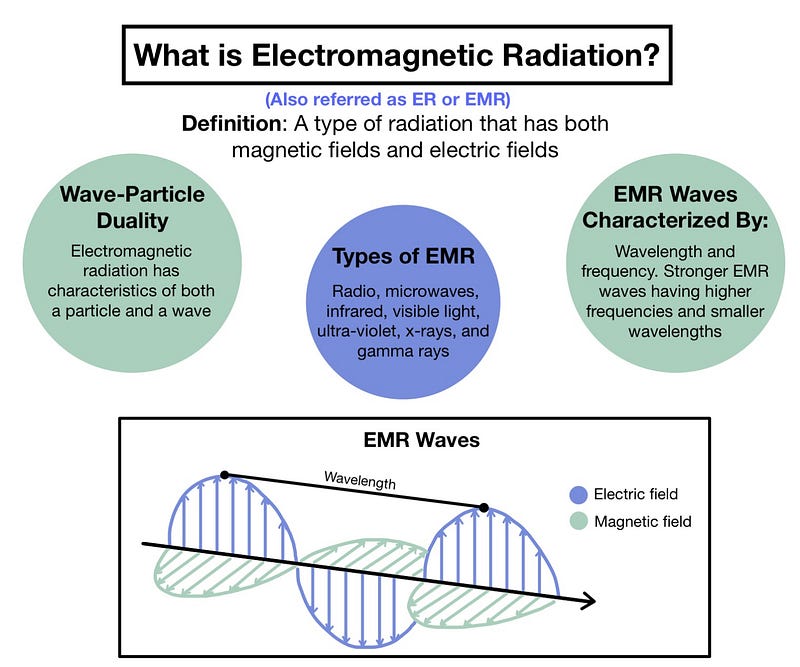
Photo Credit: https://www.expii.com/t/electromagnetic-radiation-overview-types-8301

Wave-Particle Duality

You may wonder how radio waves, which can span a length greater than a continent, to gamma rays, smaller than the nucleus of an atom, are related to mathematics. Well, the key puzzle lies in the propagation of these electromagnetic waves — a phenomenon that involves a complex dance of magnetic and electric fields. Another vital question to ponder is, how does this electromagnetic spectrum, which includes radio waves, microwaves, infrared radiation, visible light, ultraviolet radiation, X-rays, and gamma rays, manage to travel near and far, transmitting data across the globe?

Enter the realm of mathematics, the cornerstone of understanding the behavior of these waves. You see, every aspect of wave propagation — from the orientation of the magnetic and electric field vectors, to their complex interaction that generates sinusoidal variations — is captured by complex mathematical equations. It’s these mathematical models that help us predict how a wave might behave.
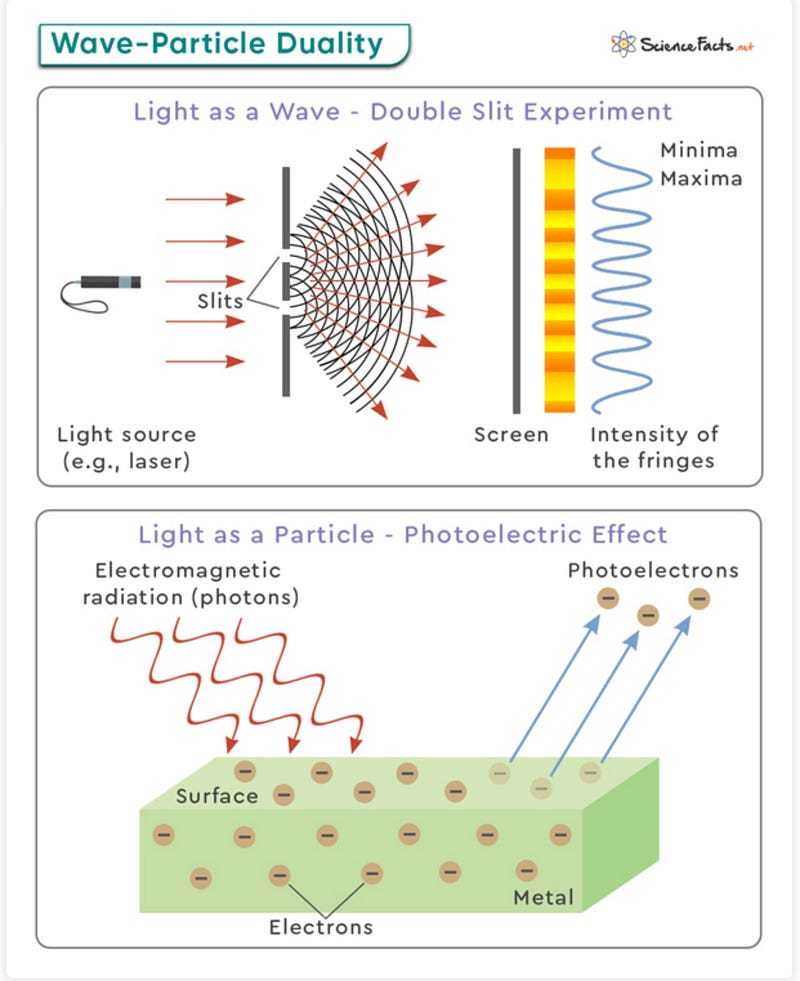
Photo Credit: https://www.sciencefacts.net/wave-particle-duality.html

The Electromagnetic Spectrum

Let’s dive deeper into the subject, the propagation modes of electromagnetic waves: ground wave, sky wave, and space wave. Ground and sky waves are commonly used for long-distance communication, with the latter involving a direct or reflective journey from the transmitter to the receiver. Does this remind you of geometry yet? These phenomena and their predictable nature are modeled and understood via the principles of mathematics.

Now, keeping in mind the elements of frequency-related dispersion where different waves take different paths (or angles of refraction), we come across an interesting concept in wave theory. It’s here that mathematics throws an exciting twist: the development of quantum theory, which was introduced to resolve an anomaly in wave theory concerning thermal radiation.

In essence, the science of electromagnetic propagation isn’t solely about physics. Instead, at its heart lies a complex framework of mathematical principles that paint a comprehensive picture of wave behavior. When you flip on the radio, stream a video, or heat your dinner in a microwave, it’s all made possible by the intricate dance of electromagnetic waves, governed by a symphony of mathematical equations.

In the end, isn’t it interesting that by peeking into the world of complex mathematics, we can better understand an aspect that impacts our day-to-day lives so profoundly? It’s a fascinating journey that links the abstract world of numbers with the very tangible, real-world phenomena of electromagnetic waves.
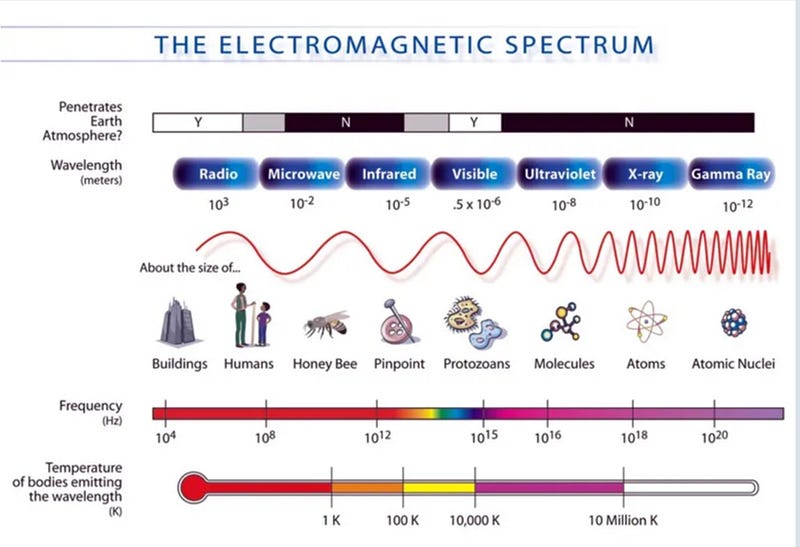
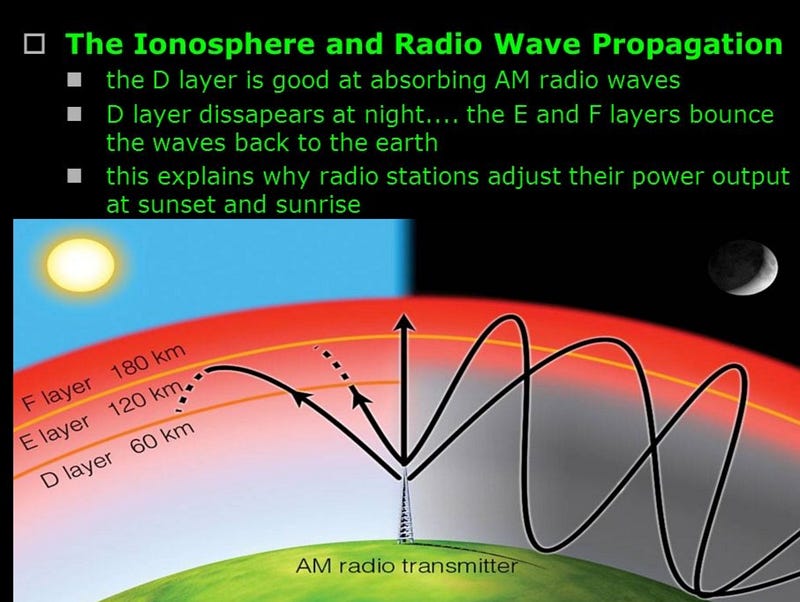
Photo Credit: https://www.quora.com/Why-can-the-AM-stations-be-detected-only-at-night

Maxwell’s Equations

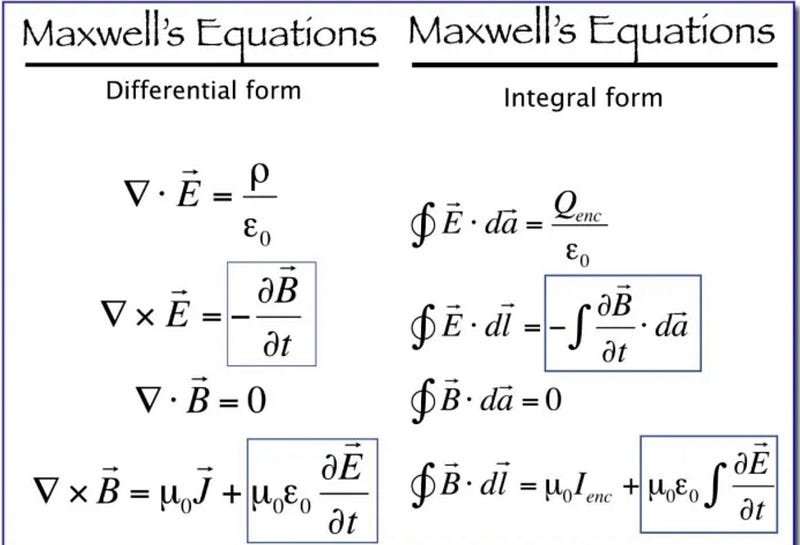
Let’s take an abstract journey, bringing math into the equation. Imagine we’re examining a hypothetical electromagnetic wave holding Maxwell’s equations as our guide.

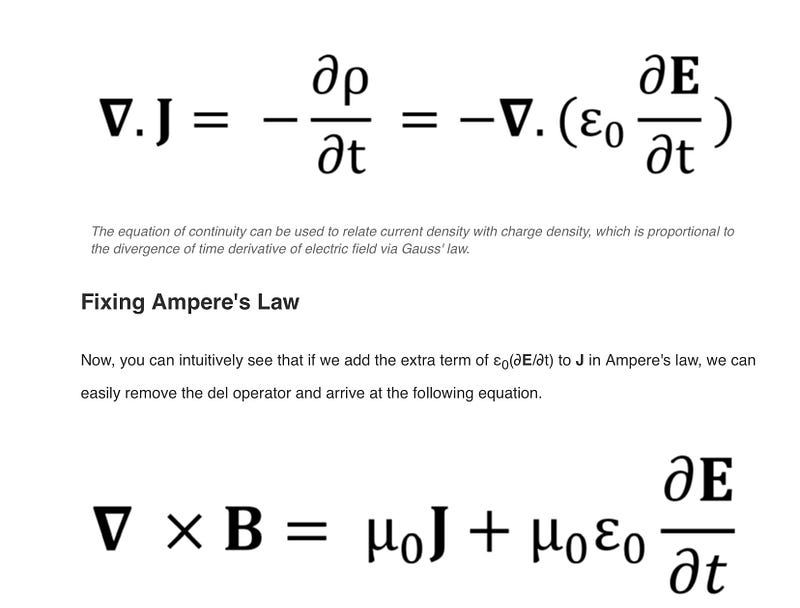
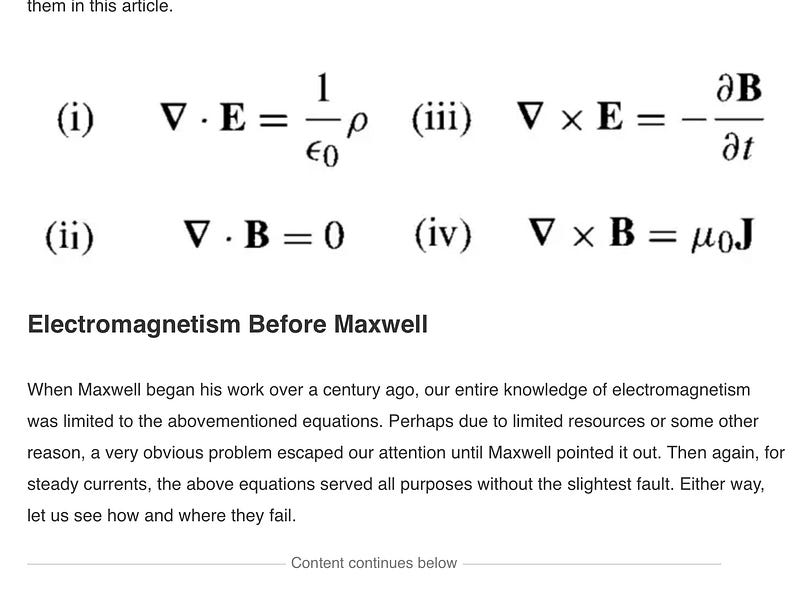
Maxwell’s equations describe the behavior of electromagnetic waves. A simplified form of these equations for the case of an electromagnetic wave propagating in free space (that is, no charge or currents present), is as follows:

div(E) = 0 / div(B) = 0

curl(E) = — ∂B/∂t

curl(B) = μ0ε0 ∂E/∂t

Where E and B are the electric and magnetic field vectors, div(.) and curl(.) represent the divergence and curl operators, “∂./∂t” is the temporal partial derivative, and μ0 and ε0 are the vacuum permittivity and permeability, respectively.
Characteristics of Electromagnetic Waves

From these equations, we can understand how any changes in the electric field (E) generate a varying magnetic field (B), and vice versa. This interaction leads to the propagation of electromagnetic waves. The complex mathematics involved here predict the wave’s behavior and, excitingly, take us a step closer to understanding radio waves and other forms of EMR, like visible light.

Ultimately, the beauty of mathematics gives us the tools to predict and interpret the natural world, which is nothing short of magical.

Applications and Predictions with Mathematics
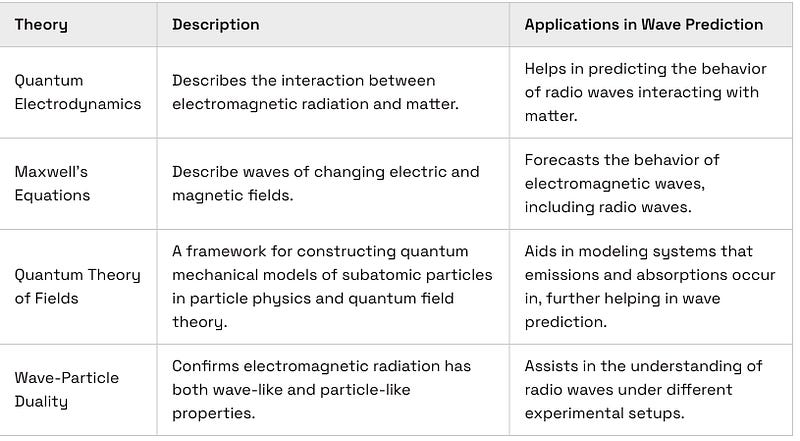
Table Credit: Benskin, Jason Characteristics and Application of Electromagnetic Waves, 2024 research

A framework for constructing quantum mechanical models of subatomic particles in particle physics and quantum field theory.

Aids in modeling systems that emissions and absorptions occur in, further helping in wave prediction.

Wave-Particle Duality — Confirms electromagnetic radiation has both wave-like and particle-like properties.

Assists in the understanding of radio waves under different experimental setups.

Conclusion

In conclusion, complex mathematics truly underpins our ability to comprehend and anticipate radio wave behavior. Quantum electrodynamics, Maxwell’s equations, the quantum theory of fields, and wave-particle duality each offer unique lenses through which we can better understand these intriguing phenomena. Whether it’s probing the interactions between electromagnetic radiation and matter, describing waves of changing electric and magnetic fields, constructing quantum mechanical models of subatomic particles, or affirming that electromagnetic radiation simultaneously exhibits both wave and particle properties, each of these theories contributes significantly to our knowledge of radio waves.

Indeed, complexity within mathematics illuminates the fascinating, intricate world of radio waves and their behavior, providing us robust tools to predict and explore the invisible yet powerful world of electromagnetic radiation.

Technews
Science
Mathematics
Math
Mathematics Education
Recommended from ReadMedium