
Comparison of Chinese and American Views on War (Part 2)
Cognition of the root causes of modern war: China emphasizes that hegemonic power politics is the root cause of modern war, and the United States uses the “democratic peace theory” and “clash of civilizations theory” to cover up war crimes.
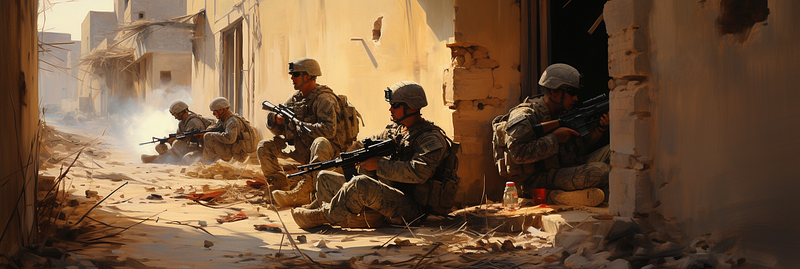
Since modern times, China has suffered from aggression by foreign powers and plunder by imperialism.
In the long-term struggle practice, the Communist Party of China and the Chinese people have discovered the truth of Marxism to save the nation and survive. They have inherited and developed the Marxist view of war on the root cause of war and believe that hegemonic power politics is the root cause of modern war.
Relatively speaking, the United States has continued to expand its territory since its founding, and its development history is a history of aggression.
Since the Second World War, especially after the Cold War, the United States has regarded itself as the hegemon of the capitalist world and even the global hegemon. It has launched many proxy wars and unilateral military actions, claiming that wars are not easy to break out between democratic countries and that wars originate from conflicts between different civilizations. Conflict and other arguments provide a “legitimate cloak” for its war crimes.
Lenin pointed out — —
“‘War is the continuation of politics by another means.’ This is a famous saying of Clausewitz, one of the most profound writers on military issues. Marxists have always regarded this argument fairly as an examination of any The theoretical basis of the significance of a war. Marx and Engels always examined various wars from this point of view.”
“‘World hegemony’ is the content of imperialist politics, and the continuation of imperialist politics is imperialist war.”
New China further developed this theory, and its main points include:
First, it is clearly pointed out that hegemonism is the root cause of war.
Deng Xiaoping pointed out: “When China was led by Chairman Mao Zedong and Premier Zhou Enlai, it emphasized its opposition to the hegemonism of superpowers and believed that hegemonism was the root cause of war.”
The second is the emphasis on hegemonic power politics, which has led to unrest in many countries.
Deng Xiaoping pointed out that the Western world, especially the United States, “is inciting unrest in many countries, which is actually engaging in power politics and hegemonism. They want to control these countries and bring countries that they could not control in the past into their sphere of influence.”
The third point is to point out that hegemonism brings the danger of world war.
Deng Xiaoping pointed out: “We believe that the competition between the two superpowers, the United States and the Soviet Union, for world hegemony has brought about the danger of a new world war.” “Today, if we really want to launch a third world war, no one else has the ability. Only the United States and the Soviet Union have this ability, and there is no third party.”
The fourth is to resolutely oppose hegemonic power politics.
Deng Xiaoping pointed out: “To strive for peace, we must oppose hegemonism and power politics.” “We will oppose whoever engages in hegemony, and we will oppose whoever engages in war.” “The new hegemonism and power politics that have emerged now cannot be sustained for a long time. . A few countries monopolize everything. This form has not solved any problems in the past many years, and it will not solve any problems in the future.”
Fifth, cultural differences should become the driving force for the progress of human civilization.
Xi Jinping pointed out: “The diversity of human civilization is the basic feature of the world and the source of human progress. There are more than 200 countries and regions, more than 2,500 ethnic groups, and multiple religions in the world. Different histories and national conditions, different ethnic groups and customs have given birth to It brings together different civilizations to make the world more colorful. There are no superior or inferior civilizations, only differences in characteristics and regions. Differences in civilizations should not be the source of conflicts in the world, but should become the driving force for the progress of human civilization.”
The American “democratic peace theory” pushes the root causes of war to so-called non-democratic countries.
Its main points include -
First, war will not break out between democratic countries.
In 2008, Boris Bass, a famous professor of modern history at the University of Konstanz in Germany, pointed out in his book “The Democratic Peace Debate: A Critical Survey”: “The central point of the democratic peace theory can be summarized in one sentence: Democracies will not There is a war with another democracy and they are able to each remain at peace.”
Second, U.S. senior officials and officials play an important role in spreading the “democratic peace theory.” “
In the 1990s, the theory became popular among some American political scientists and accepted by some German and Scandinavian scholars.
Two U.S. presidents, Bill Clinton and George W. Bush, publicly declared their firm support for this theory.
Clinton also called ‘democracy expansion’ the third pillar of his foreign policy… The president believed that democracies would not go to war but would engage in free trade and respect the human rights of their citizens. “
Third, democratic countries are safer.
“Democracy and critical theorists initially believed that democracies were generally more peaceful than authoritarian or dictatorial states.”
However, there are many opposing voices to the “democratic peace theory”.
Fuller, a British military expert, believes: “In Europe, except for similar religious wars, all wars at a crazy pace are democratic struggles, and their spirit comes from the ‘whole will.’” “The driving force of democracy is not to fight against others. Instead of love, he hates all tribes, sects, parties or nations that do not belong to his own. This ‘total will’ means total war, and it is the powerful factor that stimulates people to join the war.”
At the same time, Professor Bass also pointed out that there is evidence that in the case of non-democratic and authoritarian regimes, peace is the norm and war is the exception, which has nothing to do with their domestic oppression or terror.
The famous American political theorist Samuel Huntington proposed the “clash of civilizations theory”, believing that cultural similarities will push these civilizations to take common actions, while cultural differences will cause wars to break out between different civilizations and between different members of the same civilization. .
First, the antagonism between different civilizations is obvious.
Huntington pointed out in “The Clash of Civilizations and the Reconstruction of World Order”: “The relationship between countries and groups belonging to different civilizations will not only not be close, but will often be confrontational. However, the relationship between certain civilizations Relations are more prone to conflict than other civilizations. At the micro level, the strongest fault lines are between Islamic countries and their Orthodox, Indian, African and Western Christian neighbors. At the macro level, the most significant cleavages are between The most serious conflict exists between the West and the non-West; between Muslims and Asian societies on the one side and the West on the other.”
Second, the conflict of civilizations may lead to war between countries.
“As Thucydides noted, in Greek civilization, the increase in Athenian power led to the Peloponnesian War.” “The Afghan war became a war between civilizations because Muslims around the world believed so. and united against the Soviet Union. The Gulf War became a war between civilizations because the West intervened militarily in Muslim conflicts, and the vast majority of Westerners supported this intervention. This is the case for Muslims around the world Seeing this intervention as a war against them and thus uniting against what they see as Western imperialism is yet another example of this.”
Third, cultural affinity can effectively avoid war.
“In Western history, there has never been a hegemonic war between Britain and the United States. The transition from world peace under British power to world peace under American power is probably due to the close cultural affinity between the two societies.”
The “clash of civilizations theory” overstates the cultural differences that trigger wars, while ignoring the fact that war is a continuation of politics. It is also a theoretical weapon used by the United States to conceal its hegemonic intentions and serve strategic expansion.