
Community Values
Families Sharing, Helping, Laughing, Learning, United.
Prospering in Good Times and Surviving Bad Times.
Genesis.
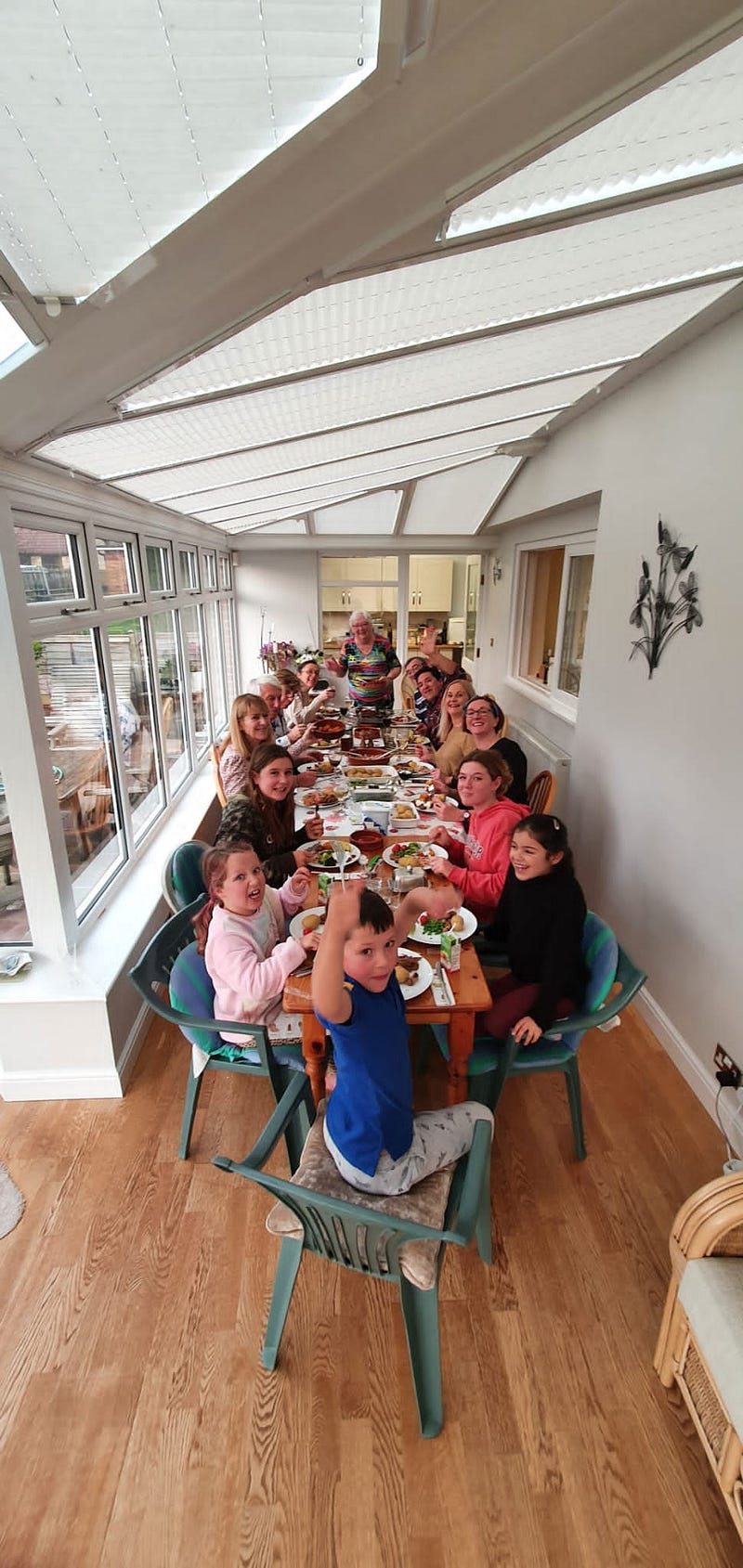
I remember a time long gone when I sat at such a table, holding my fork up, after being forewarned of the consequences of misbehavior. My memory was mainly around my plate running out of delicious roast potatoes. Obviously, it scarred me for life.
The picture above belongs to my grandchildren. It invokes memories of similar times with my parents, siblings, grandparents, and cousins. My father told me of his family times and I remember watching my grandmother bake mouth-watering cakes and pies using recipes passed down from her grandmother. We all have these stories, it’s our cultural heritage.
Times change. Globalization has birthed modernity. Yet, I believe it has weakened our cultural heritage, our ties to the land and made us vulnerable to natural disasters. I fervently believe our future lies in returning to traditional values; relying upon our families working in strong communities to face natural disasters. Aesop’s saying “United we stand, divided we fall” means as much now as it ever did.
Globalization.
In our globalized world, people talk with smartphones oblivious to time, place, and distance. They travel with few restrictions compared to past centuries. Education is freely available to those who can afford it. Information, false and true, floods our senses. We are disconnecting from the land beneath our feet.
Global supply chains deliver luxuries and necessities cheaply and efficiently to uncaring customers. Perceptions of crumbling barriers heighten senses of individualism, self-righteousness, and self-entitlement. Together with the relentless pursuit of profit maximization, globalization has weakened and disrupted traditional community values of frugality and working together.
Globalization has made us more vulnerable to the increasing severity of natural disasters bought about by climate change. As I write, there are severe floods in North-Eastern Australia with lives lost. Communities have been isolated in Northern Australia as severe floods damaged roads and rail.
Globalization Falters
Chinks in globalization are there for people to see in the complex intertwined knotted-together planet-wide systems. The benefits of globalization aren’t evenly spread. Gaps are inexorably widening between rich and poor; those in work and unemployed; permanent and casual workers; educated and not; connected and not; powerful and not. Outsourcing has depressed local incomes and moved industries and profits offshore.
The global pandemic exacerbated these gaps and highlighted local, regional, political, and social inequalities. Nationalism has reasserted itself as nation-states sought to take advantage of perceived weaknesses in other states. Some nations have resorted to military force, others use trade and supply chain manipulation as a weapon to cower smaller nations.
Greater awareness of globalization's issues has spread in the community, calls are being made for greater self-reliance and less dependency on external supply chains. People now voice their growing distrust in governments and institutions. We must return to our roots.
The Need to Rebuild our Sense of Community
Despite the pandemic and supply chain issues, climate change impacts are coming to the fore, particularly in Australia. In matters of climate change, Australia is the proverbial canary in the coal mine.
The stark reality of suffering prolonged isolation due to natural disasters makes communities acutely aware of how much they depend on strengthening their preparedness and resourcefulness. They recognize the need to protect our homes by taking stock and preparing for future events.
Preparation.
Understanding and using the family’s lived-in experience of the local environment is key to preparing for natural disasters such as flooding, fire, and severe storms. Family gatherings provide the opportunity to gather information about the effects of past events: what damage was done; how long did the event last; how long were we isolated; was the family promised help to recover; and when was the promised help actually delivered?
Gathering information on past experiences gives us the opportunity to compare notes with other families. Sharing experiences lay an excellent basis for understanding what actions are needed to cope with future events. There is one caveat, future events, due to ongoing climate change, will be worse. A good idea would be to assume that isolation times may double and damage estimates should be based on worst-case scenarios. Now ask: “What can we do?”, “ What do we need?” and “Who can we rely On?”.
Family Playing its Part in Community Activities.
A strong community comes from “taking care of our own”. Families work, talk, and socialize together. People banding together to take on tasks too big for one family such as fencing, infrastructure (barns and outbuildings, drainage, flood water diversions, and fire reduction), volunteer fire fighting, first aid stations, local hospital support, and so on.
Community organizations such as Australia’s Country Women’s Association and the Country Women’s Council USA have been strong advocates of rural and regional rights and now need to be strengthened. The increasing risks associated with natural disasters mean communities must stick together as never before and spread their ideas, zeal, organization, and commitment to others including families living in the cities.
Talking to a neighbor across the fence, or at the kitchen table, or at the supermarket checkout, or even at the school gate waiting for the kids is all it takes to start the ball rolling.
Coping with Short Term Natural disaster
The family may face periods of isolation of a few weeks. This would apply to living in localities associated with tornados, severe storms, floods, wildfires, earthquakes, or heavy snowfalls. Tornados are not just limited to parts of the USA, they have occurred not too far from where I live in Sydney Australia.
Typically, for short-term natural disasters families invest in material for fortifying structures and tools for rebuilding and constructing temporary shelters. While assuming the long-term continuity of society, some may invest in a custom-built shelter, food, water, medicine, and enough supplies to get by until contact with the rest of the world resumes following the disaster.
Coping with Long Term Natural disasters.
This applies to families living in areas of long-term weather cycles (2–10 years). For example, recent severe droughts in Eastern Australia have caused crop failures and destocking of sheep and cattle properties. In the US, the corn belt is moving Northwards, although the change is gradual, farmers and the supply chains will need to adapt.
Long-term events, such as severe droughts may decide families to stock several tons of food per family member and have a heavy-duty greenhouse with canned non-hybrid seeds. I feel that it is more likely that the property will become financially unviable and be unable to support any long-term continuance of its current practices.
Lifestyle.
In truth, a family’s plan to cope with a natural disaster is only as good as the last natural disaster it survived. Watching the land and being aware of changes is a vital lifestyle choice, something you do naturally as part of living in a community. One thing is for certain, thinking of a plan when the kitchen floods or the earth moves or the roof disappears is probably too late.


