Communication Is Critical in Virtual Learning
You’re part teacher, part customer support representative

With the ongoing concerns of the pandemic, my wife and I agreed that it was in the best interests of our children to sign up for our school district’s virtual learning program. I am a certified teacher, but I do have work obligations throughout the day so it was nice to think I wouldn’t have to prepare material.
Two months into the program, our school district’s virtual learning plan has been nothing short of a total disaster.
The main issue seems to be that some of the professionals that have been tasked in important roles are not very tech-savvy, and they are stubbornly refusing to acquire and implement the skills necessary to fulfill the requirements of their positions. The simple fact is that the unique challenges of the 20/21 school year are going to require more work from everybody. The sooner teachers, parents, and students learn to adopt good practices, the more we can reduce our collective workload.
Stops and starts
The program our school district chose for virtual learning was not properly vetted, and several weeks in the lessons started to feature insane religious propaganda and racist material. The school district quickly suspended service and switched to a new program.
Although this was the right course of action, the result was that parents, teachers, and students had the rug pulled out from under them just as they were starting to find a rhythm.
It’s important that everyone demonstrates patience as we work through challenging circumstances together. Changing the program was necessary, but my school district did not provide proper guidance as we switched platforms, and the result has been mass confusion.
My daughter’s coordinating teacher
My daughter has a coordinating teacher who is supposed to monitor her progress and check-in via meetings and emails to offer assistance. However, from the beginning, it’s been obvious that the coordinating teacher is not very tech-savvy and she has not been very proactive.
Initially, the coordinating teacher scheduled regular meetings on Friday morning, although she missed the first scheduled meeting. The last meeting we had was in early October and during that meeting, she indicated the Friday meetings were no longer necessary.
I was content not to attend the Friday meetings because I’d felt they were not a source of useful information. I continued guiding my daughter through the new program.
The text message
This Wednesday, my wife received the following message from my daughter’s teacher.
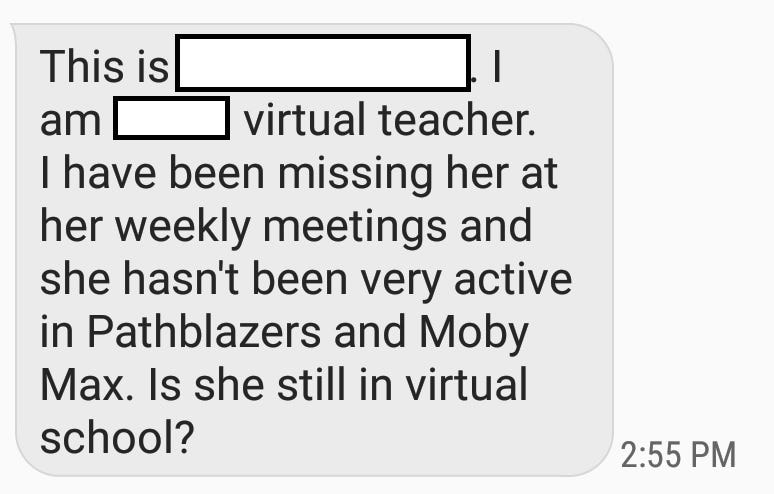
This email struck me as insane for several reasons. First, I’d interacted with the coordinating teacher several times via email and digital meetings, therefore I didn’t understand why she was sending a text message to my wife. Second, the last time I talked to her she said she had discontinued the Friday meetings, only to reference them here. Third, we’d been doing the Pathblazers assignments daily, but there had been no communication about Moby Max. Finally, the suggestion that my daughter wasn’t in virtual school seemed like a dramatic leap coming as it did without any prior feedback or questions.
My wife called her on the phone and the teacher did admit that my daughter had been doing the Pathblazers work, so at least that first part of the mystery got resolved. Alas, there were more problems on the horizon.
Communication restored
I sent the coordinating teacher an email assuring her that my daughter was still in virtual school and asking what Moby Max was. I also asked for a list of assignments that my daughter might have missed.
I quickly heard back, but instead of receiving a specific list of the coursework that was missing, the coordinating teacher sent me a link. “Everything is explained in my Google Classroom.”
Now, it might be the case that she has posted everything in her Google Classroom. However, in a moment like this when there is a clear communications problem, it is incumbent upon the teacher to make sure the parents she’s working with know exactly what is expected of her students. Remember, this was only a couple of weeks after a whole new program had been installed.
It’s unacceptable to notice that some work is lacking and then wait two weeks before jumping to the assumption that the student might no longer be in school. A much better approach is to send a polite email asking if there are any questions.
Moby Max
I finally figured out that my daughter was supposed to be doing Social Studies exercises on a program called Moby Max. I couldn’t find emails in either my inbox or that of my daughter detailing this change, or with information on how to log in. When I went to the login page, we found my daughter’s school email and password didn’t work.
I sent a message to the coordinating teacher. “What is the username and password that I have to use to get into Moby Max.”
She wrote back with a school code.
I tried the school code and we were still locked out, so I sent a screenshot and wrote, “Here is the Moby Max landing page. We need a username and password.”
Only then did she send the appropriate user name, password, and school code. By then I was grinding my teeth. As I said, I have work from home obligations, and the runaround of checking the web page, sending an email, waiting for a reply, etc., was not an efficient way to do things.
Poor communication
It should not have taken multiple emails to get into the program. The coordinating teacher should have sent out explicit instructions and anticipated obstacles the moment they changed over from the previous program.
The coordinating teacher’s job is to make sure all parents and teachers understand what is expected of them and to help them get on track if there are indications something is being overlooked. Adopting a rather haughty attitude and demonstrating a refusal to provide direct answers for simple questions is not an appropriate action to take.
Parents are trying to be patient, but the school district did have the summer to prepare for virtual learning and they have not performed well. If there is extra work right now, the teachers need to recognize the school district is at fault for the mistake they made in choosing their first program. They should be anticipating that there might be problems, not sending emails that say, “You haven’t done anything for two weeks, are you still in school?”
District testing
I had just started getting over my anger two days later, when I logged into my daughter’s email to turn in one of her writing assignments. While there, I noticed an email from her coordinating teacher.
“Make sure to take your district assessments in math and reading today. These are time-sensitive and must be done!”
The email was two days old!
I found it absolutely astonishing that on the same days that I was trying to extract information on how to log into Moby Max (which she was withholding like a Cold War spy under interrogation), she didn’t bother to mention that my daughter should be taking the district testing that day.
“By the way, your daughter needs to do her district testing today, don’t hesitate to contact me with any questions.” See how easy that was?
The announcement
I went back to her Google classroom only to find an angry announcement from the coordinating teacher that 11 of her students had not yet taken the district assessment. This should be an indication of the teacher’s incompetence. If so many of the students in the class didn’t know or couldn’t access the test, there is clearly a fault in communication that falls directly on the coordinating teacher.
Before any learning can take place, it is incumbent upon teachers to make sure there are clear lines of communication between themselves, the students, and the parents. This goes double in a brand new virtual learning program, and quadruple if a school district changes the program a few weeks after being launched. If work is missing, the teacher needs to first fortify the lines of communication.
One word responses to questions in emails, and failure to include parents in messages sent to students is completely unacceptable.
What else is my daughter missing?
At this point, I am completely uncertain about how to proceed. The district often sends rambling emails that address everything but critical information parents and students need. My approach has been to make sure my daughter is up to date on her math and reading, and cross my fingers on everything else.
The school district should be sending out weekly, personalized assessments indicating if the parents are on track, or if work is missing. They need to point to specific assignments and make regular inquiries to ensure there is no confusion.
The required school work should not be a secret, particularly when a parent asks for it.
Assume it’s communication
Whether you teach in a traditional setting or you are a virtual learning teacher, it’s important to make sure you always follow good communication practices.
Before you arrive at the assumption that a student is at fault for a missing assignment, it’s important to ensure you’ve done everything necessary to convey expectations.
Everyone is aware that the pandemic has created an overwhelming number of new obstacles. However, being mindful of good communication practices will always be of utmost importance regardless of whether you are teaching in a classroom or through a computer screen.


