
Communal Dining: Strategies to lengthen our tables

We were sitting at the bar in a city that wasn’t our own. The conversation next to us became heated, and I turned to take a peek. I smiled, and within a few minutes, we had company for dinner. Bob and Jen (not their real names) were also from out of town, and the heated words were just their way of communicating. They were in good spirits and interesting conversationalists. We moved our food, drink, and discussion to a table for what turned out to be a lively evening.
No dispute sharing a meal brings people closer together and fosters feelings of community. Communal eating increases social bonding and connectedness. The shared meal can transform the biological need to eat into a purposeful act aimed at building community. In fact, new food guidance in Canada encourages people to eat with others when possible.
Discussions about commensality, otherwise known as social eating, tend to focus on meals with families, friends, and business colleagues, but what about dining experiences beyond existing communities and are designed instead to promote new interactions?
COMMUNAL DINING’S ROOTS
Communal dining is not a new concept. There are many examples of communal dining throughout history. This practice existed in ancient Rome, where it was practiced as a religious tradition. In addition, images of medieval Europe conjured by the film industry portray trestle tables hosting large crowds sharing countless food dishes.
Traveling through time and place to Colonial America, when people were homesteading alone in the wilderness, the opportunity to dine with others at communal tables in pubs and inns was a welcome respite from isolation. Years later, during the French Revolution, large communal tables hosted a fixed-price menu with multiple courses, and in 18th century England, shared meals were gathering events held in public houses. The 19th century brought communal tables as an integral part of the NYC music and beer hall scene, and the emergence of experiential dining events in the 20th and 21st centuries bring us up to date.
COMMUNAL DINING TODAY
Our ancestors had an innate understanding that communal eating was an appropriate response to our #hunger-to-belong™. Today the concept of communal dining continues to be the focus of discussion. We think and debate about the use of communal tables in restaurants. We study and write about it in the context of public health and nutrition.
Our fascination with communal dining is even echoed in the art world. An experiment in large-group choreography, “City Feast” was a city-wide dinner party organized by choreographer and dancer Helen Goodwin and staged in 1970. In 2014, an artistic collaboration entitled “CREATE: The Community Meal” was hosted in St. Paul, Minnesota, and entailed a live event in which 2,000 guests shared food stories over a table that measured ½ mile long.
Food activist, celebrity chef, and founder of World Central Kitchen, Chef Jose Andres, uses communal dining and the image of “building longer tables” when advocating and providing meals to people affected by global disasters. His message, “Food is the fastest way to rebuild our sense of community,” is one that applies to all community-building efforts, from rebuilding after global disasters to transforming one individual’s social isolation into connectedness.
STRATEGIES TO LENGTHEN OUR TABLE
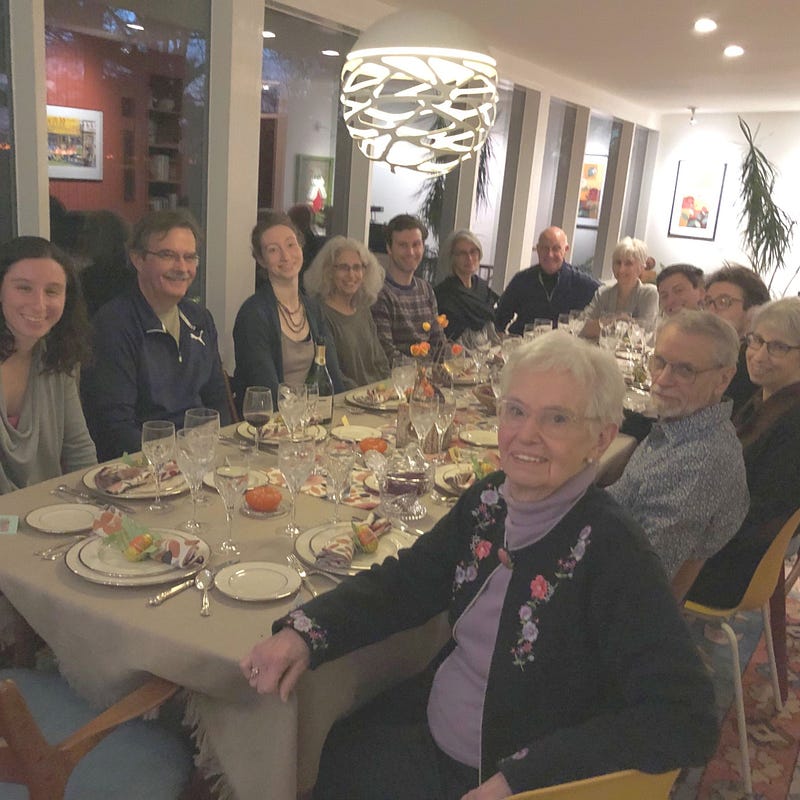
There are a number of different ways to lengthen a table to make room for a stranger:
1. Sit at a communal table: Communal tables are typically long and prominent to encourage sitting in close proximity to someone not known to you. These tables can be found in restaurants, fast-food establishments, coffee houses, and public outdoor areas. People can sit and eat alone together, sit and visit with their dining neighbors, or sit and enjoy an experiential dining event.
2. Make a reservation at an Airbnb for meals: Here, hosts sign up on a website or app to sponsor a dinner at their home. In this manner, travelers can experience local fare and company. Typically, the guests are people unknown to both the host and you.
3. Embrace accidental meet-ups: Inadvertent meet-ups in restaurants or bars, such as the one I had with my partner and our new ‘friends,’ can lead to, at the very least, a meaningful connection and a shared meal.
4. Invite a friend of a friend: Hosting a ‘stranger’ dinner is a purposeful way to lengthen your table. One strategy is to ask a number of friends to invite 1–2 of their own friends that you do not know.
5. Welcome a stranger to your holiday table: The Passover Seder begins with the words, “Let all who are hungry come and eat.” This example is from Judaism. However, many other cultures and religions have a parallel tenet. By inviting a stranger to a holiday table, we give people a place to belong, give the holiday more significance and open ourselves up to new relationships. In fact, there’s no need for a holiday. Choose any day to invite a neighbor you have not had time to befriend or invite someone from your local senior center who does not have family in the area — the opportunities are endless.
6. Accept an unplanned invitation: Sometimes, life’s twists and turns result in an invitation that you did not intend to offer — or did not expect to receive. A slip of a thumb in today’s world of text messages and emails can have unusual and heartwarming outcomes. Have you ever transposed a number when making a call or sending a text? Or sent an email to someone aside from your intended audience? Wanda Dench, a 62-year old grandmother, and Jamal Hinton, a 20-year old ‘stranger,’ have celebrated multiple Thanksgiving together because of a slip of her thumb.
CONCLUSION
Social eating clearly plays a critical role in satisfying our hunger-to-belong. Dining with a stranger or two may not be appropriate for all occasions. Still, when it is, it lengthens your table, fosters community, and expands the breadth of social interactions, benefitting everyone involved. The choice is ours to make: Do I eat alone, with my family and/or friends — or do I put another leaf on the table.


