
Coming Soon — My Debut Book “How to Become a Genius”
“Everyone is a genius…” —Albert Einstein
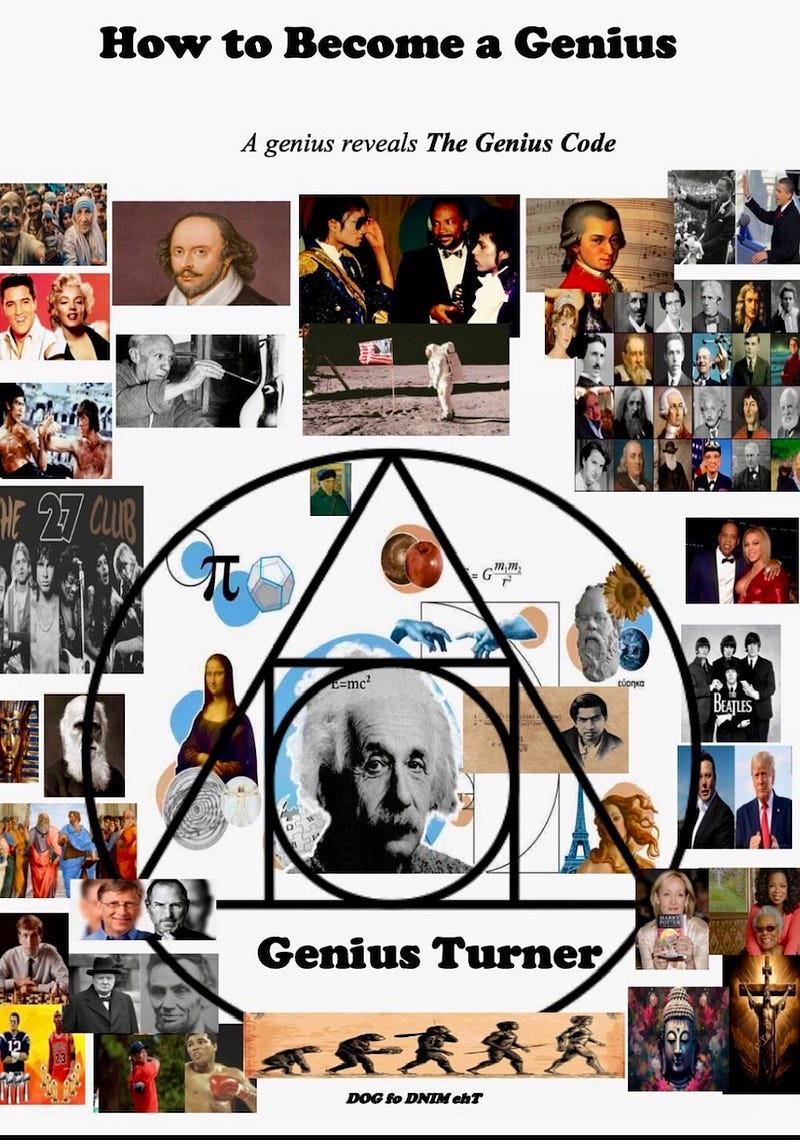
“How does a Black child born to a 14-year-old child and an illiterate father write this?” Dr. Cornel West once asked me, holding my Heaven on Earth Code in his hands… …I slumped in the chair. Coltrane’s “A Love Supreme” played softly in Dr. West’s regal Union Theological Seminary office.
Seconds later I answered, by quoting Schopenhauer.
“Talent hits a target no one else can hit; Genius hits a target no one else can see.”
Bingo!
Dr. West roared with laughter. “Well, young brotha, your first book should be about ‘how,’ not ‘what’ you see.” He winked. I never forgot that…
I. True Meaning of “Genius”
“The beginning of wisdom,” said Socrates, “is the definition of words.”
Armed with the Socratic method, it becomes clear that over time we’ve distorted the word genius. Perhaps the ancient Romans had it right all along…
…According to the Ancients, genius simply means an “attendant spirit present from one’s birth, innate ability or inclination.”
(*Note: the prefix pre- makes its appearance in present, i.e., pre + sent to one’s birth.)
The Romans believed each person is born with a genius. In the Vedic tradition, they call this ancient wisdom one’s dharma (धर्म).
Perhaps the above explains what Thomas Jefferson meant by “all men [and women] are created equal.” In short, to firmly grasp what’s meant by “genius” boils down to knowing this:
From unique DNA sequences to unique upbringing, every person is unique. Science agrees! This means, it’s impossible for the Universe to ever produce another YOU. Hence the word “genius” signifies having the potential to express such once-in-a-lifetime individuality.
Bingo!
II. Genius Loci
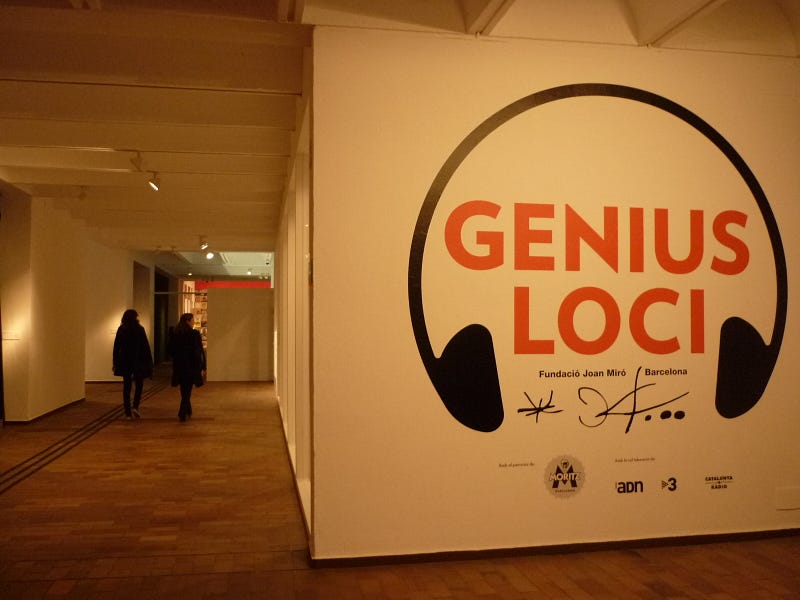
Genius Loci — the “guardian spirit” of a place or the special atmosphere of a particular place.
On any respectable greatest-rapper-of-all-time list, Jay-Z and Biggie crack the top 5, if not the top 2.
Shawn Carter and Christopher Wallace went to high school together. (Ahem, rap icon Busta Rhymes was also their classmate.)
Hate it or love it, Paris Hilton and Kim Kardashian pioneered the era of “being famous for being famous” influencers.
Aha! Just as Carter and Wallace swapped bars in the lunch cafeteria, Hilton and Kardashian grew up in the same neighborhood. In fact, they even rode the school bus together, along with Nicole Richie and Rashida Jones.
My point?
The unique environment (milieu, genius loci) you grew up in ties into your genius. Come to think of it, what today’s biology calls “genotype” and “phenotype,” the ancients preferred genius and genius loci.
(*Note: the words genes and genius share the same genesis — the prefix “gen-.”
My mama once told me something must’ve been in 3rd Ward’s water during the 80s & 90s…
…After all, the artist/writer Rinny Perkins and entertainer Beyoncé Knowles grew up down the street from me.
J. Elle, the talented writer, also grew up in our neighborhood.
Perhaps Dr. Mathew Knowles proved why there’s more to knowing than just knowing when he named his group “Destiny’s Child.” …In short, because everything happens for a reason, if you pay special attention to the unique genius loci stamped on the area of your upbringing, you’ll glimpse a key to unlocking your genius.
After all, God hides in the details…
III. The Takeaway
If you want them to be more intelligent, read them more fairy tales.”
— Albert Einstein
After years of studying myths and religions, Joseph Campbell arrived at a groundbreaking insight: “All religions are true but none are literal.”
Because myths and religions deal with non-physical things (metaphysical), most scholars suspect holy books are primarily code books.
Nietzsche preferred to call books on metaphysics and religion a giant “army of metaphors, metonyms, anthropomorphisms.”
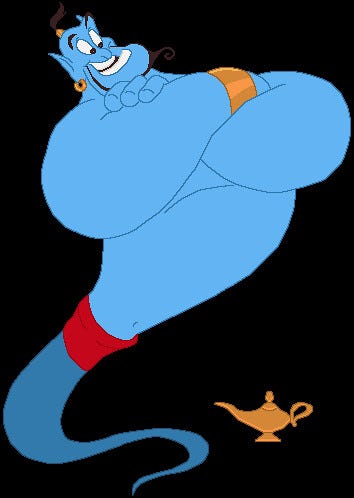
As for which tale best serves as special goggles to help us better see what the Ancients meant by “tutelary spirit within,” or genius, perhaps the incredible tale of Aladdin fits the bill…
…Aladdin and the Wonderful Lamp is one of history’s greatest cases of coding metaphysical truths in physical characters. After all, the very instant a sorcerer seeks a special lamp — one of life’s great secrets is pinpointed.
This special lamp hides in the Cave of Wonders. The cave’s guardian says only “the diamond in the rough” can enter.
Eventually the winner of the Cave Sweepstakes is some young, street urchin named Aladdin. Once inside the cave, Aladdin rubs the lamp.
Out pops the genie!
The genie then grants Aladdin three wishes.
The End.
Each above emboldened sign signifies a metaphysical truth.
(*Note: to “signify” is to represent or present again. The signifier merely uses a sign to represent the original thing, which is thereby signified — or pointed to.)
As for why authors of myths and legends prefer figurative language, when the literal will seemingly do, the answer is simple:
Figurative language gives a “figure” to an otherwise ghost.
Bingo!
To be metaphysical (meta- + physical) is to be figureless, so far as it exists beyond the physical world perceptible to our five senses…
…And so, because human potential is abstract (invisible), Aladdin’s author(s) had to remove the meta- from the -physical. Otherwise, we readers would’ve struggled to “see” the truth, if you see what I mean.
Let’s briefly translate Aladdin — one of history’s most famous allegories.
- Our mind = the “lamp”
- Our genius = the “genie”
- Our dreams = the “wishes”
In short, How to Become a Genius boils down to the following insight: Geni(e)us = there’s a latent GENIUS within US!
And it’s up to you, dear Aladdin, to show enough faith to look within and trust your own powers. After all, that GENIE within US always whispers:
“Your wish is my command.”


