
LODESTAR GAZETTE | FICTION
Coming Home
The long way home
Please stop here for at least 30 seconds so Medium sees it’s been read. If you enjoy it, please consider sharing a little love with a clap or two, and I’d love to hear your thoughts on my work!
“We choose to go to the moon. We choose to go to the moon in this decade and do the other things, not because they are easy, but because they are hard because that goal will serve to organize and measure the best of our energies and skills, because that challenge is one that we are willing to accept, one we are unwilling to postpone, and one which we intend to win, and the others, too.”
President John F. Kennedy told the nation back in September 1962. He was a bold man with big ambitions. He had a vision. Back then, nobody would have dared dream so big. He did, though, want to put us on the Moon. Why did he want to do this? Because he wanted to see if it could be done to push the envelope of human ingenuity and adventure.
Though he never saw it, he made it happen. Kennedy set about a race that enthralled the world and saw the best and brightest create the technology to make lunar exploration a reality safely. You see, that’s the thing with human curiosity. Sometimes, we have to do something just to see why.
It’s like that sign warning us ‘Do Not Push’ or ‘Wet Paint’ — sometimes we have to reach out and test it, we have to know. And just because we could, we went back to that little grey rock spinning around our home five more times. We kicked some rocks, scooped some dust, and ran some tests to learn more just because we were curious.
That curiosity spurred us on to even greater heights, even if the priorities shifted. NASA became enthralled by the planet that has spawned so many stories—that one red planet that we so often imagine being home to other intelligent life—Mars. Throughout the 21st Century, many missions were launched to explore the dusty red surface in search of life, or at the very least, the means to sustain life.
The probes and rovers sent over the years succeeded. Intrepid little robots, controlled from afar and anthropomorphised by their controllers, found evidence of water below the surface. The atmosphere was less than ideal, but that could have been solved. And so plans were formulated — how soon could we put people on Mars?
It took far longer than the most pessimistic strategists imagined. The journey was long and would put a strain on the human body. We weren’t meant to spend that long flying through space. Space agencies all raced to be the first to make the arduous journey. NASA started out using what they already knew — the Moon was achievable. It was easy, safe almost. Been there, done that.
Publicly, NASA was conducting further research into the origins of our own planet. Privately, they set about establishing a base from which further missions could be launched. The plan was to run trials, send rockets to Mars and study the data gathered from the journey. Within the decade, the hope was to send astronauts to the red planet. Things changed. Before testing had a chance to yield any meaningful data, something happened. An armada of rockets was launched to the Moon. Each one carried additional crew, cargo, resources and the components designed for the spacecraft intended to convey man to Mars.
I’d been on the Moon for three long years, spurred on by the same curiosity that spurred on Kennedy and all the astronauts before me. I’d not seen my family or friends for even longer. But I got the chance to visit the Moon and walk about its surface.
Something so few people have had a chance to experience so much for the dreams of space tourism. My role was to take part in the exercises that would replicate the conditions for the journey to Mars. I was expecting to have returned to Earth long before the first long-distance ship arrived.
Whispered conversations spread throughout the colony, and high-security messages passed to the higher ranks only increased the gossip. The situation on Earth had worsened. Between pandemics, viral warfare, and climate change, humanity was tearing its home apart. Sending manned missions to Mars was no longer a curiosity; it became imperative.
The base, once placid, tranquil almost, was a hive of activity. The vast construction hangars were alive, with the best and brightest minds working to assemble three vast vessels. The rockets and shuttles of the past were familiar.
The Saturn Vs were something to behold — enormous constructions reaching for the heavens. And the power they generated to break gravity and carry on ever higher into the cold embrace of space was unfathomable. The shuttles were something else. Two sleek white reusable boosters to get the whole thing off the ground, a cumbersome orange-brown fuel tank to keep the shuttle supplied and the shuttle itself.
They looked like aircraft to an extent and were the first method of truly reusable space travel. But these new vessels are like nothing else. Sleek lines and shining chrome, they wouldn’t look out of place in a sci-fi film. Having received my orders, watching them being assembled filled me with equal parts excitement and fear.
They had the gleaming vessels completed in just over a month. It was incredible to think something so technologically and mechanically advanced could be constructed so quickly. It left me with a tinge of apprehension. It would only take one person to overlook one little screw or rivet, the tiniest component, to cause the complete destruction of the craft in the vacuum of space.
But time was not on our side. The crew prepared for an early start with final health checks and a one-night stay in an isolated suite. Sparse though they were, they ensured limited exposure to anything prior to launch.
Everything occurred in a blur of frenetic activity as final preparations were made and the launch procedure began. Strapped into uncomfortable seats in only slightly more comfortable spacesuits, the doors were locked and sealed. The next time they opened, they would reveal the red dust of the Martian surface.
Our time preoccupied with pre-launch checks, ensuring engines, fuel lines, and systems were all fully primed and showing no indications of faults, the countdown began. The cramped cabin aside, the spacecraft felt decidedly different to the rockets that had conveyed me to the Moon. For one thing, they carried forty men and women each.
Though there was no escaping the vibrations of the engines powering up, they felt far less violent than those on a rocket. It was a strange feeling, looking out the panoramic glass frontage at the empty blackness of space. On the monitors, the Moon grew smaller, and the green and blue view of Earth receded rapidly beyond the periphery.
Thirty years ago, back when a global pandemic swept the planet in 2020, the journey would have taken the better part of seven months. Between the pandemic and other global issues, accelerated technological advancements cut the journey to three months. It is an impressive feat, no doubt, but it would still be a long journey, plenty long enough for us to speculate over what might be waiting for us on Mars.
The journey could have been more fruitful to the point of becoming tedious. The landing could have been more straightforward. None of our data had ever indicated that Mars suffered atmospheric storms. Electrical strikes knocked out navigation systems.
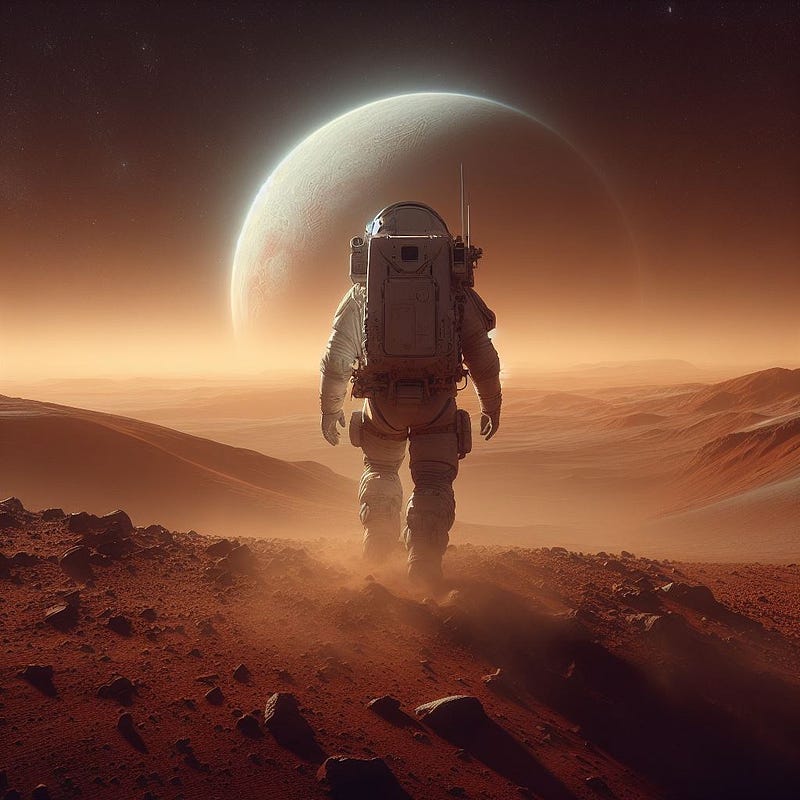
With zero visibility all three vessels got separated, and atmospheric interference meant the comms systems were useless. The landing was rough, and the rugged landscape damaged the ship. I still had a job to do. Most of the crew stayed behind aboard the vessel. Scientists checked and rechecked their equipment for damage. Pilots and half of the engineers set about attempting to repair the ships and attempt to make contact with the other ships. A small expeditionary team, including myself, struck out into the unending vista of red rock and dust in search of a place to make home.
I felt a deep sense of unease. The surface was arid and rocky. Dust everywhere. How the planet would sustain life, I could not fathom. But that was not my primary concern. The scientists deemed this to be the best chance for humanity, ran all the data, and analysed all the samples.
They must know what they were talking about. Our small party stepped out from the weak shadow of the damaged craft, testing the reduced gravity. It was a strange sensation.
It was stronger and more present than on the Moon but not nearly as strong as on Earth. It would take some adjusting to after so long on the Moon. Syncing our devices to the tracking beacon of the ship, we all headed out in different directions, aiming to cover more ground. Some were looking for the ideal place to start a settlement, and others sought resources. I fell into the latter bracket. I had a hunch that if there was any water to be found, it wouldn’t be on the surface.
An hour-long hike brought me to a vast cliff face stretching up into the swirling maelstrom of dust. A large cavern mouth opened up at its base. No light seemed to reach more than ten feet inside. The large LED lamps mounted to my helmet helped push back the shadows. The roaring of the wind outside dulled to a low howl, getting quieter the deeper I walked.
More than once, I paused, certain I had heard a noise. A chittering, scrabbling sound just on the edge of my hearing. It made my blood run cold. Every time I looked at where the noises seemed to come from, I found nothing. As I descended, the frigid temperatures of the surface slowly rose.
Soon, I could swear the sound of dripping water reached me. The narrow tunnels opened into a vast cavern with an enormous lake of water. It was a sludgy brown, thick and unappealing. As its surface rippled, it appeared almost alive, such was its thickness. After testing it with my scanner, my concerns were confirmed. Completely unsuitable. Its toxicity was too high to salvage for any human use and even showed alarming levels of radioactivity.
This wasn’t good. I had expected to find one of two things. Nothing at all, or by some miracle, a source of water fresh enough for us to work with. What I found was the worst possible outcome. It made no sense. While we couldn’t claim to know the full catalogue of minerals and compounds here on Mars, I was pretty sure there was nothing in what we’ve found that could cause the levels of toxicity and radiation I was seeing.
A little further around the lake was another tunnel stretching further down beneath the Martian surface. Something caught my eye as I rounded the corner that made my blood run cold. Bones. From what, I had no idea. But it was very clearly a pile of bones. My hand rested on the butt of the gun at my hip. I had no idea whether it would work here on Mars. And even if it did, who knew what I might be using it against?
I moved on hastily, not wanting to look too closely at the remains. Every little noise now sent me into a panic. Was I being watched? Followed? None of this was expected; it didn’t fit with the reports we were given. I tripped and stumbled away from the macabre mound of bones and deeper into the tunnel.
The further I went, the less natural the tunnel seemed to be. It looked like it had been carved out of the rock. Further in, the floor was littered with unusual-looking tools, containers and chemical barrels. All were very much manufactured. Something really wasn’t right.
At the end of the tunnel was a series of destroyed doors and airlocks. The doors seemed to be trying to function, stuttering shut and open amid a grinding of damaged motors and the occasional shower of sparks. The tunnel opened out into a small square room. It contained rows of desks covered in thick red dust.
Each was set up with a range of equipment. It looked like some kind of computer hardware. Nothing like what was seen on Earth. This looked far more advanced. A low humming sound filled the room. They were still running. One machine in the far corner of the room emitted a fuzzy glow. Curiosity got the better of me. I strode over, standing in front of the weathered desk.
A small, thin, disc-shaped object was the source of the glow. Swiping at it with a gloved hand cleared the dust from its surface, the hazy image instantly sharpening. A glowing holographic representation of a globe. Of the Earth. It spun lazily in the dusty air.
A series of figures fluctuated in a box floating above the planetary depiction. They highlighted the population, which has been decreasing for decades. They also showed the remaining amount of minerals and resources on the planet. All dwindling far faster than most people had any idea about.
This was worrying. Who or what was observing Earth? Possibly more troubling than this was why they were watching. Noise from a passage behind drew my full attention. Drawing my weapon, I cautiously headed down the sterile metal tunnel.
Peering through the small windows in the doors, I could see what seemed like living quarters running down its length. Halfway down the passage, an open door spilt a pale light.
Inside, a small desk and lamp sat against the back wall. It was littered with documents and scraps of paper. All of them were typed in English. The date on them was bizarre, entirely alien to me. It outlined the destruction of Mars. War. Famine. Plague. Overpopulation. Pollution. Dwindling resources. Atmospheric change.
I shivered. It read like the recent history of Earth. If I didn’t know what I was reading, I’d have easily believed it was the rationale put together to leave Earth. A planet-wide population that had grown, evolved and expanded physiologically and technologically, over time, their needs drove them to strip the planet of all viable resources and poison it with its waste.
A once beautiful place was now barren and dry. Wealth and greed drove those with the means to horde what they could. Friction became tension. The tension led to scuffles. Scuffles became a global war. Factions and nations turned against one another. One group launched attacks against another to take what they had for their own. The parallels with what was happening on Earth were horrifying.
A plan was set in motion and outlined in clinical detail in the document. To relocate and repopulate their civilisation elsewhere, on a nearby planet. Their plight mirrored our own perfectly. A scrawled note on the final page caught my eye.
My hope rapidly turned to dread as I read it. ‘CAELUM ORBIS: OUR LAST HOPE’. The people of Mars had fled to Earth. We had fled to Earth. The knowledge had somehow been lost, and now we vainly hoped to migrate back to where we started. Humanity had not evolved on Earth. He had come from here, Mars, and colonised Earth as our own. And now it seemed we were set to repeat the mistakes of our past.
A shuffling noise at the door, along with a wheezing, strangled breathing heralded the unseen arrival of a humanoid figure, shadowed in the gloom. His form hunched, deformed, withered. With a rasping voice, he uttered a short phrase.
“You should not have returned here. Humanity has failed. None shall survive.” A sharp pain exploded through my skull before everything went black.
| Steven Smith © 2024. All rights reserved. |


