avatarDhyanopaedia

Summary

Comets are ancient celestial bodies composed of ice, rock, and organic compounds, categorized by their orbital periods into long-period and short-period types, with notable examples including the Siding Spring and Halley's Comets, and they possess distinct features such as nuclei, comas, and tails.

Abstract

Comets are fascinating celestial objects, essentially icy rock formations containing gases and complex organic materials. They are remnants from the early stages of the Solar System's formation and are divided into two main categories based on their orbital periods: Long-Period Comets, which take more than 200 years to orbit the Sun and originate from the Oort Cloud, and Short-Period Comets, which complete their orbits in less than 200 years and come from the Kuiper Belt. The Siding Spring Comet, with its 740,000-year orbit, and the famous Halley's Comet, which returns every 75 years, are prime examples of these categories, respectively. Each comet has a nucleus, a surrounding cloud of dust called the coma, and two distinct tails: the white dust tail and the ion tail made of ionized particles. These features are shaped by the Sun's radiation and solar wind, creating a spectacular display in the night sky.

Opinions

  • Comets are considered leftovers from the formation of the Solar System, suggesting they are ancient and hold valuable information about the system's history.
  • The discovery of comets is attributed to astronomer Gerard Kuiper, indicating a significant milestone in our understanding of these celestial bodies.
  • The Oort Cloud and the Kuiper Belt are believed to be the origins of long-period and short-period comets, respectively, highlighting the accepted theories about cometary origins in the scientific community.
  • The description of comets' features, such as the nucleus, coma, and tails, reflects the current scientific consensus on comet composition and behavior as they interact with solar radiation and the solar wind.
  • The mention of specific comets like Siding Spring and Halley's Comet, along with their orbital periods, underscores the diversity and intrigue of comets as subjects of astronomical study.

Comets: All about them

Comets are icy balls of frozen rock, gases and other complex organic compounds. They were first discovered by astronomer Gerard Kuiper in 1951. They are believed to be the leftovers of the formation of the Solar System. They were first theorized as icy bodies that exist beyond Neptune.

Types of Comets 1) Long-Period Comets — Long-Period Comets are comets that have an orbital period of more than 200 years. Long-Period comets are believed to originate from the outermost division of the Solar System — the Oort Cloud. An example is the Siding Spring Comet, which made a close flyby of Mars in 2014. It has an orbital period of around 740,000 years!

Mars and the Siding Spring Comet (Source: NASA)

2) Short-Period Comets — Short-Period Comets are comets that have an orbital period of less than 200 years. Short-Period comets are believed to originate from the Kuiper Belt — A vast belt of icy comets and asteroids. An example is Halley’s Comet, which is the most famous comet. It has an orbital period of 75 years.
Halley’s Comet (Source: ESO.org)

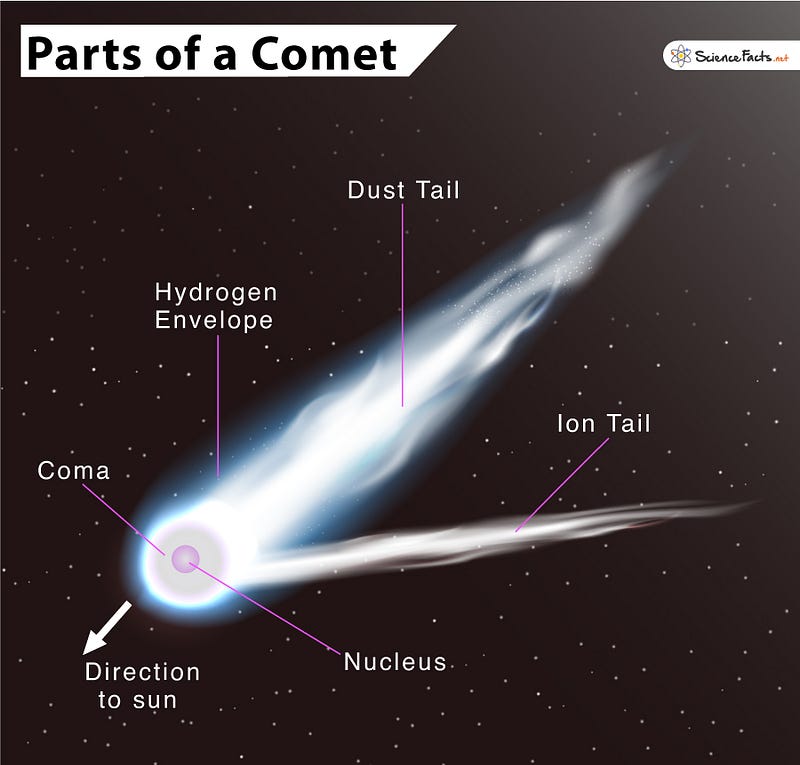
Parts of a Comet

(Source: Sciencefacts.net)

1)The Nucleus — The nucleus of a comet is the frozen ball of gases, rock and organic compounds. The nucleus is usually a few kilometres in diameter.

2)The Coma — The coma is a cloud of dust particles that surrounds the nucleus of the comet.

3)The Dust Tail — The Dust tail is one of the 2 tails of the comet. It is made up of the material from the comet’s nucleus. The tail is always opposite to the comet’s direction to the Sun. The dust tail of a comet is always white in colour. This tail is the result of the material of the comet being eroded by the Sun’s radiation.

4)The Ion Tail — The Ion Tail is a tail of ionized particles originating from the coma of the comet. It is the result of ultraviolet radiation tearing and ripping electrons off atoms present in the comet’s coma.

Other examples of Comets
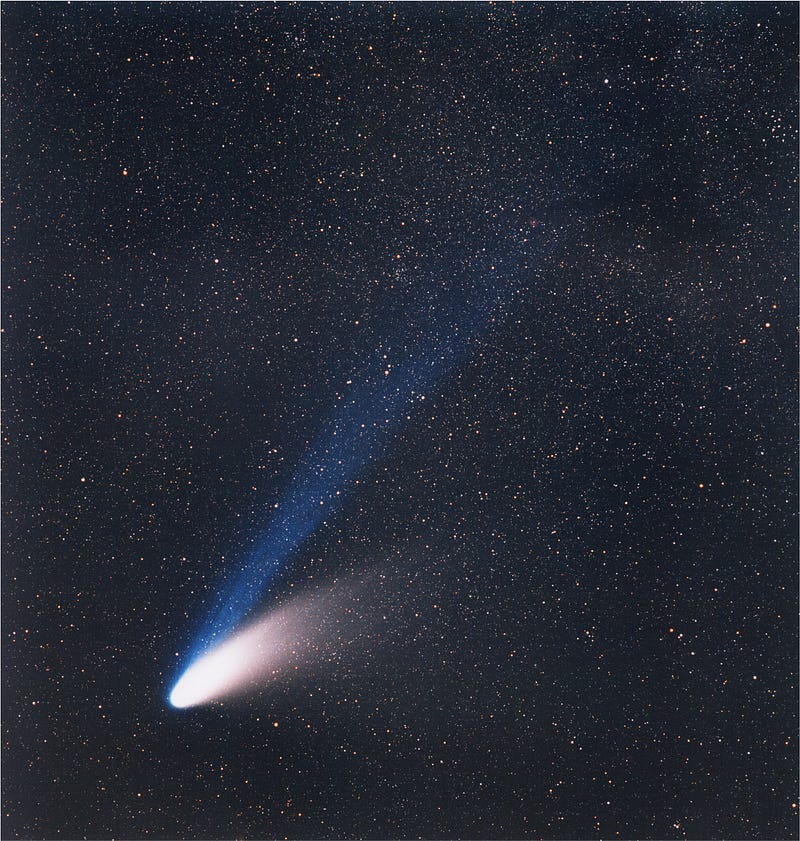
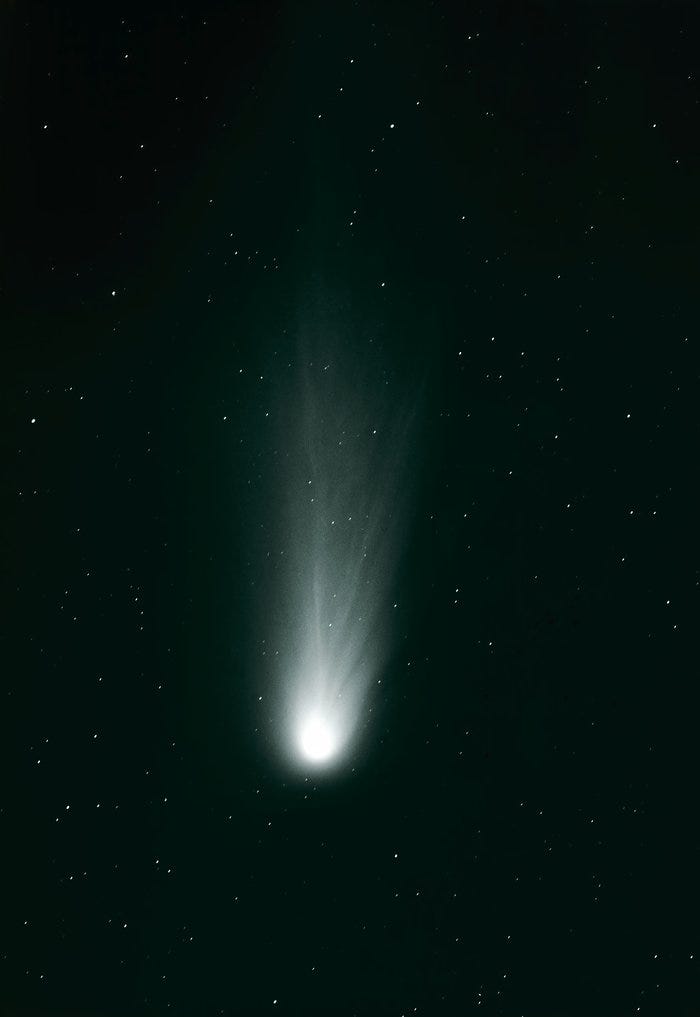
Comet Hale-Bopp (Source: ESO.org)
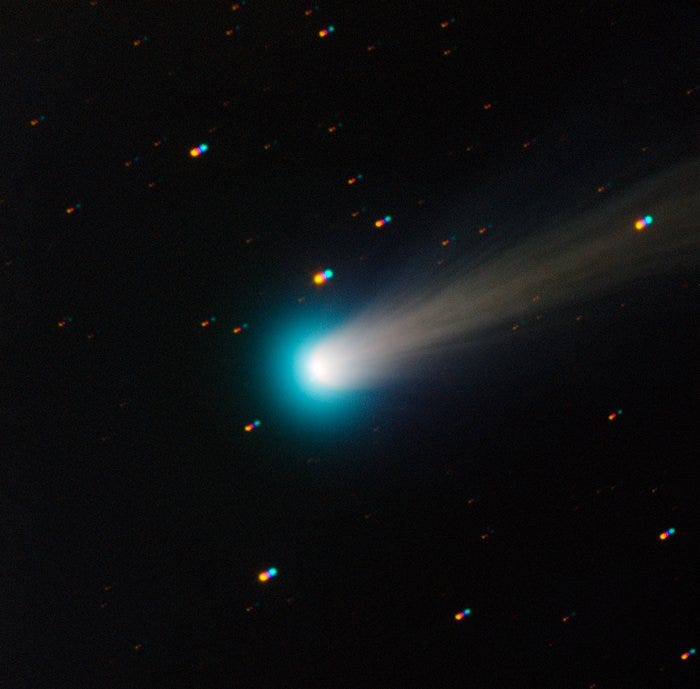
Comet ISON (Source: ESO.org)
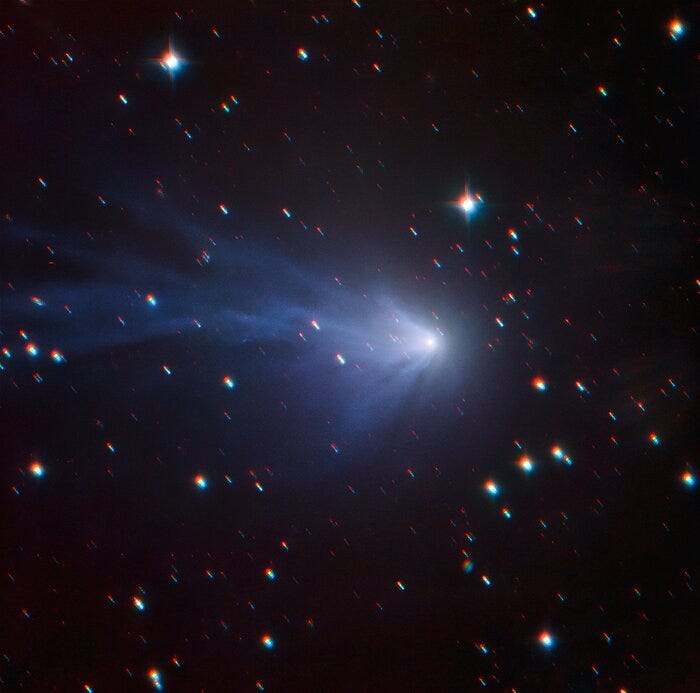
Comet PANSTARRS (Source: ESO.org)
Space
Astronomy
Science
Recommended from ReadMedium