
Colorism: The 800 Pound Racist Gorilla in the Room That Black People Are Guilty of Keeping Alive
A challenge to Black America to look in the mirror and be truthful with self- examination
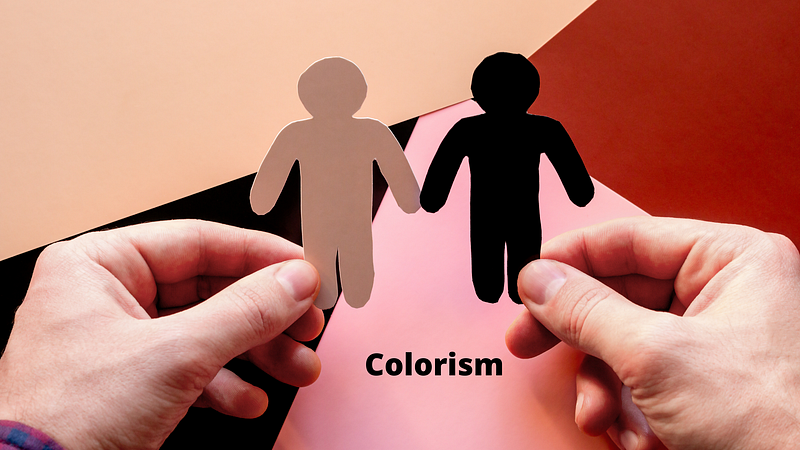
There is a racism problem in America created by Black people against Black people that is just as insidious, hurtful, and wrong as what White people practice.
There is no question that systemic racism exists against Blacks in the U.S. and largely it is a system of oppression, disrespect, exclusion, and denial of human and civil rights based on the irrational mindset that White people are superior and better than Blacks and other people of color.
Black people and kindred people of color are rightfully justified to be frustrated, angry, and impatient given the current state of affairs that exist between the so-called “Haves and Have Not’s” with Whites being the former and Blacks the latter.
However, there is an undertow of racism that goes unnoticed and often not talked about as part of the national conversation to eradicate racism and its scourge of stripping away esteem, dignity, and perpetuating denial of equality.
The undertow of racism has a name. It’s called colorism. The sad fact about this term is that it defines how Black people discriminate against their own. It is an ugly but real debased treatment based upon the actions of lighter-skinned Black people who discriminate against darker-skinned Black people.
There are no organized protests and marching regarding this issue. Yet, it exists and needs to be addressed as part of the overall push to ultimately rid America of racism and its vestiges.
Colorism is the 800-pound gorilla in the room that doesn’t get talked about but it’s still there and it’s not going away anytime soon unless it is dealt with. It is just as harmful as racism perpetrated by Whites on Blacks.
What is Colorism?
Colorism is discrimination based on skin color and is a form of prejudice in which people who are usually members of the same race are treated differently based on the social implications which come with the cultural meanings attached to skin color.
People often make the mistake of branding racism as only being committed against someone different and outside the race of another. On the other hand, colorism’s distinguishing identity occurs between the same races but members therein are disdained, looked down, and treated differently because of skin tone.
Colorism’s premise is steeped in the belief that someone with any degree of lighter complexion is considered more beautiful or valuable than someone with dark skin. As ridiculous as this concept is it has existed and persists to a great extent within the Black culture.
According to empirical data, discrimination based on skin color has a profound effect on how people are treated in criminal justice, business, the economy, housing, health care, media, and politics in the United States.
Author Alice Walker, in her book, In Search of our Mothers’ Gardens, popularized colorism as a term and rekindled discussions about it globally. The book points out how light-skin preference historically has been a common practice in the Black community for generation, but is appropriately marked as an evil that must be stopped for African Americans to progress as a people.
Colorism’s Ultimate Goal Is to Pass
The ultimate goal of colorism is “passing.” That is to say, the closer a Black person looks and acts like White people and becomes assimilated and accepted in society as While folks the better. Therefore, the goal is to be as white as possible in all that you are despite being Black.
Passing creates motivation to remove as much trace of Black in one’s looks as possible. If you’re dark you should try and lighten your skin by any means necessary.
Stay out of the sun, indulge in lightening your skin with caustic chemicals and do whatever it takes to get as close to being white as possible. Passing is the goal and those are damned that get in the way.
Where Does Colorism Come From?
In the US, colorism was born out of slavery, where lighter-skinned enslaved black women and their children — often the result of rape by slave masters — were given preferential treatment. This lingered through centuries and, to this day, lighter skin is associated with wealth and power, giving privileges to those who have it.
Colorism has been perpetuated in America since its inception. One of the most widely held theories of how colorism was instituted and promoted, although disputed as a myth and untrue, is the story of William (Willie) Lynch, who is credited with developing and preaching across America a doctrine that would keep Blacks from becoming a major threat to white people through means of creating a cultural environment of differences between them that played on the psychic.
Lynch, according to the story, came to America in 1712 from the British West Indies after being summoned by slave owners of the Virginia Colony to advise them on problems they were experiencing in managing their slaves.
He was purportedly a slave owner himself who had devised a system to control Blacks simply by getting them to fight among themselves and keep each other from advancing or growing in strength by fomenting hatred and discord between them based on color.
The lighter-skinned should be encouraged to think more highly of themselves and privileged than the darker-skinned.
Indeed they would be given preference. They would be allowed to work for the master inside the home, be treated better, and even given more freedom.
This would create resentment from the darker-skinned blacks who had to toil in the fields and suffer greater punishment.
Myth or reality, the concept took root within colonial and slavery times and it persists. Sadly, Blacks treat each other differently within their race based on color.
Colorism is also steeped in America’s fiber, based upon the concept of what the standard of beauty is. Eurocentric standards of beauty have for centuries dominated what beauty and acceptance should look like.
The message of “White is right” has been subtly and boldly proclaimed through media, products, body physics, and an educational system.
Eurocentric standards of beauty of white women as the model of perfection, grace, and acceptance has been and still is a global disease of sorts. Unless colorism is addressed and dealt with appropriately global standards of acceptance, beauty, and tolerance will remain the same and that gets us nowhere.
Is Colorism Different Than Racism?
There is a subtle difference between colorism and racism. Colorism is the practice where people with lighter skin are given preference over people with dark skins. This practice is a sub-category of racism.
By its’ practice, colorism validates that seeking to meet standards of acceptance set by white people in every category that makes a difference in the quality of life of an individual is a good thing. It permeates every institution including employment, entertainment, health care, food, families, sports, etc.
Racism is a form of different and distinct treatment and discrimination based upon the race of a person no matter whether they are light or dark. It’s the fact that they belong to or are regarded as part of a different race or ethnic group that sets them apart for disparate treatment.
Racism is a systemic problem that is baked into American society through its institutions and gives privileges and higher status to Whites regardless of their abilities and qualifications than Blacks, Latino, Asians, and Native Americans.
The institution of racism was created in America within its Constitution wherein Native Americans were not included as part of the U.S. at the time and Blacks were not even regarded as human. They were property and given a status of only being three-fifths of a person.
This was the beginning of institutionalizing racism. It hasn’t changed much since then despite changes in the law. This is a testament to the saying that you cannot legislate morality. Treating people right and providing equality and inclusiveness has to come from a place of the heart.
America has suffered from the heart disease of racism for centuries and now it has hardening of its arteries that has led to a heart attack of racial unrest and a pandemic of discord, violence, and further division within our nation.
The Consequences of Colorism
History is replete with the consequences of colorism. Even in current times, Blacks still cling to the harmful and ignorant notion that the hue of their skin makes a difference. It is so embedded in the Black culture that it appears to have been passed down from generation to generation as if it’s become a genetic gnome.
That is a scary thought but it has some degree of legitimacy. Decades and generations of cliques and sayings still exist and proliferate within the Black culture:
“If you’re White, you are alright; If you’re yellow you are mellow; if you are brown stick around, but if you’re Black get back.” The clear message is one that is often bantered as a joke, but pointedly making the argument that people with Black skin should be excluded. This is offensive, disrespectful, and nonsensical.
Black women’s attractiveness is still referred to with a tone that the lighter they are the more beautiful and acceptable they are and even preferred for sexual preference or perhaps even marriage.
Terms like “High Yellow”, Redbone, and Caramel are used to describe the desirability of Black women with lighter skin. Among Black men these expressions have been used when they talk among themselves about preferences of becoming involved with a Black woman.
It is as if the lighter skin magically provides them with more status and envy to be seen with a Black woman that more closely resembles a White woman.
Often and ignorantly, in this writer’s opinion, Black men get caught up in the notion that White women are a better choice simply because of their white skin. Nothing could be further from the truth. Women are women and should be treated as God’s gift to men in a loving, acceptable, and respectful way no matter what color their skin.
Similarly, Black women who also fall into the trap of having a preference for lighter-skinned men should beware of colorism. Black men as well as all men are God’s gift to women to be loved, accepted, and respected no matter what color their skin.
I recall growing up as a dark-skinned Black boy and not being as accepted as my lighter-skinned counterparts. It did not matter that I was smarter, more studious than most, and was taught and practiced the utmost respect for Black females by the raising of a single Black mother.
I can still remember the sting of the saying. “The blacker the berry the sweeter the juice, but you’re so black there ain’t no use.” Thank God, I didn’t internalize it to make me bitter or discouraged. Rather it fueled me to excel.
The Paper Bag Test for Acceptance
Colorism has played real tricks on the Black psychic. So much so that within the culture, tests were devised to determine if one would be acceptable within certain groups of Blacks.
One such test was known as the “paper bag test.” The test was allegedly used as a way to determine whether or not an individual could have certain privileges; only those with a skin color that matched or was lighter than a brown paper bag were allowed admission or membership privileges.
This ritual is reported to have been used by Black sororities, fraternities, and even churches.
The currency of colorism
Colorism has an impact on how much earnings can be made depending on the lighter or darker skin of a Black person.
According to a recent article from the Journal of Economics light-skinned Black men earn more than dark-skinned Black men.
The Doll Test: A Colorism Demonstration That Changed the Nation

Studies show that children born with a dark skin that later learns that dark skin is not valued the same as white skin are more likely to develop shame of their color and internalize the erroneous concept that being dark-skinned is a bad thing.
Children are extremely vulnerable and their minds can be shaped very earlier and those mindsets last. This was demonstrated by studies of Kenneth and Mamie Clark, African-American psychologists who proved that colorism is real and how devastating it is on the young mind of a Black child exposed to it.
They demonstrated through careful study that Black children exposed to colorism overwhelming chose a white doll vs a black doll when asked questions about which doll was a good doll vs a bad doll, which doll was more beautiful, and which doll they preferred.
Many of the children when asked which doll looked like them were visibly reluctant to identify with the black doll.
Their studies ranged from 1947–2006 and were, in large part, the turning point in the argument that caused the U.S. Supreme Court to rule in the 1954 case of Brown vs. Board of Education that the concept of separate but equal school facilities for Blacks and Whites was not only illegal but detrimental to the mental and educational wellbeing of Black children.
Colorism creates and leaves a stain on the fabric of America and around the globe. It is a stain that Black people have to admit they have help to create and must own up to the responsibility of removing that stain as part of the quest to rid the U.S. of racism and all of its insidious tentacles of destruction.
What’s the Answer to Colorism?
Let’s start with the foundation of just about everything that a society is built on, the family. I’ve written in other articles that the family is the basic unit of society. It is the family unit upon which all institutions have their foundation.
The “Doll Test” in this article is a prime example of how colorism gets into the bloodstream of America’s veins and pumps the venom throughout its body. One answer to colorism is to start at home.
Black and White families must train up a child in the way that he/she should go and when they are old they will not depart from it. Proverbs 22:6 NKJV
America will never get rid of colorism or its parent, racism until it finds its moral compass. It must come full circle and walk what it talks. The inscription on its money says “In God we trust.” That statement has for years shown the hypocrisy of the nation.
God is love and in His Word, He has clearly stated that we are all of one blood. In God’s eyes, there is no distinction between Black, White, Brown, Yellow, or Red people. We are mandated through His Word in the Bible that “There is no difference between the Jew (the nation he chose to be an example), nor Greek (all gentiles and races of the world). Galatians 3:28 KJV
All are one blood and are to be loved and cared for if we are to live in harmony and peace as a society of order. Acts 17:26 KJV
What colorism will you practice in the future? Will it make a difference for better or create more stain on the wall of humanity?


