
ARTICLE ON
Collaboration in the Workplace by Understanding Personality Traits of Introverts, Extroverts, Ambiverts, and Omniverts
And Ways to Boost Productivity for a Brighter Future.

As we are moving towards different business models altogether, it is crucial to collaborate with teams and project members more than ever before. Moreover, the self-centered career path and excellence drive are changing towards more collaboration. And In these aspects, it is essential to collaborate with the team members, including introverts, extroverts, and ambiverts, to achieve the higher goal.
Each personality has its motivational fingerprint (a unique combination of motivators to determine their priorities and success), so it is crucial to understand their driving factors.
Today’s world mostly recognizes leaders as engaged, gregarious, assertive, and more socially connected. However, introverts are leaders too, and they operate on their strengths. Susan Cain’s “Quiet: The Power of Introverts in a World That Can’t Stop Talking” is a great book to look into for more details on the world of introverts (not promoting the book, it is to acknowledge the facts from the perspective of introvert side).
Before moving on to draw out the ways to drive collaboration effort, let’s have a look at the definitions of each of the personality traits in brief.
According to Merriam Webster (I), an ‘Introvert’ person is: • one whose personality is characterized by introversion (especially: a reserved or shy person who enjoys spending time alone), or • Something (such as the retractile proboscis of some worms) that is or can be drawn in, especially by invagination. In the psychological term, it is a tendency towards being reserved, timid, and solitary.
According to Merriam Webster (I), an ‘Extrovert’ person is: • one whose personality is characterized by extroversion (broadly: a gregarious and unreserved person). Extroverts favor the tendency of being more communicative and outgoing, sometimes perceived with more social competencies.
According to Merriam Webster (I), an ‘Ambivert’ person is: • A person having characteristics of both extrovert and introvert. Ambiverts orientation varies from situation to situation. For example, they might feel like introverts in their work-station but extroverted within their friends’ group. And I am a person with ambivert traits.
There is also ‘Omnivert,’ closer to ambivert, but they have different modes in different scenarios.
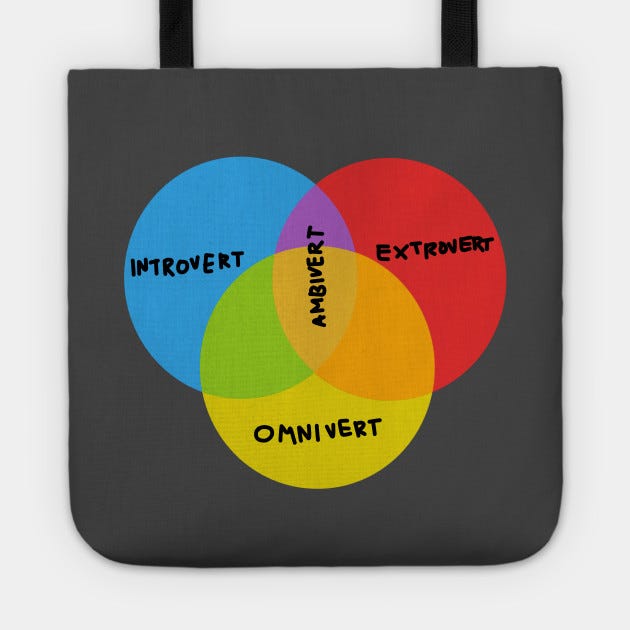
According to research (II), 40% of the population has ambivert traits, with nearly 1/3 of the people being introverts and almost 1/3 of the people being extroverts. However, pushing these statistics to a conclusion is not meaningful and, most of the time, harmful for a team to work towards a better goal.
Jennifer Kahnweiler, Ph.D., simplistically interpreted the scenario. In an interview with Forbes, she highlighted a couple of essential facts to consider. (III)
As each person is wired differently based on their characteristics and personality traits, understanding the differences and putting the relevant effort within the team are important factors. For example, introverts are sometimes considered as slow, with a lack of emotion and passion to the extrovert person. Sometimes, introverts think that extroverts lack depth in conversations as they talk a lot.

However, there are many examples of a team of introvert-extrovert-ambiverts, where they have peaked into the success mountain. Here are the names of a couple of famous introverts: Abraham Lincoln, Mahatma Gandhi, Charles Darwin, Vincent Van Gogh, Rosa Parks, Eleanor Roosevelt, Albert Einstein, Frederic Chopin, Audrey Hepburn, Author J. K. Rowling, Microsoft co-founder Bill Gates, Actress Emma Watson, Investor Warren Buffett, TV host David Letterman, Actor Harrison Ford, NBA great Michael Jordan, Google co-founder Larry Page, Director Steven Spielberg, etc. (IV)
What are the possible ways to collaborate?
Jennifer Kahnweiler, Ph.D., mentioned five possible ways to mitigate the issue and work for a successful collaboration. She called it the ‘ABCDE’ process. (III)
A = Accept the Alien. Everyone must accept that the personality traits are different, and each individual has their their way of expressing or reacting. People need to acknowledge the fact and understand the other person’s traits to break down the stereotypes.
B = Bring on the Battles. People also require to acknowledge that there will be disagreements in the collaboration. Being respectful of other’s opinions will ensure more diversity, more enriching ideas, and better approaches to reach higher heights.
C = Cast the Character. Based on the traits, we must understand each person’s role in a given scenario and cast the person to bring out the best from the other personality traits.
D =Destroy the Dislike. By breaking down the stereotypes and letting people know about the uniqueness the other personnel brings in, we have to destroy the classification and division of perceptions.
E = Each Can’t Offer everything. Finally, we have to remember and be cognisant that, even if we have the most potent characteristics & strengths, one single person can not offer everything on the table. Diversity matters, and through diversity comes different skill-sets and values that are essential for success.

According to Francesca Gino, a professor at Harvard Business School, the following ways can ensure proper calibration within a team or workgroup. (V)
• Educate yourself on the traits, acknowledge the strengths and diversity.
• Talk to your team and identify appropriate ways to ease up everyone.
• Rethink the workday. The work schedules and meetings can be set up to provide equal opportunities and individual-level brainstorming.
• Promote privacy. Every individual works best in their own perceived settings. The establishment of ‘quiet zone,’ ‘separate meeting zone’ — which requires it or privacy sign for the individuals and respecting the sign by not interrupting are a few examples.
• Encourage introverts to speak up and extroverts to listen. In one research, it was found that two people do more than 60% of the talking in a typical six-person meeting. Therefore, you should provide alternative ways to get input from introverts, extroverts, and ambiverts so that everyone’s voice can be heard.

Along with the research mentioned above, your organization and the team leader can incorporate many things to drive successful collaboration.
• Meeting pre-work and discussion list can be sent to attendees beforehand so that everyone can prepare accordingly and write down some ideas or initiatives that can be incorporated.
• Contribution slot for hearing out the thoughts and actions without any criticism can be incorporated.
• Brainstorming the ideas (found from previous steps) can be discussed by segregating into different groups and teams with the mix and match of diversified trait persons.
• Balancing open office spaces with private spaces is required to cater to the requirement of all personalities.
• The collaboration needs to be natural, not pushed, and definitely, the name-calling with the personality type is not acceptable at all.
• Team-leader can leverage the power of anonymity by identifying the ideas using by incorporating technological innovations.
• Relevant 1-to-1 sessions with each team member should occur, as this will facilitate understanding each one’s strengths and improvement areas.
• Leaders require to assign tasks, considering the timing to deliver. As each person acts differently, the best thing would be to identify the necessary time to execute the job and schedule the planning accordingly.
• Facilitating professional training for employees from time to time with new team-building activity can enhance the understanding and improve the team-engagement furthermore.
• Most importantly, organizations should ensure and preserve psychological safety for all employees. For example, the overall organization will suffer if introverts do not feel like speaking due to psychological factors and imbalances.
In one Ted conferences video (VI), Adam Grant (Organizational Psychologist at Wharton) mentioned that most of the time, introverts are task-focused, and extroverts are socially focused. So, by providing leadership exposure to people with different traits, you encourage more values in the organization. He also mentioned that as introverts tend to hear and then communicate, they are more likely to understand and value other people’s ideas.
Both society and organizations have to change their current perspective on leadership traits and provide ample ground for every individual to shine with their strengths and capabilities.
And by ensuring the paths mentioned above, we can move towards a more collaborative structure, not only for the tasks and projects but also for providing for a better societal structure.
More importantly, for a better tomorrow.
Source links:
(I) Merriam-Webster. Link: https://www.merriam-webster.com/dictionary/introvert (II) Hubgets. Link: https://www.hubgets.com/blog/introverts-extroverts-teamwork/ (III) Forbes. Link: https://www.forbes.com/sites/kathycaprino/2015/09/07/can-introverts-and-extroverts-ever-work-well-together-how-opposites-can-collaborate-brilliantly/#514e2a351acd (IV) Steelcase. Link: https://www.steelcase.com/research/articles/topics/privacy/quiet-ones/ (V) Harvard Business Review. Link: https://hbr.org/2015/11/how-to-be-good-at-managing-both-introverts-and-extroverts (VI) LinkedIn post on Ted Conferences. https://www.linkedin.com/posts/ted-conferences_worklife-worklife-activity-6671878808209104897-XeFR