
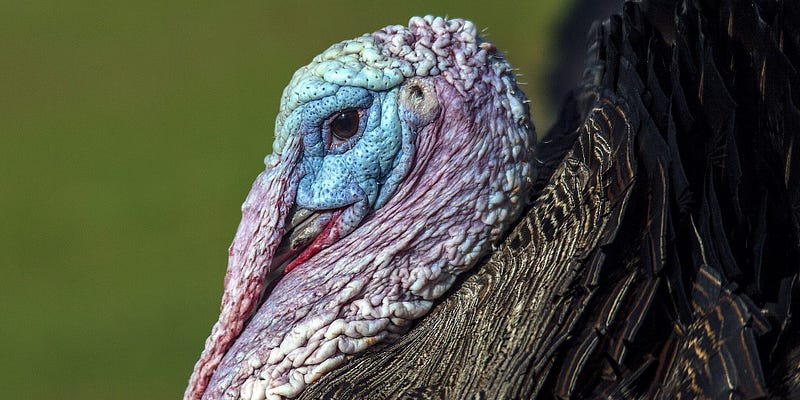
Cold Turkey
When writing is an addiction
(From 8–17)
George’s morning was just like every single one of his mornings. He awoke each morning at 6 a.m. sharp. After performing ablutions he would take a short walk around the neighborhood. It was the best time of day for a walk.
He would then come back inside and have breakfast. Every single morning his breakfast was exactly the same. He would eat three eggs and nothing else — and he did not even eat all of the eggs. With the fried eggs on his plate he would cut away the white part of the eggs and then scoop the yolk whole into his mouth. There is nothing like the taste and texture of a hot egg yolk exploding in one’s mouth. Over ninety per cent of all the nutrition found in an egg is in the yolk. The white parts of George’s eggs ended up in the trash.
After breakfast, George would fix himself a tall glass of ice water then he would proceed to his desk where he would boot up his laptop. He then spent the rest of the morning writing. Seven days a week, every morning was the same.
Today, George found himself staring at the blank screen for a very long time. It is not that he had nothing to write about. Writer’s block is something he never experienced. It is because he was thinking intensely about his writing and how it was like an addiction.
George had always identified himself as a writer. That is what he was. Of course, there were many times in his life when he had to put his writing on the back burner for reasons of practicality (like keeping a roof over his head and buying eggs). But everything always led back to writing. He was never very happy during those times when he could not write. He only felt a steady happiness when he could write every single morning, every single day.
But was it really he who was happy?
Or was it his ego?
Was the vague happiness he felt really just ego gratification? Was it his ego that identified as a writer? One’s egoic identity begins solidifying during one’s teenage years and once adulthood is entered the egoic identity is usually firmly ensconced and becomes what the person identifies with rather than their true identity as the awareness and conscious observer of what the ego, mind, body and soul are doing. The true identity becomes elusive and seems to fade away as we identify ever more strongly with the ego. We become convinced that the non-stop chatter of the ego is who we are.
To maintain its power the ego needs a lot of energy, attention and validation from us. As unaware slaves to our egos, we do whatever we can to keep that ego propped up because that is who we think we are.
George’s egoic identity was that of a writer. So to maintain that he dutifully wrote every single day. It was not that hard. With access to a lifetime of information stored in the noggin, the ego could provide an endless stream of things to write about.
But when George finished a story then published it and the story got almost no response then George’s ego was not happy with the lack of validation and, since George identified with his ego, George also was not happy.
The only thing to do was keep writing. At least that kept the egoic identity going. Eventually the writing would stumble into some validation that would empower George’s ego and make it happy and then, and only then, could George also be happy. As long as he kept writing every day there was always the chance that the writing might garner a significantly large amount of validation some day and then his ego would truly be filled with great joy and, by extension, so would George.
George was finally seeing the machinations of his writing addiction. But he felt almost powerless to do anything about it. He had become so thoroughly identified with his ego and the writing addiction that enslaved him to that ego that he could not imagine what life would be like without that. A lifetime of conditioning had kept him seemingly separated from his true identity and he did not know how to disengage from his ego in order to embrace that true identity. It seemed like without his writing addiction his life would become meaningless.
Staring at the blank screen of his laptop, George remembered when he quit smoking many years before. He had tried numerous tricks and gimmicks to quit but nothing ever worked. Then one day he ran out of smokes and his first reaction was to reach into his pocket for his car keys as he headed for the door to go buy more smokes. But suddenly he stopped in his tracks. Out of the blue, right then and there, he decided that he was not going to go buy more cigarettes. Abruptly, George made a decision.
He quit smoking at that very moment. He went cold turkey. Sure, he experienced some withdrawal for a few months but that decision stuck and he had not smoked since then.
George then thought about his late father who had been an alcoholic. One day in his fifties George’s father suddenly quit drinking and never had another drop of alcohol for the rest of his short life. “Cold turkey is the only way to go. It’s the only way to stop an addiction,” he had told George.
Of course, before one can go cold turkey one must first realize, recognize and admit to the addiction. This is the point where George currently was in his awareness. But he had yet to make a decision.
Taking a healthy swig of water, George put his fingers over the laptop keyboard to begin writing the story he had planned for that particular morning. Curiously, he did not care one iota whether the story would be read or liked by anyone. It did not matter. But he was addicted and had to write it.
His fingers twitched ever so slightly above the keys of the keyboard. George was overcome with an odd mixture of elation and dread as he realized that his day of cold turkey was quickly approaching.
Copyright by White Feather. All Rights Reserved. This is a work of fiction.


