
Coherent Breathing Is the New MDMA
In my own experience, there’s nothing more psychedelic than the breath

There’s a reason why MDMA is called the ‘love drug.’ However, few people know what happens to the brain when we’re under the influence.
One Study found that oxytocin — the hormone that helps bond couples, as well as mothers to their babies — surges in the brain.
This is one reason why it’s called the love drug. Another study went one step further, though, and their results show why there is such a buzz around it in terms of supporting mental health and PTSD.
They used functional magnetic resonance imaging (fMRI) on a small group of 25 volunteers to show the activity of the brain on MDMA.
Here’s what the coordinators at the Imperial College of London had to say for themselves:
“The results show that MDMA decreases activity in the limbic system — a set of structures involved in emotional responses. These effects were stronger in subjects who reported stronger subjective experiences, suggesting that they are related.”
Then they added:
“Communication between the medial temporal lobe and medial prefrontal cortex, which is involved in emotional control, was reduced. This effect, and the drop in activity in the limbic system, are opposite to patterns seen in patients who suffer from anxiety.”
For anyone suffering from low energy levels, anxiety, depression, or PTSD, this is one of the reasons why it can be so life-changing.
I know this from my own life.
During my 20’s, MDMA was my drug of choice. It completely freed me of inhibition and allowed me to be wild. I felt a love as I’d never felt before, I was able to access more sadness, joy, bliss, and wonder, and I was able to listen to my heart and speak my truth.
I also felt none of the anxiety I had been carrying for 20 years whatsoever.
Later, I learned why.
MDMA increases the communication between the amygdala and the hippocampus.
The amygdala is best known as the part of the brain that drives the so-called “fight or flight” response.
The hippocampus is a part of the limbic system that serves three primary functions: forming new memories, helping us learn, and regulating our emotions.
Studies with PTSD patients found a reduction in communication between these areas. So, what MDMA helps to do is turn off our fear response while heightening our emotional state of being.
Remarkably, breathwork has been proven to do the same too.
Here is a study on Soma Breath — a holistic form of breathwork — by a renowned neuroscientist that highlights this point.
A Study on Soma Breath
Soma Breath is a form of breathwork that combines coherent breathing with brainwave music. This piqued the interest of a leading neuroscientist Dr. Jeff Tarrant who wanted to try its effectiveness on his patients.
Years prior to this, Dr. Jeff had done extensive research on psychedelics and psychedelic-assisted therapy but he wanted to see if there was a way to create similar results without taking a particular substance.
After the results had been gathered, here is what he concluded:
“SOMA Breath techniques could be as effective as psychedelics for treating anxiety and depression.”
He then claimed that just 20 minutes of coherent breathing a day — for Soma Breath this is their signature 22-minute daily dose practice — is plenty because participants’ brains respond in the same way as when they’re on psychedelics like MDMA or psilocybin (mushrooms).
The only other time he’s seen similarly impressive results was when he studied the minds of monks!
What they all seem to have in common (monk or no monk) is that each participant was able to shut off their thinking brains, find a new perspective, and feel connected to the world around them.
For anyone suffering from anxiety, myself included, this can feel like a superpower.
“We may be sitting on one of the most widely available and cost-effective therapeutic modalities that ever existed” — Turow
After witnessing the effects of breathwork in my own life, I dedicated myself to breathwork and ever since, major shifts have happened in my physical, mental, and emotional health.
I loved that I could practice my breathing exercises in the morning and then breathe in a specific way throughout the day (coherent breathing). This then prevented anxiety from happening before it became anxiety which helped my nervous system to trust me again.
That’s the power of repetition. It retrains the nervous system and the neural pathways in the brain that write the stories of our lives.
In this case, my story didn’t involve anxiety anymore so I stopped experiencing it.
Heart Coherence
Coherent breathing is more broadly known as heart coherence so that’s what I’d like to share with you next.
Before I get into it, take a moment to review the chart below. Notice the different shapes and sizes of HRV (heart rate variability) as well as the number of seconds it takes to move between them. I’ll then share why that’s important on the other side.
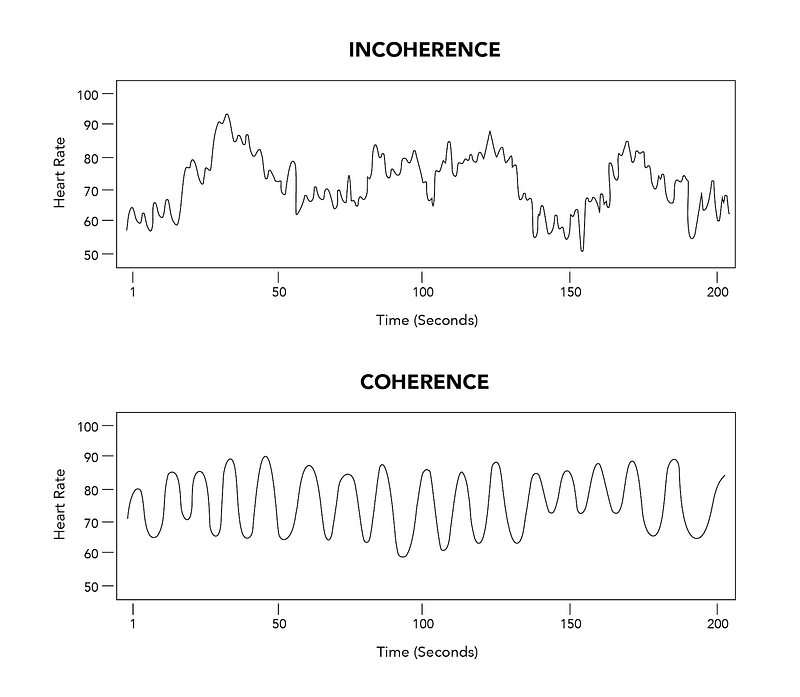
As you can see there are some visible differences. Firstly, incoherent heart rhythms are spiky and inconsistent whereas coherent ones are smooth and regular.
The importance of this is that spiky, incoherent heartbeats create more erratic, incoherent thoughts which then trigger more incoherent emotions such as anxiety, anger, sadness, jealousy, and fear.
Fortunately, the opposite is true. A coherent heart creates coherent thoughts which create coherent emotions such as joy, gratitude, compassion, peace, and love.
The saying ‘we’re just on different wavelengths’ has perhaps never been more accurate here.
Certain activities and substances have been proven to disrupt or harmonise the rhythm of our hearts. The breath is one of them.
If you’re a visual person, imagine a vast body of water that has waves equal in size and equal distance apart. Now imagine those waves as heartbeats — that’s heart coherence.
Choppy swells, riptides, and/or white water could be considered incoherent.
The good news here is that it really doesn’t take long to get into a state of coherence. Sometimes only a few breaths are all it takes. This can then begin to change not only our own body’s biology and chemistry but the field around it.
The longer we can stay there, the quicker our cells, heart, brain, and organs can communicate as one unified organism. And as one unified organism, a deeper sense of peace, health, healing, connection, and love can be felt as a result.
Beautiful ripples (or waves) then start to radiate out from the heart as it signals to every cell in the body to also become coherent. These waves move both vertically (up and down the body) and horizontally (out from the body), meaning that not only are heart coherent waves healing for the person who is experiencing them but they are also healing for everyone within that energetic heart space.
The Heart Math Institute has measured this to be as far as 10 feet outside of the body!
Here is how they define heart coherence themselves:
“Coherence is the state when the heart, mind, and emotions are in energetic alignment and cooperation. It is a state where there is increased synchronisation and harmony between the cognitive, emotional and physiological systems, resulting in the efficient and harmonious functioning of the whole.”
Breathing in a simple rhythm (in for two seconds, out for two seconds or in for four seconds, out for four seconds) is a wonderful practice here because it helps the body remain in a coherent state regardless of any outside stimuli. And this, in regard to anxiety, makes the world of difference.
Other benefits of heart coherence include:
- Decreases stress
- Bumps dopamine, serotonin, and oxytocin levels
- Boosts energy levels
- Creates balance and clarity
- Boosts productivity
- Enhances creativity
- Builds emotional resilience
- Creates less emotional reactivity
- Builds compassion, empathy, and understanding
- Improves physical health
- Creates better circulation & blood flow
- Improves overall heart health
- Soothes anxiety and depression
- Aids digestion
- Boosts the immune system
Now, let’s bring it all together.
Coherent breathing:
- Breathe in through your nose (smoothly and without force) for 4 seconds
- Breathe out through your nose or mouth (smoothly and without force) for 4 seconds
- Leave no pause at the top of the inhale or at the bottom of the exhale
- Continue up to 5 minutes or 40 breaths — this is enough to get into heart coherence
- Finish by holding your breath in for as long as comfortable
- Return to normal breathing.
If you find that four seconds is too long, try breathing in for two seconds and out for two seconds instead, or in for three seconds, out for three seconds until your breath naturally relaxes. Then extend your breath once you feel more at ease.
If you’ve been inspired by the power of the breath, check out my favourite breathwork — Soma Breath — here
Or discover the 22-minute daily dose practice that inspired Dr. Jeff Tarrant to run clinical trials.
Alternatively, you can sign up for a free online masterclass here.


