
Cognitive Therapy — Thought as a Curative Agent
“There is nothing either good or bad, but thinking makes it so.” — Shakespeare, Hamlet

The idea that individuals’ thoughts influence their emotions and behavior is hardly a new concept. In fact, the origins of this idea can be traced back to the Stoic philosophers, namely Epictetus, who wrote, “Men are disturbed not by things, but by the view which they take of them”. Modern cognitive psychology maintains this fundamental philosophy which purports that how individuals think largely determines how they feel and behave.
Psychotherapy conducted in the cognitive tradition is based on the premise that pathological information processing is the causative agent of mental disorders. The underlying assumption of cognitive therapy is that affect and behavior are largely functions of how individuals mentally construe their world. When these interpretations or constructs become distorted or dysfunctional patients experience helplessness, anxiety and depression (Beck, Rush, Shaw & Emery, 1979).
Treatment is directed primarily at modifying distorted or maladaptive cognitions and their associated behavioral dysfunction. The various strategies of cognitive therapy are designed to facilitate client awareness of negative automatic thoughts, to recognize connections among thoughts, affect and behavior, and to replace distorted thoughts with more realistic and adaptive interpretations. Thus, therapy based on this orientation consists of a collaborative process of empirical investigation, reality testing and problem solving between therapist and patient and is generally focused and problem oriented. In this way the patient’s maladaptive interpretations and conclusions are treated as testable hypotheses (Corsini & Wedding, 1989; Kaplan & Saddock, 1991).
The Cognitive Model
The cognitive model focuses on the individual’s interpretations of internal and external events, viewing them as crucial aspects in the understanding of behavior. This orientation posits that the emotional and behavioral responses to a current situation are largely determined by how individuals perceive, interpret and assign meaning to the particular event.
Figure 1 — The Basic Cognitive Structural Model
The configuration of core beliefs, rules, protective behaviors leads to distorted automatic thoughts which strengthen the existing style of thinking and behaving at all levels.
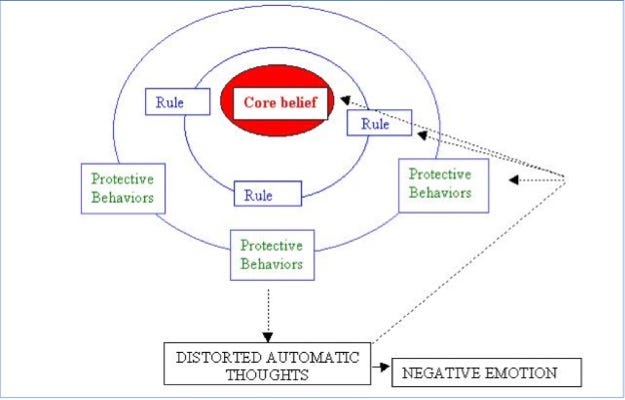
The cognitive view of human functioning (Figure 1) emphasizes three aspects of cognition. First, an individual’s automatic thoughts, the immediate, spontaneous appraisal of the situation, are seen as playing a central role in eliciting and shaping an individual’s emotional and behavioral response to a situation. Additionally, human behavior is influenced by schemas, cognitive structures containing the individual’s basic beliefs and assumptions, which shape the individuals’ perceptions of events and their responses to them. These cognitive structures are thought to be the templates, or basic rules, for interpreting information from the environment.
Schemas (sometimes termed core beliefs) can be either adaptive or maladaptive. Individuals possess an assortment of schemas which are relevant to various external and internal stimuli which they encounter. The context of a situation influences the unconscious process of the selection of schemas so that those which are judged most likely to be relevant to the situation are tried first and subsequently a series of schemas are analyzed until a “good fit” is achieved. Normally, schemas greatly facilitate responses to the situations in everyday life, however, they can also play an important role in maladaptive responses to stimuli. In addition to core beliefs and assumptions about “the way things are”, individuals also construct beliefs and assumptions about appropriate reactions and corresponding behaviors, referred to as interpersonal strategies (Pretzer & Beck, 1996).
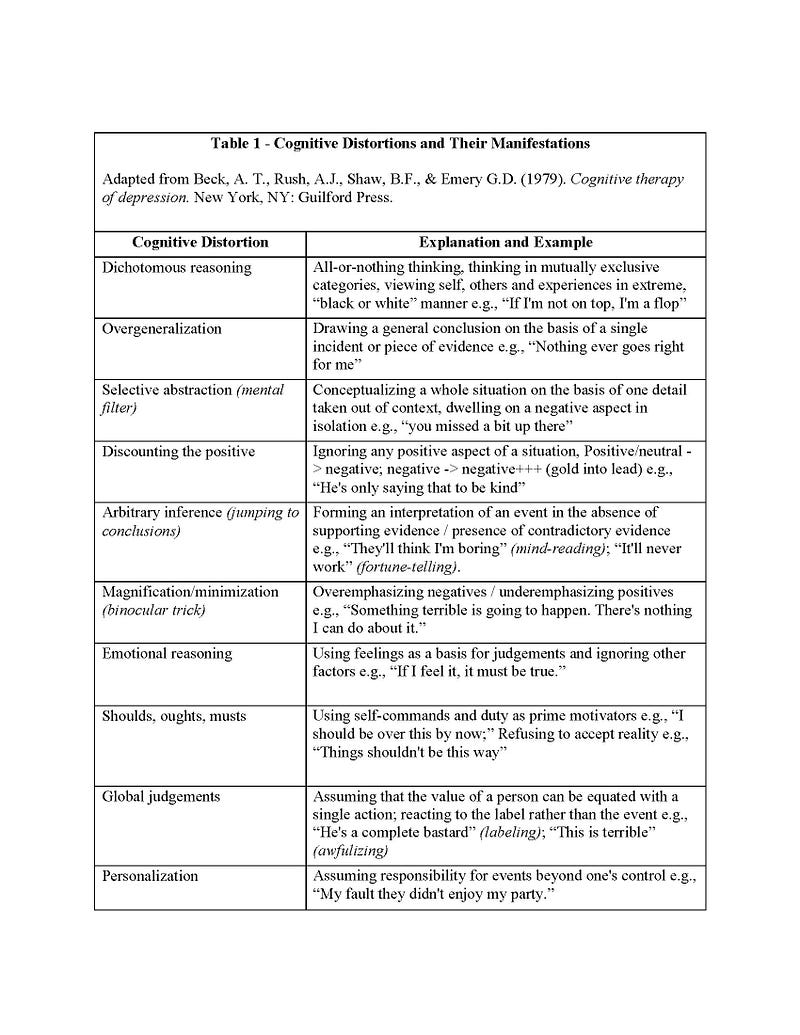
A third aspect of cognition which can contribute to persistent misperceptions of situations are systematic errors in reasoning, termed cognitive distortions. Humans are prone to a variety of errors in logic which can contribute to misinterpretations of events, and which can amplify the impact of schemas. See Table 1.
References
Beck, A. T., Rush, A.J., Shaw, B.F., & Emery G.D. (1979). Cognitive therapy of depression. New York, NY: Guilford Press.
Beck, J. S. (1995). Cognitive therapy: The basics and Beyond. New York, NY: The Guilford Press.
Corsini, R. J. & Wedding, D. (1989). Current psychotherapies, 4e. Itasca, IL: F. E. Peacock Publishers, Inc.
Kaplan, H. I. & Saddock, B. J. (Eds). (1991). Synopsis of Psychiatry, 6e. Baltimore, MD: William & Wilkins.
Pretzer, J. L. & Beck, A. T. (1996). A cognitive theory of personality disorders. In: J.F. Clarkin & M. F. Lenzenweger (Eds.) Major Theories of Personality Disorder. New York, NY: Guilford.


