
Cognitive Maps — Making Our Way Through this Thing We Call Life

In early cognitive psychology studies (Tolman, 1948), the term cognitive map was originally used to describe the process by which rats learned the sequence of a maze. As such, it represented the process by which they acquired and stored knowledge about the correct route by appearing to develop an internal map-like representation of the environment. Subsequently, this characterization was applied to human thought processes as well.
In current psychological literature, cognitive maps refer to one’s internal mental representations that simulate the physical environment, particularly aspects of relative location and spatial relationships. These representations are based upon three types of orienting information: (1) landmark knowledge — information about particular features at a location which may be based on both imaginal and propositional representations; (2) route-road knowledge — specific pathways for moving from one location to another which may be based on both procedural knowledge and declarative knowledge; and (3) survey knowledge — estimated distances between landmarks which may be represented imaginally or propositionally (Matlin, 2002; Sternberg, 2003). Table 1 provides examples for these aspects of the cognitive maps.
Table 1: Spatial Cognition
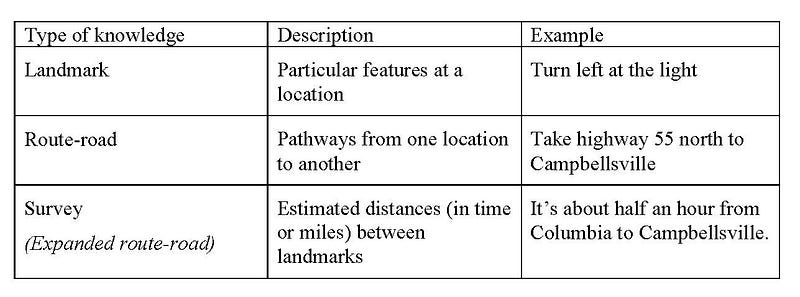
Cognitive maps enable individuals to construct a mental representation of an environment which may not currently be in the perceptual field, thus allowing integration of new information and providing a meaningful whole from the various parts which have been previously perceived. Research indicates that the cognitive maps individuals create from listening to a verbal description are similar to those which are created from the direct observation of the environment (Matlin, 2002). Thus, when the professor describes the layout of buildings, these features are integrated into the current context of known information about the relative placement of locations and reference points in the city.
Research has also indicated that individuals incorporate landmarks into mental models and use these as reference points as descriptions unfold (Matlin, 2002). Using one’s cognitive maps and heuristic methods, mental placement of the various structures will involve incorporating the new information with existing knowledge in the process of drawing a physical map of the city and the buildings described. Strategies such as these enable individuals to make generalizations across situations, retain more spatial information and abstract innovative solutions for novel problems. Additionally, they explain some of the distortions present in people’s cognitive representations of an environment.

In effect, these cognitive maps constitute a series of mental pictures depicting an area of the physical environment. While these representations generally tend to create relatively accurate depictions, systematic distortions occur with relation to distance, shape and orientation/relative positioning. These latter errors are based upon common cognitive heuristics about spatial relations.
Specifically, the alignment heuristic indicates that “people tend to represent landmarks and boundaries that are slightly out of alignment by distorting their mental images to be better aligned than they really are” (Sternberg, 2003. p. 245). Similarly, the rotation heuristic states that “when representing figures and boundaries that are slightly slanted (i.e., oblique), people tend to distort the images as being either more vertical or more horizontal than they really are” (p. 244).
These distortions cause errors in the judgment of relative compass locations — i.e., mentally depicting a location as north of a reference point when it is actually south. However, they differ in that the rotation heuristic refers to a single reference object rotated in order to better align vertically or horizontally, while the alignment heuristic refers to aligning two or more separate reference objects along a common horizontal or vertical axis. In general, based on the use of the aforementioned heuristics, individuals tend to cognitively represent reference points as more orderly and aligned than they exist in reality (Matlin, 2002).
Thus, the process of creating the map requested by the professor will include formulating these mental representations which include the additional structures included in the verbal description and transferring them to an actual physical map. As cited above, the research indicates that the product will be relatively accurate, but include some predictable systematic errors based on common human perceptual bias.
References
Matlin, M. W. (2002). Cognition, (5th ed.). New York, NY: Harcourt College Publishers.
Sternberg, R. J. (2003). Cognitive psychology, (3rd ed.). Belmont, CA: Thompson/Wadsworth.
Tolman, E. C. (1948). Cognitive maps in rats and men. Psychological Review, 55 (4) 189–208.