
Coffee Is Just Hot Water Tinted Brown With Special Plant Juice
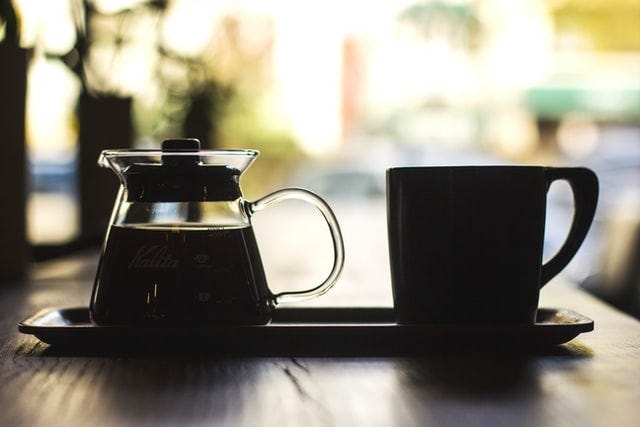
So I’m getting 8 coffee mugs full of water every day!
I drink a pot of brewed coffee a day. After my yoga and meditation, I pour a cup and sit down at my laptop. When I run out, I get another one. And another one.
When the pot runs dry, we brew another batch. That’s a total of around 16 cups of fresh joe, split between me and my honey every morning. It’s a firmly entrenched habit for us. And we’re not alone, with a ton of people around the world starting their day drinking coffee. It’s a big industry, that has Starbucks, Tim Horton’s, and other big franchises supplying thousands with their daily dose. We get coffee when we go to McDonald’s too.
But I’m constantly getting told by a few people I know that my coffee habit will dehydrate me and wreck my life. The caffeine will burn me out and make me sick. I’ll end up living in a van down by the river because I drink too much coffee. And the health police will come and take away my birthday.
Should I worry about wrecking my body? Am I dehydrating myself by peeing out all of that fluid? Are my caffeine levels astronomical and dangerous? Do I need to quit caffeine and just drink water? What else is in that coffee anyway?
Brewed Coffee Is Almost 99% Water
We have a regular old twenty dollar Black & Decker coffee machine that’s years old. This reliable friend heats water and then drips it onto coffee grounds. On its way through the filter basket, the water picks up particles and flavor in the form of soluble plant matter. The beautiful stream of liquid gold collects in the glass carafe on a little hot plate below.
We make coffee by tinting water brown with plant juice. The end product is still over 98% water.
In an average cup of coffee, there’s somewhere around 90 mg caffeine. There’s also varying amounts of substances like 2-Ethylphenol, Quinic acid, antioxidants and more. All of these chemicals combine to give us the flavor and caffeine jolt us coffee addicts are looking for.
The FDA recommends less than 400 mg of caffeine a day. Toxic effects start showing around 1200 mg a day. So maybe I am getting in a little too much. Estimated total dose in an average day for me is about 750 mg from just my morning coffee routine. Then sometimes I get a coffee when I go out…
But Does Coffee Make Me Dehydrated?
Coffee is a mild diuretic, which causes the body to flush out water and sodium. So it will cause you to lose a bit of water, but the amount lost would have to be higher than the amount going in. And I know that I’m not in the bathroom losing fluids that often. I would estimate that for every cup I drink, I feel the need to eliminate around half a cup. That’s a net gain in my books.
They say you can find a study to prove anything. And Look! I found a scientific study that supports my anecdotal coffee ideas. https://www.ncbi.nlm.nih.gov/pubmed/24416202
To quote that study, “These data suggest that coffee, when consumed in moderation by caffeine habituated males provides similar hydrating qualities to water.”
I am indeed a caffeine habituated male. And I drink plenty of coffee. So I’m probably hydrated, right?
But this doesn’t mean coffee is good for you. Especially if you add all kinds of junk to it. And apparently only around 35% of North Americans drink their coffee black. That means the rest of you are crudding it up with who knows what!
Coffee With Extra Stuff In It Could Be Bad For You
I drink my coffee straight up black, thank you very much. I don’t add yuck to my perfectly good java. But a lot of others add sugar, dairy, whipped topping, and/or booze.
A little bit of cream and sugar is I’m sure safe. Several cups of coffee with cream and sugar are going to add up though. That’s extra calories, extra fats and extra work for your body.
Non-Dairy Creamer Might Have Dairy In It
Do you use Coffee Mate? This handy product comes in powdered or liquid form and has been around since 1961. It was the first “non-dairy” creamer, but that’s a lie. It also has trans-fats!
The ingredients in this product are corn syrup solids, partially hydrogenated soybean and/or cottonseed oil (trans-fats), and sodium caseinate (milk proteins).
So if you are health conscious at all, avoid the trans-fats for sure. And if you’re avoiding dairy, this is actually a product containing milk proteins. Which is dairy. Be careful what you put in your coffee!
Caffeine After Two PM Can Affect Your Sleep
I try to never drink coffee after 2:00 PM. I like sleeping a lot, and I found out the hard way more than once that I just can’t sleep if I have coffee too late in the day. It can take up to six hours for your body to deal with caffeine, so if you have any at 8:00 PM things won’t return to normal until around 2:00 AM.
This might be another good reason for me to slow my coffee roll and cut down a few cups. It might be lowering my sleep quality without me even knowing.
I Need To Cut Back A Little
I guess I’m getting too much caffeine. But the good news is I’m not dehydrating myself! All I have to do is not go back for so many cups and I’m golden.
And I don’t add unhealthy things to my coffee so I’m okay there too.
How about you? Do you drink coffee? Do you add things to it? Can you sleep if you have any too late? Let me know in the responses below!


