
Coaching and Yogic Koshas
Using yoga to better your coaching skills
As per the Indian Yogic teachings, humans are composed of 5 sheaths –
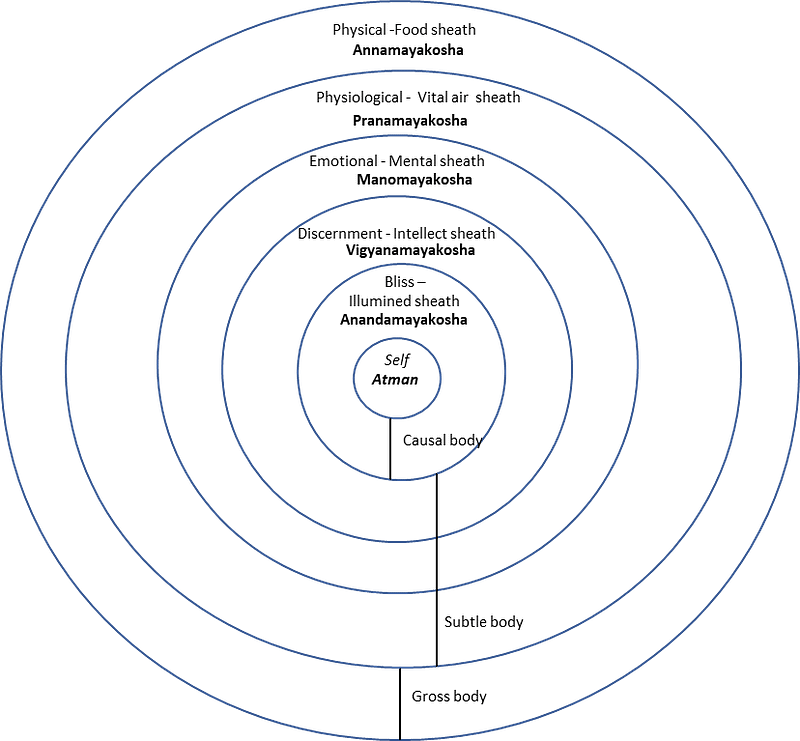
Anatomical or physical sheath called the anna (food)- maya (illusion) -kosha (sheath) is the outermost physical layer sustained by food. It includes our 5 senses and 5 action organs.
Physiological or the vital air sheath called the prana(life force or life energy)- maya (illusion) -kosha (sheath) is our physiological makeup. It includes all the autonomous body functions — Respiration, circulation, digestion, assimilation and excretion on which we don’t have any voluntary control.
Mental sheath called the mano(emotion/mind)- maya (illusion) -kosha (sheath) is our emotional body. Our mind is forever thinking, assuming, judging and building emotions around our life situations. This is where our experiences build conditioning, the filters through which we look at life and people. The makeup of our mental sheath affects the lower two sheaths, both the anatomical as well as the physiological sheath. That is why, if our emotions are always negative, it affects our health.
Intellect sheath called the vigyana(discretement)- maya (illusion) -kosha (sheath) is the wisdom or the knowledge sheath. It gives us discretion, willpower and determination that helps to control the ever-fluctuating emotional mind to stay on course and differentiate between right and wrong. Rightly used, it allows us to recognize the limitations of our conditioning and break away from negative life patterns and emotions.
Bliss sheath called the ananda(joyful)- maya (illusion) -kosha (sheath), is our basic personality, which is forever happy and joyful if we don’t let the negative conditionings of the outer sheaths affect it.
The practice of Yoga integrates the person through the journey of intelligence and consciousness from external to internal. All the sheaths are illusions (maya) and when we realize this and move to the core of our being, we meet the superconscious state of oneness, which is devoid of any individual ego or mind. Our true Self or Ataman recognizes the oneness of all beings and the illusions that the conditioning of material life has built as layers on top of this basic personality.
Isn’t this what we are trying to achieve in coaching?? Move our coachees and ourselves away from the external conditioning towards the ‘Internal.’ As we work with our coachees, the aim is to create a space of reflection where they can understand themselves better - their conditioning, their emotional body, their desires and use discernment to come up with what is fulfilling and important for them in any situation.
If as a coach we can support them to get in touch with their inner being, it will be a fulfilling and joyful experience for the coachee to realize that he/she has the power to be happy and fulfilled irrespective of the life situation. Working through the Pranamayakosha can help the coachee to connect more deeply to his/her inner being.
Leveraging Pranamayakosha in coaching:
Pranamayakosha or the energy sheath controls all autonomous functions of our body, which includes respiration, circulation, digestion, excretion and assimilation. When a person is stressed or anxious, the sympathetic nervous system takes over and directs all energy to handle the stress by putting the body in the ‘fight or flight’ state. All energy (life force) is focused on the outer layers — physical, physiological and mental, to prepare the body to protect itself from imminent danger. This is an archaic response of the brain which can not differentiate between actual physical danger and mental stress or imaginary tension. Unfortunately, the day to day stresses and anxieties build a pattern of living in this constant high adrenalin state, where a person is hardly ever in touch with his/her true Self, consciously. In this state, it is useless to reflect on fulfilment and growth because the intellectual sheath has no life force or energy to discern and will itself out of the situation. Just asking your coachee to calm down and think, will not help.
There is one autonomous function, however, that can be leveraged to move the coachee’s life force/energy into the outer layers, and that is respiration.
Simple breathing exercises like pranayama (even count breathing) or full yogic breathing (diaphragmic breathing) can be used by the coach as centring exercises to bring respiration to a steady, calm pattern. By doing this, the brain is tricked to believe that there is no threat, shifting the control of the physiological body to the parasympathetic nervous system, which puts the body back in the ‘rest & digest’ state. The heart rate slows down, autonomous functions like digestion & assimilation are triggered again and the body shifts to a restful state. The outer layers — anatomical, physiological and mental all become relaxed allowing the life force or energy to be directed towards the inner layers. The intellectual sheath can start reflecting and discerning. Coachee becomes more Present and more in tune with his bliss body and inner Self.
In summary, coaching has the power to facilitate life-changing transformations by putting the coachee in touch with his/her inner being. Whatever the challenge, everyone is finally looking for fulfilment and joy. Yoga, in essence, is the path towards this fulfilment and joy achieved through Self realization. Bringing the teachings of yoga into your coaching practice will not only enhance your skills but help you connect with your coachee at a much deeper level.