
GRADUATE SCHOOL
[CMU MISM-BIDA] Attending Graduate School at CMU in Fall 2020
What I’ve encountered during my 1st mini at Heinz College
Preface
2 months! It has been 2 months since my “Pandas!!! What I’ve Learned after my 1st On-site Technical Interview” post on Medium. If you are wondering what happened in these 2 months, this article will give you a complete answer. During this time, I have been preparing and starting graduate school at Carnegie Mellon University. I have met a lot of new people and immersed myself in the “MY HEART IS IN THE WORK” lifestyle.
Carnegie Mellon University Heinz College of Information Systems and Public Policy Master of Information Systems Management — Business Intelligence and Data Analytics (MISM-BIDA)
October 18th, 2020 marks the ending of my 1st mini semester at CMU. I wanted to take you along what happened since August 31, 2020, when I become an MISM-BIDA student at Heinz College, Carnegie Mellon University! If you want to learn more about graduate school life during this time of the year, come along and join in my journey!!!
Overview
This article will be simply about “graduate life,” and will be posted on my publication: As a Graduate Student in Data. If you are interested in reading more about my graduate experience, feel free to check it out! Since COVID-19 is still on-going, I have started school online in Taiwan, taking the Slow Start option offered by Heinz. I will go over the orientation, the courses, and my plans for the upcoming 2nd mini in Fall 2020! Let’s get started!!
Slow Start option

To start off, I want to be more specific about the “Slow Start option.” I have received lots of questions on Heinz College’s alternative for the on-going pandemic. This option is simply one of the solutions for students who apply to the following criteria:
- Admitted to the MISM or MISM-BIDA program at Heinz College for 2020
- Cannot be in-person/arrive at the US due to VISA/flight issues
Let’s go back to August 2020! At the time when the COVID-19 pandemic started raging, many international flights in Taiwan were canceled and the AIT (the American Institute in Taiwan) was not processing VISA appointments. I recall that I was not able to book a VISA interview until September 30th. Yet, CMU’s graduate orientation was on August 17th and classes started on August 31st! (I went back to check on my old I-20 and got the precise dates!)
All of a sudden, plans can change and time still flies.
Luckily, I did not have to defer a year for my education but instead take the Slow Start option. The option grants students an extra 24 credits to take CMU classes online from where you are. What's more, it is free of charge, so the total tuition students pay will not increase. I know that this may be a one-time solution for the current coronavirus pandemic but I am so glad that the school provided this opportunity.
Take 16-month MISM-BIDA track students for example: Normally, in order to graduate, students are required to take 132 core + 30 elective = 162 total units. If you choose the Slow Start option, you will graduate with 132 core + (30 + 24) elective = 186 total units.
Here is my new graduate school timeline at CMU:
- Fall 2020: 24 credits Online (Slow Start)
- Spring 2021: 54 credits at Pittsburgh (Full-time 1st semester)
- Summer 2021: Required Internship
- Fall 2021: 54 credits at Pittsburgh (Full-time 2ndsemester)
- Spring 2022: 54 credits at Pittsburgh (Full-time 3rd semester)
- May 2022: Graduation
Placement Exam and Exemption

Most programs at Heinz offer students the opportunity to waive courses if they already have already taken the course. Passing a placement exam will not only give students more credits on electives but also it provides students to choose more advanced level courses. In my point of view, this is a decent design since most students at Heinz come from various backgrounds. For students with a computer science background, they may want to further their learnings in the business domain. For students that come from a more business background, waiving accounting or economics may give them more credits to take technical courses.
I did take database, accounting, and economics in college, but years have passed since then, so a review of the materials is definitely needed. While the school will not tell you what is covered in the test, I recommend studying it as if taking a final exam for the course. Thus, I spent a large portion of the summer reviewing the materials of each course. Here are my results:
- 95–703 Database Management: 12 credits (Failed) ★★★☆☆
- 95–710 Economic Analysis: 6 credits (Passed) ★★☆☆☆
- 95–719 Accounting and Finance Foundations: 6 credits (Failed) ★★★★★
- 95–796 Statistics for IT Managers: 6 credits (Failed) ★★☆☆☆
- 95–888 Data Focused Python: 6 credits (Failed) ★★★★★
The stars above are indicators of how difficult each exam was! As I see it, you really need to be very good at the subject to pass. The only one I should have passed but did not was the “Statistics for IT managers” exam. I was frustrated when the results came out but eventually felt better. “It might as well act as a review for what I know.” I find failure a turning point to improve. After all, I will use statistics every day as a data scientist, why not give myself another good revision on it?
“It’s not so much the destination as it is the journey.” — Captain Jack Sparrow
Another interesting fact about the exam is that the school decided to cancel the “Object Oriented Programming in JAVA” test this year due to an extremely low pass rate (6/380) in the previous years! Based on what I have heard, the Python exam pass rate this year was approximately the same as those of the Java exams in the preceding years.
University-wide New Graduate Student Orientation
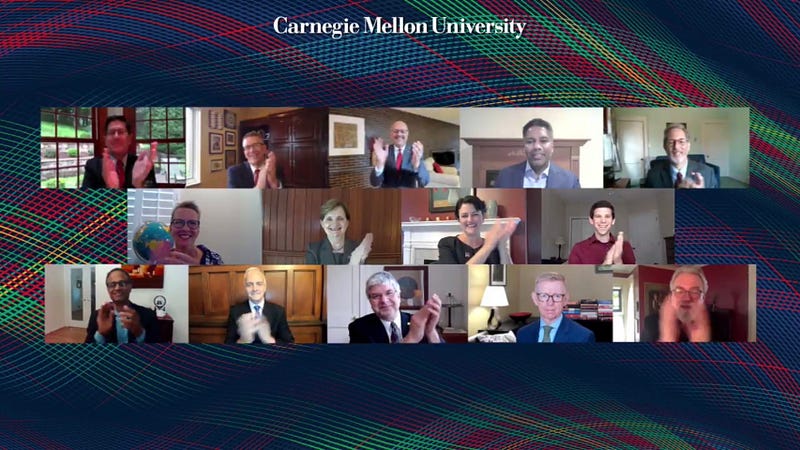
This year’s graduate orientation took place online. The school invited the president and the deans to say welcoming words to all graduate students at CMU. Though it is a pity to not attend in person, I did get a glimpse of the campus and the facilities through an awesome short video. What really caught my eyes were the bagpipe and drum performance, Scotty, and last but not least:
Go Tartans!
Following up on the orientation, I also attended the “Heinz College 30-Day Orientation Challenge” to count down to the 1st day of class. The challenge was to complete 30 tasks all related to CMU in 30 days. I thought that it was quite interesting to learn more about the school before coming to campus. If you are interested in the Instagram Stories I posted, all of them are on my IG account: @hen.e.lin.
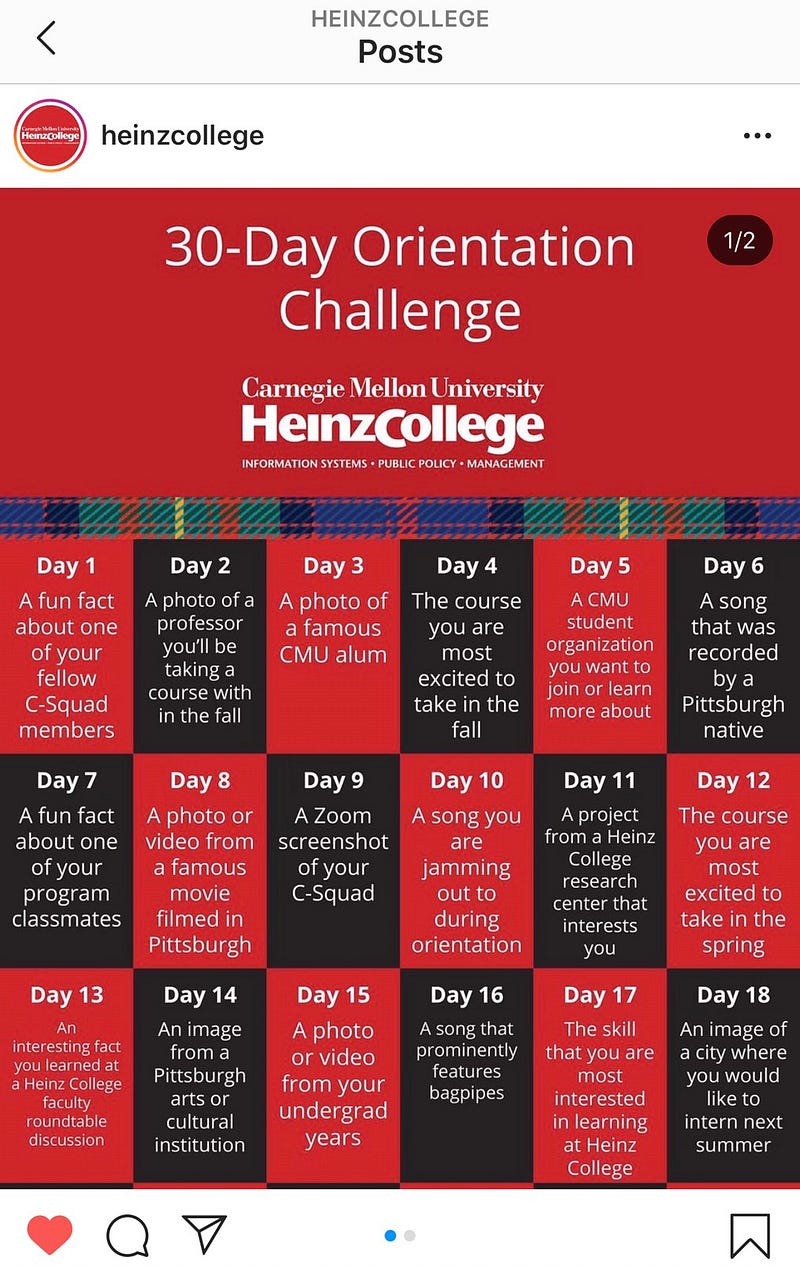
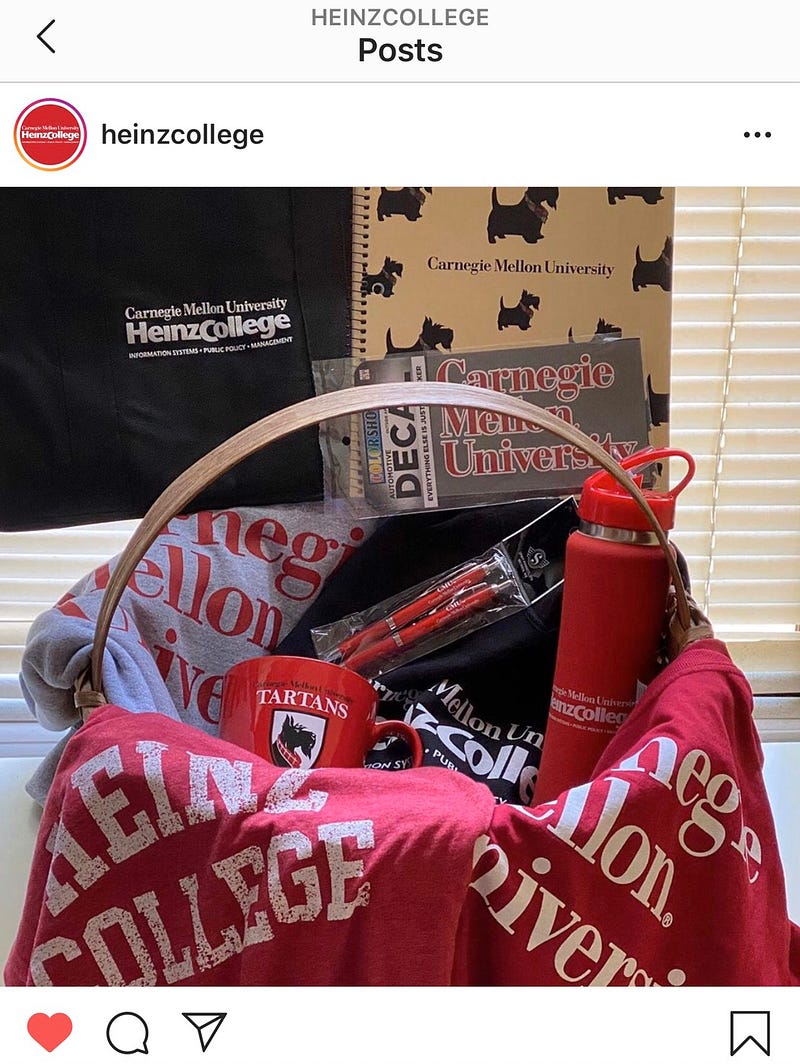
After 30 days, I was surprised and thrilled to win the big prize — the @carnegiemellon prize package! Can’t wait to receive it and what an experience to start off graduate school!
Fall 2020 Class Schedule
The most important part of graduate school is to take classes and learn new knowledge. Since Heinz College provides courses both in business and technology, I’ve decided to take 1 business course and 2 technical courses in the 1st semester. The following are the courses that are on my schedule:
- 10–601 Introduction to Machine Learning (Master’s): 0 credit (Audit/Full Semester)
- 94–700 Organizational Design and Implementation: 6 credits (Mini 1)
- 95–703 Database Management: 12 credits (Full Semester)
- 95–888 Data Focused Python: 6 credits (Mini 2)

10–601 Introduction to Machine Learning (Master’s)
Maybe one of the most prestigious courses in the school of computer science, I had the chance to unofficial audit the course with permission from professor Pat Virtue. The course had a format of lectures and discussions. Pat frequently hold class polls and let students talk about the questions in break out rooms. The reason why I wanted to take this course is to further the machine learning concepts I learned from my undergraduate studies.
During mini 1, aside from more general ML concepts, we covered decision trees, nearest neighbors, linear regression, logistic regression, and neural networks. I really enjoyed the neural network lectures, in which Pat demonstrated the concepts clearly with pictures of cats! As far as I can tell, constantly building on the foundations in ML is super important. That is why I am preparing to officially take this course in Spring 2021 or even challenge the “10–701 Introduction to Machine Learning (PhD)” version. Who knows?
94–700 Organizational Design and Implementation
I just have to say: “I love this course!” Professor David Lassman did an extremely good job getting students to engage in tons of discussions. Then, ending each with a full-rounded summary. From an international student’s perspective, more talking in the class may be scary at first, but it is definitely a way to practice communication and learn how to explicitly express yourself.
The most important lessons of the course are not just debate and dialogue, but learning how to prosper in organizations, teams, and eventually your career. The thing that I regret the most is finally getting the courage to go to Dave’s office hour. To sum up, whether you are still in university or graduate school like me, I will encourage you (and myself) to go to more office hours! I learned more than I expected while interacting with a Harvard Business School MBA (referring to Dave)!
95–703 Database Management
Professor Janusz Szczypula is a very experienced professor in database management and Oracle. It is just amazing that he has been teaching database management for at least 20+ years. The first half of the course was mainly on ER models, normalization processes, and relational algebra. The class has started SQL in the second half and will be implementing it in the final project. I am setting my sights on passing the Oracle Database SQL | 1Z0–071 in the near future after finishing this course. Apart from class schedules based on Pittsburgh time, the class is held during Australian hours since Janusz is on the Adelaide campus. I have also met wonderful TAs in the course. Overall, though I learned my database systems in MySQL, it’s never bad to add Oracle under my belt!
Life at CMU

The best part of graduate school is meeting professionals in your field and doing what you love in your profession!
The Heinz Mentorship Program
The Heinz College Mentor program is a must-participate program where 1st-year students connect with one 2nd-year student mentor and one alumni mentor. I have always love mentorships since it is a way to learn from other’s perspectives and build relationships. That is the reason why I am writing articles on Medium too! I believe that words can inspire!
My 2nd-year student mentor gave me a lot of advice on my upcoming internship search. By sharing her Facebook internship experience, she walked me through a mini-lecture about the company’s role and culture. I learned that many tech companies in Silicon Valley are more product-oriented. Accordingly, this experience inspired me to learn more about building products from data, which provides guidance for my learnings.
Clubs
Clubs are fun and educational! It is supposed to show your professional interests or hobbies. Because I have joined a dance club during my undergrads, I decided to switch to professional clubs in graduate school.
There are at least 400 clubs at CMU. From sports clubs to regional clubs, it took me some time to scroll down the list to find the organizations I am most interested in. The clubs of my choice are mainly in the data science and business analytics domain. I am super excited to do data projects, participate in competitions, and attend seminars with club members! Here is the list of clubs I planned to attend during my time at CMU:
- CMU Data Science Club
- Heinz Analytics Club
- Students Using Data for Social Good (SUDS)
- CMU Sports Analytics Club
Something New!
There is always something new in life! Whether making new friends or learning a new skill, people grow by changing. As a graduate student, I wanted to share a new tool that worked out for me and my personal goals for the remainder of this semester.
Notion
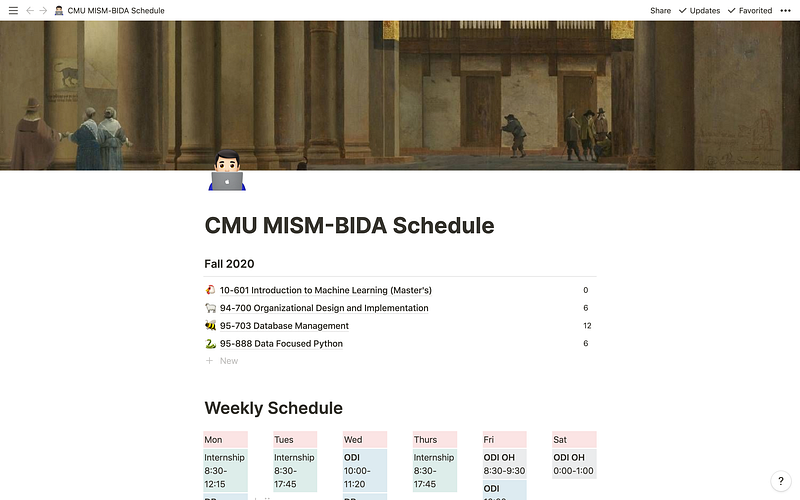
I started using Notion as my PDA at CMU. It turns out to be quite user-friendly and can perform more sophisticated tasks. For example, I frequently upload documents to help organize lecture slides. To work on projects, I was also able to share page access with my teammates. My to-dos are clearly listed out on my Notion page and sorted by the deadline dates. Notion is just a great tool to map out my busy graduate life and keep me up to my schedule.
The best part of Notion is that I can work from either my computer or my phone. The notes I’ve made will sync on multiple devices. I do encourage those who wanted to get organized at work or in school to give this amazing workspace a try! (By the way, this is definitely not an advertisement!)
Plans for Summer 2021 Internship Search

Most companies typically start recruiting for summer 2021 interns in the fall semester. From my experience applying for internships in mini 1, I also learned a few things. If you are someone who is on an internship search as well, here are some of my thoughts:
- Start as soon as possible: The earlier you start, the faster you find yourself improving based on past experience. Life is always full of obstacles. I believe that learnings from failures are the more effective stepping stones. For instance, there are always sections in interviews for applicants to ask questions. Have you ever wondered what kinds of questions work the best? Instead of guessing and hypothesizing which may catch the interviewer’s attention, it is better to not hesitate and just ask!
- Start by preparing all the relevant materials: The most important ones are resumes and cover letters! Start working on those and revise them after interviews or with a career advisor. Resumes are never perfect! I may be satisfied with my current resume at one time. Yet, after talking to an alum, I want to alter some of the details on it.
- Know your projects, your experience, and the materials: The bottom line of preparing for interviews is that you can explicitly explain what you did. This may involve a lot of preparation for your background. The simplest way to practice is to have your resume in front of you and ask yourself about the details. I personally like to record myself on my phone and repeat until I have a clear and precise answer.

In addition to what I am doing for my internship search, I plan to progress and improve myself by doing the following:
- Setting up a portfolio website: I got this idea from Linkedin, where I found a wealth of resources and suggestions to build my own website. A personal website can not only show your dedication in a more visualized manner but also provides a place to list contributions that are not in your resume. This is one of my top priorities in the coming month.
- Networking, networking, and networking: Since I am still a young data professional, I would love to learn more about practical applications in the industry. Building connections is one way to achieve that and minimize the gap between academia and real practice. One of the best suggestions for networking is “just do it!” If you are new to the field like me, don’t afraid to step out your comfort zone and introduce yourself to your alums. Most of them will be happier to help!
- Learning more: In addition to coding more, following up on recent industry trends can help shape one’s data science career. It could be done by simply reading articles about how a problem is solved in the industry. There are even podcasts that talk about data science and recent machine learning trends! As for me, I am aiming to read articles on Medium every week. As long as I am in the field, I will try to learn more from others and upgrade myself.
Epilogue
My 1st mini at CMU has been a blast! Thanks for joining on the ride as I will dive into more of my school life at CMU next time. If you have learned something or have a similar experience, feel free to comment below! If you have more to discuss, you can contact me via LinkedIn, Instagram, or Twitter. Also, feel free to follow me on Medium for more graduate life articles to come!
As a Graduate Student in Data