
Writer’s Blog
Clustering: Generate Ideas That Connect to Your Story
Use this method to enhance your writing and inspire new creativity.
Clustering is a way to help writers develop a visual map of thoughts and feelings about specific topics, phrases or words. As writers, we can get caught up in our minds and stuck because we struggle to explore the central theme or location fully.
Often we visualize what we want our story to look like but don’t ever explore the other possibilities that could make our work more unique.
The cluster technique enables writers to pull apart and dissect their thoughts on a topic, often leading to more details, more personality and ultimately a more interesting take on the subject.
Clustering enables us to recognize all of the associations we might subconsciously have with the chosen word or word group and then allows us to chose which path we want to take in our story writing.
It’s basically the barebones of a ‘Choose Your Own Adventure’ book.
What is clustering?
Clustering was defined and developed by Gabriele Lusser Rico in her book Writing the Natural Way (1983) her goal in developing this style was to help link the brain and all it’s thought processes together by using images to connect ideas, and scramble linear thinking while still utilizing it as an asset.
This technique allows us to move backward and forwards through our thoughts and understandings without getting stuck and gives us a broader scope of inspiration to draw from.
How to cluster.
The best way to explain a cluster is to show you what one looks like, for this to work I’m going to use one I wrote earlier. I used the word forest as the main topic as it is relevant to a story I am writing in my ‘playtime’.
Scenery can be used in an incredibly subtle way not only to give an atmosphere to a story but also to introduce feelings that your character might be experiencing within these places.
A character is unlikely to feel the same way in every possible setting. They will feel more at home, or on edge depending on where they physically are.
Setting a scene helps us to develop the emotional state of our characters.
Clustering becomes essential when trying to understand the scope of emotions that you personally experience when looking at a topic.
This particular method allows you to know where comfortable connections can be made in just a few steps, so you don’t end up pushing a specific idea, that doesn’t necessarily connect to what your story is actually saying.
Clusters are deeply personal because of the way our brain works in developing them. Jumps are not always apparent to everyone; you can see this clearly in the cluster that I made.
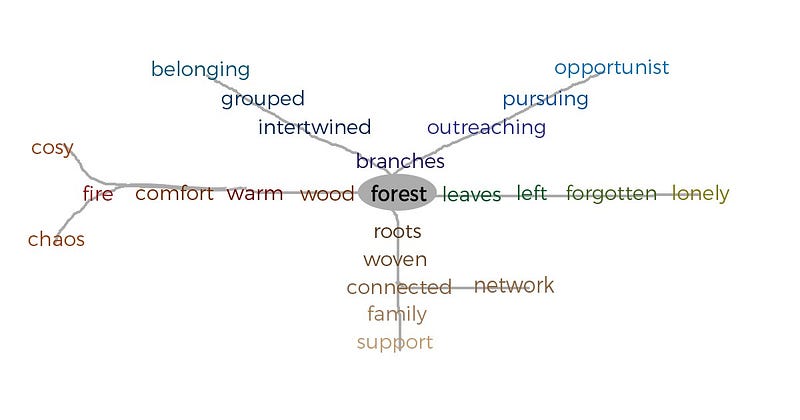
In my cluster, I made the jump from family to support, whereas someone with a more negative experience of a family unit would’ve never made this connection.
By looking at our leaps objectively, we can begin to understand what aspects of our thought processes make us different. This allows us to highlight and personalize our writing further with our own unique way of viewing the world.
Clusters will enable us to understand where our connections are made; this takes away any fear of our connections being weak or unsure because on a personal level we know how we developed our scene or character.
I scribbled this on paper at first because for some reason putting pen to paper allows me to be more honest about what I’m feeling. Starting with the root word you progressively write down what you feel about each word as it crops up.
It’s like a game of word association without the element of a time limit, although a time limit can be helpful for some thinkers as speed correlates to immediate thoughts. This helps you to jot down reflex thoughts without needing to explore the immediate emotions correlated with them.
From looking at this cluster, you can see that I have a fairly optimistic relationship with forests as a lot of my cluster routes end in positivity. However, there are some negative, darker paths. This shows me that if I were to utilize this cluster I’ve got a few different types of emotions I can use in this scene.
I could move it from a safe place to a place of loneliness or chaos in just a few turns of the page. This could play out in a lot of different ways, and it’s fun to explore the paths I could take my characters on.
Other ways clustering is useful.
This is just one of the ways a cluster can be used, it also is fantastic for poetry writing, creating short stories and freewriting. It’s definitely a technique you should try out in any future writing endeavors. Clusters are something you can add to your story bank.
You can always refer back to it if you are experiencing a bit of a lull in the story or want to add more detail, to figure out where your next turn should be.
How to use a cluster.
I wanted to show how useful a cluster can be, so I wrote two short paragraphs. One is a simple freewrite around the topic of forests that I made before I created my cluster. The second example is one that I made after creating the cluster. It provides a clear example of how having your thoughts laid out can help improve your first draft.
Freewrite
I enjoy walking through forests, depending on whether or not I have company. If I am walking my dog I love a good long stroll; if I am alone, I find them rather scary. To glance up at the sky and see the branches reaching above me, sometimes I’m afraid the trees will fall, sometimes I imagine them stretching out their arms to capture me. But it’s never like that when I’m with my dog; I never have to worry about being afraid, I know he will protect me from my invisible fears at a moments notice. I guess I have an overactive imagination; I guess that’s why I’m a writer.
Freewrite guided by cluster
I walked along the forest floor, stepping over the roots that were woven so delicately together, everything was connected, it was like a network a support group. It made me miss home, miss my family around me. It’s hard to stay upright when you feel uprooted; it’s hard to feel grounded without your family nearby. I glance at the leaves falling off of the branches, and I am aware of how lonely they are when they leave their home. Floating away from everything they know, forgetting who they are and where they come from, destined to die alone. I think I should visit my family.
Clustering helps writers take in everything that they actually know about the topic and not just what they think they want to write about.
It’s a great way of helping you come to grips with elements that you want to introduce into your story and is helpful in most forms of writing. This technique is useful if you’ve been given a topic that you’re unsure about or just want to figure out the truth behind what you’re saying and where that connection comes from.
Obviously, you won’t use everything in your cluster, so feel free to highlight what interests you and discard what doesn’t.
Clusters give you the freedom to decide what you really want to write about after you’ve determined all end results. I hope this information helps you to improve your freewriting and build your writing habit. As always, I cannot wait to see you on the bookshelf.


