Clubhouse Assumes that Black Folk Equates Celebrity with Community
Clubhouse shows how Blackness interacts with celebrity and forms community — or, rather, how white supremacy expects Blackness to form community.
Every night feels like Friday night on Clubhouse.
I got an unexpected invite to the app from a fellow Black writer on Medium on January 30th in anticipation of a room she and a few other writers and editors of color (#weoc). I have not socialized with anyone outside my immediate family and friend circle since COVID took over in March 2020, and was eager for community.
I spent the rest of that evening floating through the rooms. OutKast’s “Spottieottiedopaliscious” hummed in the back of my mind as I floated in and out of rooms. My libidinal energy was supercharged with Blackness. My journalistic impulses took over and I decided to document and find the story of this app, valued at $1 billion dollars by white people, with a Black man as the picture on the avatar, in a space where so many of the app’s rooms were moderated by Black people, with majority Black audiences, discussing Black issues.
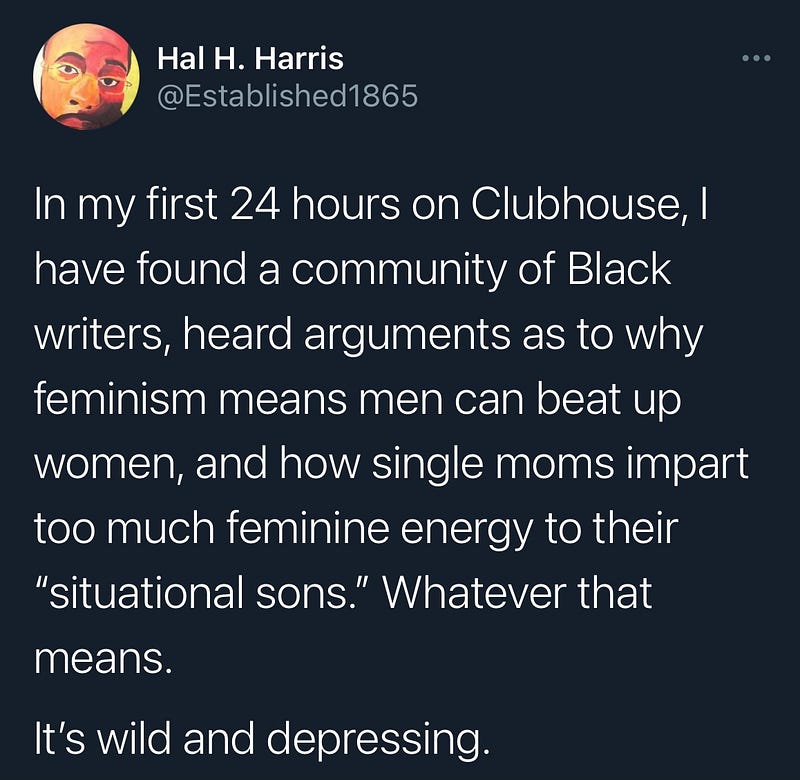
Clubhouse is a petri dish on how Black personhood adapts to living and loving within a technologically evolving white supremacist society. Science-fiction, and predictions of technology into the future, do not consider Blackness. Yet here we are, writing ourselves into the source code of an app white people are staking their fortunes and reputations into. How does Blackness form community in such an environment? And how do the algorithms of whiteness assume the ways in which Black people form community?
This is a chronological journal of what I found.
Saturday, January 30th, 2021
21 Savage was the first person to pop up in my People to Follow feed. I heard tell about how in December 2020 he emerged as a voice of reason by moderating a tense discussion between Akademiks and Meek Mill. As a former educator, I’d often sing “Bank Account” with my students. Those are fond memories.
I instantly followed and then went to bed at 9 PM.
Sunday, January 31st, 2021
I spent the morning in the Black writer’s community group, where Medium’s writers and editors of color (#weoc) put me on game. It eased the loneliness that comes with writing and not knowing if you would ever be able to dedicate your life to the craft and make it financially stable.
Later, during my Sunday dinner routine (grilled potatoes, grilled steaks, grilled everything) I bounced from room to room. Love was on the mind of Black folk that evening, with me bouncing in and being a fly on the wall in the following rooms:
· Courtship and Black Dating — Is it Dying if so Why?
· Normalize leaving after the 1st Red Flag
· Baby Mommas ask baby daddy’s hard questions.
I’ve been happily married for nearly a decade, so I had nothing to contribute. These rooms would not contain my tribe. It was both nice and disheartening, though, to listen to young Black folk (I am amazed how frequently I’m referring to people as young) come around the world and discuss how to love in a world that was not programmed to foster and nurture their love. I could have done less with the men in the Baby Momma room saying the word female though.
The morning offered community. The evening did not.
Monday, February 1st, 2021
Leave it to Elon Musk to steal the thunder from the first day of Black History Month.
I logged onto Clubhouse while I started making chicken marsala to find the most popular room being “Elon Musk going to Mars but will Black Lives Matter there?” For over an hour, I kept my hand up, hoping to contribute to the persistence of Blackness in the future and why such endurance threatens white industrialists like Musk.
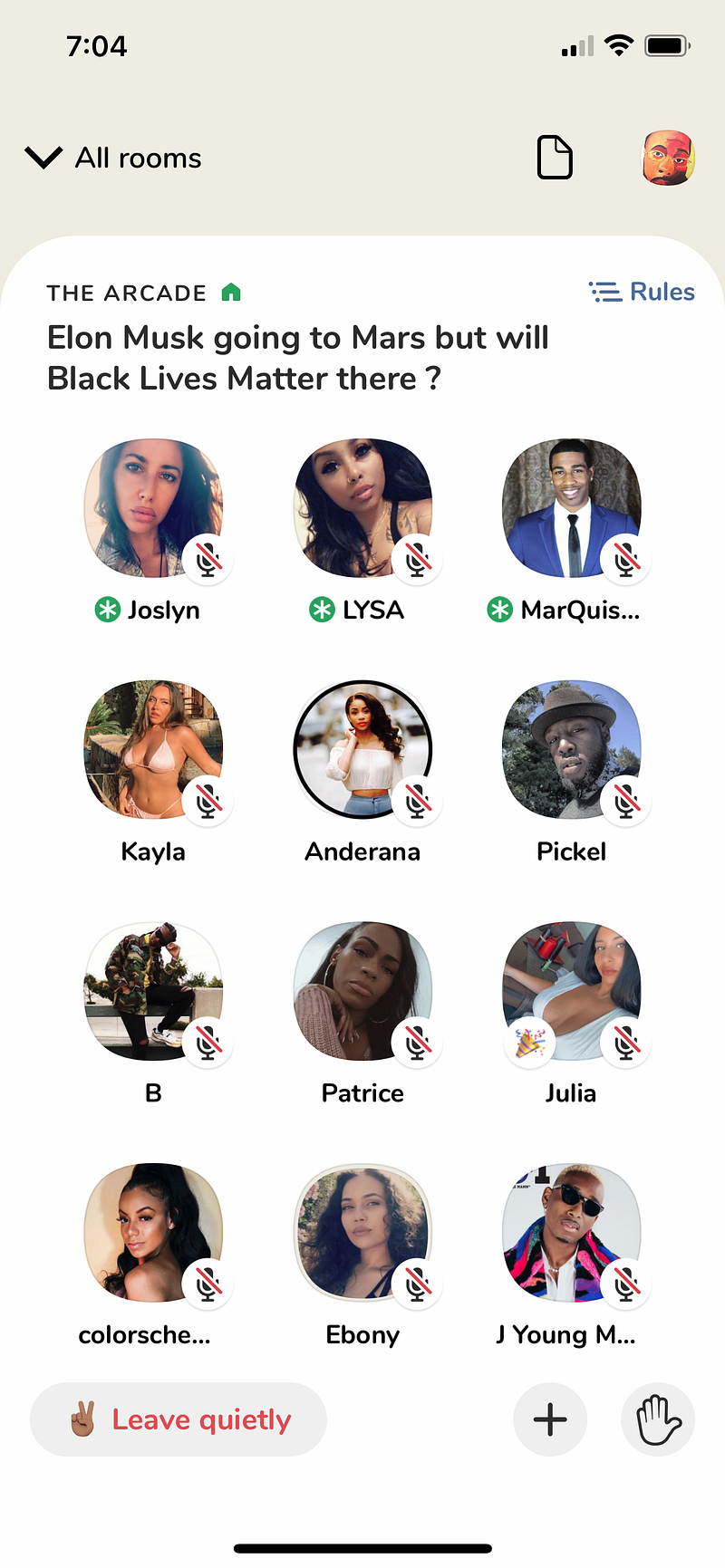
The habit of conversations about the future of Blackness is that they tend to be speculative rather than historical. We don’t need to imagine what Musk is going to do with Black Lives Matter when he gets on his rocket and lives within his dome with his other rich industrialists on Mars. The New York Times reported years ago of the discrimination rampant in his Tesla plants. He has taken steps since then to repair the damage by making Juneteenth a paid work holiday and speaking out against the lack of charges against the officers who watched Derek Chauvin choke the life from George Floyd. For men like Musk, being on the right side of history meant focusing on the bottom line. #blacklivesmatter is fashionable now for most of the nation, and he had to be prepared to enter a Black space like Clubhouse.
But I also know that he’d rather not deal with all of it on Mars. Musk stays in conversation with other billionaires and techies, which is exclusively the white boy’s club that sees Clubhouse being worth a billion. There will be police on Mars. It will be designed so that only the rich can come, with domestic grunts kept in line by force — Ayn Rand written across the Milky Way.
After an hour of waiting and not being called upon, I went to a room called “Trust is Very Delicate.” 21 Savage was in the room. In the short time I was present, he did not speak.
The gravitational force of celebrity drew me in on this day.
Tuesday, February 2nd, 2021
I had a long day of work meetings that bled into the evening. I also have an eight-month old who crawled for the first time; my evening was spent taking tons of pics on my new iPhone 12. I whipped up a quick meal for my family and bounced quickly between two rooms: “GAIN 200+ FOLLOWERS. MUTE YOUR MIC AND PING YOUR FRIENDS.” And “Professional WOC: The One Scary Thing I Did This Week.” Here I was, searching for community when I should have been paying attention to celebrity.
I somehow missed the room of the night where some brave soul asked Tory Lanez the question on the Black community’s mind:
Every night is Friday night on Clubhouse.
Wednesday, February 3rd, 2021
“This nigga Uzi really put a diamond in his head!”
“Nigga look like Thanos.”
“I’m sayin’ this in my best Baltimore accent — STOOPID!”
21 Savage, in the room “Y’all let me slip? Sayless,” finally offered his wisdom regarding Lil’ Uzi Vert’s cosmetic decision to the various plebs like me watching with hands up. “Y’all must be stupid as hell to think that diamond is worth $24 mil. Only time I’m buying diamonds is if I’m worth at least $2 billion.”
This was the sort of carrying on COVID deprived me of. It was classic Black barbershop talk, among the most consistent communal experiences of Black men. But instead of creating conjecture with the dude waiting to get his bald fade, we got to hear from 21 Savage himself on how stupid he thought Uzi’s latest cosmetic decision was.
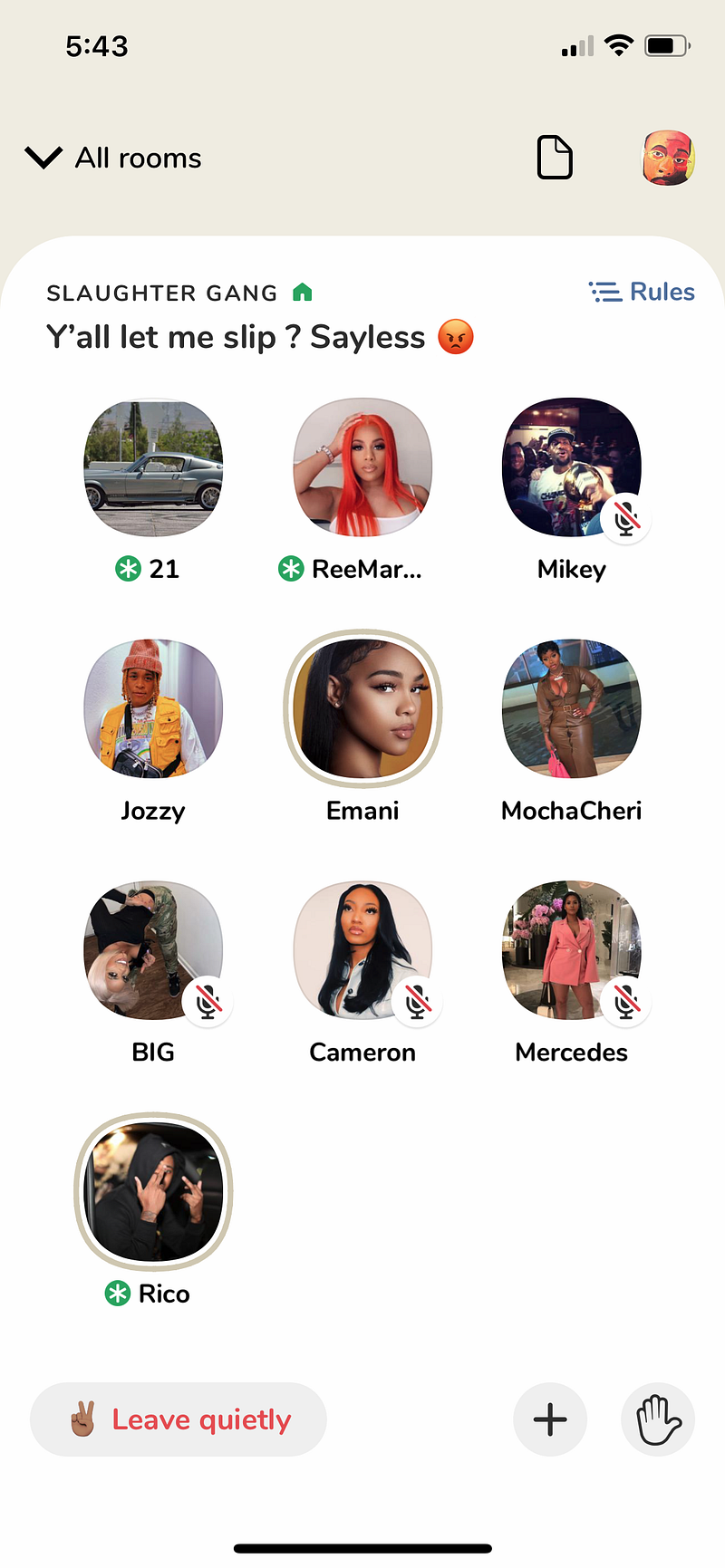
It was on this evening that I also noticed I tended to go into rooms, however briefly, where 21 was a moderator. I could no longer feign journalistic interest. I could not find escape velocity from the orbit of celebrity. 21 was the very first person Clubhouse recommended I follow. Why did the algorithm recommend this choice to me? And what did it have to do with whiteness and Blackness? I was curious because I found myself not being to help myself in following 21 in whatever rooms he chose to visit.
I have a hunch. White people believe that Black folk seeks community in celebrity. It is by their hand that poverty and incarceration visits my people so frequently. In the cages of both white supremacy and COVID — and the disparate illness and death this pandemic has wrought shows it is another tool of white supremacy — is the assumption that Black people, on social media, will be attracted to the brightest stars in our period of social isolation?
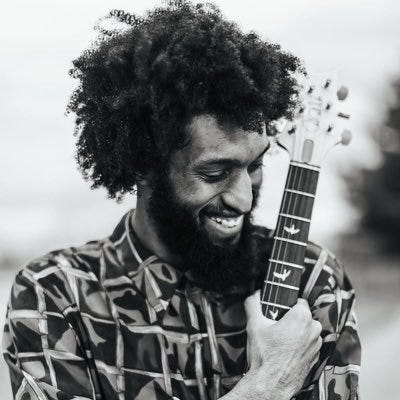
Bomani, the Black man who is the avatar icon of the Clubhouse app, hosted a room called “Text me nice things 323–676–0936.” I popped in for five minutes and listened to him strum guitar and pick on random ladies in the rafters to sing with him. The next room I went into was “The Music Industry Room.Artist.A&Rs.Execs.HITS ONLY,” where various Clubhouse members played their tracks for music executive moderators. Again, community formed around potential celebrity.
I went back to 21’s room. The conversation now was a heated talk on pescatarians and how hard it was for Black people to adhere to the diet.
“I try to be a pescatarian but I go to the Jamaican spot and get me some oxtail,” one of the moderators dryly noted.
“Popeye’s mashed potatoes got meat in it!” So did the Cajun rice before they took it off the menu, an act that feels like a hate crime.
Thursday, 2/4/20201
The final Clubhouse room I visited was “No, black men don’t want to take accountability.” I made it as I, inspired by 21’s room last night, tried to make some pan-seared cod with jollof rice.
The room was moderated both by men and women debating if Black men could do more to close the pay gap. Who is responsible for promotions? Do white people in corporate American force Black men and women to compete with each other? Or are they not responsible, and what we are seeing is a melaninated, patriarchal struggle?
I raised my hand. After 45 minutes, I was made a moderator. By this time I had screwed up the cod; too salty. My wireless headset was in. I unmuted my mic and as I put the cod to the side, spoke into the community and said my piece. “The problem here is that the men in the room are not mentioning their privilege. One of the ladies in here earlier mentioned intersectionality as a framework for understanding oppression and disparities. I understand it’s hard for people who have been put down for so long to acknowledge that there are others who suffer too. But fellas, this ain’t the Oppression Olympics. We are all in this together, and we have to listen to Black women.”
There was no talkback. I got back to my phone. The room was empty.


