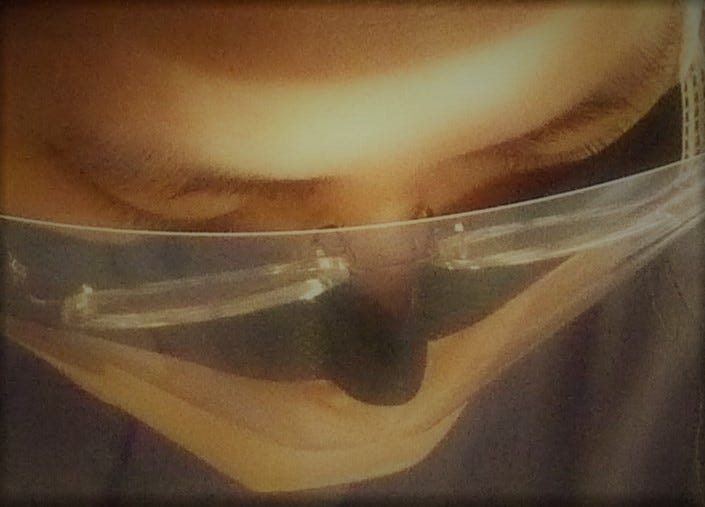
Cloth masks for all
Some experts are saying that everyone should wear a home-sewn cloth mask for “herd protection”. (By someone who wears masks for a living, not Batman)
I wear masks in my hospital day-job, and I have never liked wearing masks outside of the operating theatre. But now, after a chat with my old friend Babak Javid, a Cambridge- and Harvard-trained infectious disease professor, I have started wearing a home-made bandana-based mask to the supermarket.
He is not alone in his view. This weekend’s Science op-ed interviews experts from different countries, calling for mask-wearing in public, among a growing chorus of supporters. Last week, the Czech Republic made covering the nose and mouth mandatory in public places, as did Austria. Masks protect from droplet infection and were helpful in SARS. Dr. Anthony Fauci has just recommended wearing masks. If everyone wore a mask, in addition to hand-washing and social-distancing, then we’d be protecting more of our “herd” from the infectious droplets (and recent data modeling shows 4 in 5 patients were infected “invisibly” from people who never showed up on contact tracing), so the pandemic will be over faster.
So why the confusing, conflicting viewpoints in something that would seem “obvious”? One issue is the shortage of single-use masks since the pandemic started. The other issue, is perspective — who are we protecting, when we put on masks? So far, in the Western press, the debate has been a wearer-centric debate — it makes us more likely to touch our face since we are not used to it, and it doesn’t *really* protect us if we keep touching our face.
But that is turning the original goal of surgical mask-wearing on its head. Surgical masks were designed to protect patients’ wounds from our spittle when we speak to colleagues while operating. Ironically, it is difficult to prove that surgical face masks protect patients’ wounds from us. Importantly, most of the bacteria that we try to protect surgical wounds from, is spread by direct contact ie touching the dirty wound, not “aerosol”, which is possibly why we have never really proved we are protecting our patients’ wounds when we wear a mask.
The primary goal of mask-wearing, should be protecting others from ourselves. With that in mind, I convinced my non-healthcare-worker husband to look for a manly mask (he found a winter neck-mask that was elasticized and bought some for the whole family), and our next essential errand was masked.
The first thing that surprised me, considering I wear masks for a living, was that my home-made bandana was much easier to “customize” (to my coat and shirt collar, for example, which scrubs do not have) than those mass-produced surgical masks. The next thing, was that my non-healthcare-worker husband, who for the longest time thought that people who wore masks were “selfish” and “fear-mongers”, adapted quickly to our home-made bandana-and-mask contraption, probably because he, too, had all the time in the world to fiddle with it before getting out of the car. Both of us managed to not touch our faces after adjusting to our home-made masks.
Another thing I noticed, in the era of the “quarantrim”, was that without the surgical cap, I had to resist touching stray strands of hair while inspecting vegetables on the lower shelves. To avoid touching our faces, hair needs to be out of the way too.
When my husband commented on the increased “work of breathing” as a result of the layers in our home-made mask, I muttered: “welcome to my world!” That takes some getting used to, but in fact, for those of us who have had to wear an N95 mask to do something strenuous, we worry when our breathing is not labored, because it probably means we have a leak and didn’t put it on properly. So, it is a good thing if you find it harder to breathe through your mask — that means it probably isn’t leaking.
An infectious-disease physician based in Beijing, Babak witnessed the contrasting responses to the pandemic in China, when he returned home to England. “It’s a cultural difference,” he said, observing universal mask-wearing in Asian countries. When going out in public, he wears his own washable cloth mask now.
“Lots of odd stares to begin with,” he commented, on wearing his washable mask back home in England. “I’m still the only one wearing a mask, but that doesn’t elicit strange looks as much now,” he added — maybe the stigma is changing, and it should be.
We need to de-stigmatize mask-wearing. This harks back to early campaigns to fight epidemics of sexually-transmitted diseases: if everyone was compliant with using a condom for sex, then nobody would be stigmatized for requesting it. Right now, the message for mask use in Covid-19, is the equivalent of asking people to wear a condom only if they know they are HIV-positive.
The official line telling people to wear a mask only if they are ill compounds the stigma. For example, a pregnant lady in Vancouver was attacked for wearing a mask (she was not sick, just wanted to protect her baby on a trip to the supermarket).
A few years ago, in a non-pandemic time, a British Medical Journal editor did a straw poll, and found his colleagues citing “embarrassment” as a reason not to wear a mask.
I spoke to Dr Chen, a family physician in the Greater Vancouver area, returning from a family visit to Taiwan, who couldn’t get over how hardly anyone here seems to be wearing a mask. In Taiwan, she says, “everyone is wearing one — even the kids!”
We asked some elderly relatives living in Ontario to wear a mask when they went to the supermarket. “We’d be the only ones,” they objected, “everyone would be staring at us”.
If all the old and vulnerable are too embarrassed to wear a mask, then really, it is up to us — the young and bold, to protect them from us.