
‘Genius in a Bottle’ Prompted Writing Challenge
Closing the Door
GiaB writing prompt #2–19
Alongside my dad, a child wanted to be more. It all hinged on wood.
I can remember the moment when I grew up.
It was when my father was hanging doors in our new home.
My father always included me in the construction work he had to do around the house. Being a perfectionist, he couldn’t tolerate anyone else’s work and so he set about doing it himself. Despite being a gifted carpenter, electrician, plumber, and metal worker, he was still a short man, and often needed an extra set of hands to help him. ‘Help him’ is a little grandiose a description for what I did. ‘Hold stuff’ is more accurate.
My dad had to set the door hinges in the door itself. That meant a hinge-sized wafer of timber had to be cut out of the edge of the door.
For the life of me, I couldn’t conceive of how that was done.
It seems like such a simple thing but it requires a specific tool and some technique to accomplish. Not knowing how it was done was the beginning of the hunger.
My dad drew the rectangle in its location with a sharp pencil. I asked him why he didn’t use a marker that would be more visible. I had heaps of coloured markers. My father explained that the line needed to be as thin as possible so that it would represent the cut line precisely. The mere thickness of the marker tip would introduce too much variation pertaining to where the recess borders should sit.
“Whoa! That’s pacific!” I exclaimed, innocently.
Once my father had marked out the recess borders, he sliced the timber fibres on the short side of the rectangle with a pocket knife. I asked my father why he did that, thinking he had impulsively started to chop a door with a completely ineffective tool. He explained that wood resists when cutting across the grain. Pre-slicing those fibres before applying a cutting tool preserves the pristine edge one wants.
My father then pulled out a tool I had never seen. A chisel. A humble chisel. A straight, flat, beam of steel sharpened to a keen cutting edge at its tip, and held by a handle at the opposite end of the tool.
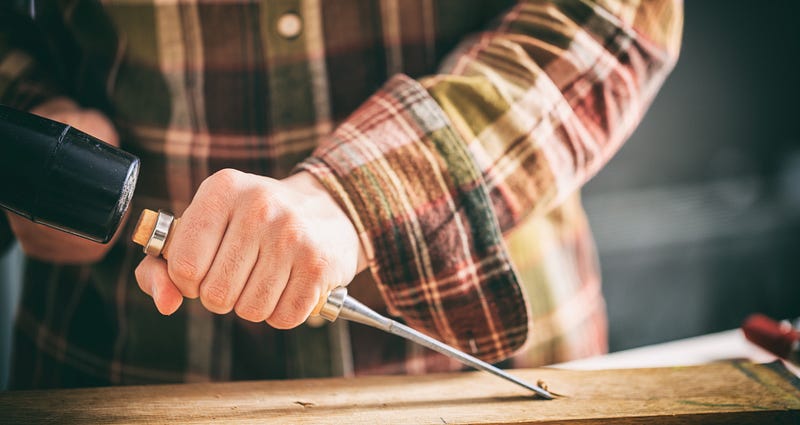
With this chisel, my father proceeded to chip away the wood within the rectangle, scribed by the pencil and blade. He hit its butt with a mallet and it drove the blade into the wood. The force of the hit determined the depth to which it cut. And when the subsequent cut was made it severed the fibres lifted by the previous cut. Meticulous repetition of this process left a recessed hole the same size and thickness of the hinge.
I was so excited watching this process with these tools that were suddenly more interesting to me than all the toys in my chest.
When my father brushed away the wood chips and slipped the hinge into the hole, he simply grunted to mark the end of the work. It wasn’t a big deal to a man who had hung many doors, laid floor boards, cut and fitted skirting and architraves, and built furniture, as needed, all his life.
When I saw that hinge slip perfectly into the recess and felt the surface sit perfectly flush with the timber I lost sense of myself. The achievement, the finish, the seamlessness of it all.
I just started to grow up. The toys. The playtime. The reliance on mummy to pat my behind. It all started to become old news for me.
I wanted to play with tools and use them to create something. I wanted to help my father build his dream house and not watch cartoons. I wanted to be useful. I wanted to be helpful. I wanted to be creative, more than anything.
Today, I have a sophisticated workshop of my own. I have wonderful tools that I care for like children. I keep them well tuned and oiled so they don’t rust. I make it a point to repair and build items for my family to resolve whatever need they have.
It’s a joy to go back to my workshop with a new project.
After all these years it still takes my breath away when I open up my wooden box of chisels. The very tools that cut away my childhood, and carved out my future.
The Challenge
We invite writers to produce a piece of poetry, fiction or non-fiction on the theme of Wood.
This prompt will close on 25th May, 2022 at 9:00AM PST/PDT. At which time, the next prompt will be released.
The Guidelines
We cannot publish pieces or reward writers who self publish or publish at another publication, so those pieces have to remain external to the challenge. Only pieces submitted to Genius in a Bottle will be considered for the challenge. If inviting other writers from outside the publication, please ensure they are aware of this.
Poetry is to be limited to 30 lines but can be in any style. Fiction and non-fiction submissions are to be capped at 750 words.
Please refer to the prompt in the subtitle. Feel free to copy this as a template: GiaB prompt # [insert prompt number and theme here].
When submitting, please ensure that one of the 5 tags is GiaBprompt. Please ensure a second tag is Poetry, fiction, or non-fiction, as appropriate.
We would like to become exposed to writers and pieces that you have enjoyed in all of Medium. Please tag up to ten writers whose pieces you have enjoyed recently, or who you feel may enjoy participating in this challenge.
For further information pertaining to the challenge, please refer to the rules and guidelines.
And away we go. We look forward to enjoying the paradise of the written word with you all.
Victor Sarkin
I write for you, my valued readers. I share my thoughts and expressions with you because I value the connection between us. If you would like to be personally notified about my published works, I would very much appreciate if you would consider subscribing to my email list.
If you enjoy immersing yourself in the vast library that is Medium, please consider using my affiliate referral link to get a Medium membership. You will be rewarded with unlimited access to the stories on Medium, in particular my own.
Follow Genius in a Bottle:
on Facebook. on Twitter (@genius_medium)
Contact us at [email protected]


