avatarSaoirse

Free AI web copilot to create summaries, insights and extended knowledge, download it at here

4513

Abstract

ally smaller than that of children today.</p><p id="7152">Let’s face reality. Coming out in any decade before 2010 was fraught with danger, risk, and challenges. It seems to be getting harder again, but for a brief while, our youth were allowed to be who they are. So while I am sure that not all transgender children are being counted (I imagine they can only be reported with parental permission), it is reasonable or even likely that children have been far more comfortable coming out due to increasingly accepting environments.</p><p id="8cc5">This changes the equation above, doesn’t it? So what we are really doing is comparing:</p><figure id="97e1"><img src="https://cdn-images-1.readmedium.com/v2/resize:fit:800/1*bCkwpg00DYyzc6THr8cqkA.png"><figcaption></figcaption></figure><figure id="c257"><img src="https://cdn-images-1.readmedium.com/v2/resize:fit:800/1*TKLf_3cuxQDzjPOPoV4CVw.png"><figcaption></figcaption></figure><h1 id="9560">TO:</h1><figure id="2c32"><img src="https://cdn-images-1.readmedium.com/v2/resize:fit:800/1*s44ZoKcvmg6VZkEXZH5D3A.png"><figcaption></figcaption></figure><figure id="20b4"><img src="https://cdn-images-1.readmedium.com/v2/resize:fit:800/1*IDQgrpO3PWIvNT5G-WqE4A.png"><figcaption></figcaption></figure><p id="2293">The closeted Adult Population is arguably a much larger percentage than the closeted Youth Population. But we cannot easily measure this, because we are not able to identify them with any accuracy.</p><h2 id="3a2e">The Lost</h2><p id="5455">What about the transgender adults who aren’t alive today? The ones who we lost to violence, or self-harm? We are not likely to know all of them, since after death, their biographies are often re-written by families and news media. They will be recorded as the tragic death of “<i>misgendered dead name</i>”. How do you count these people? They made up a percentage of the children in their childhood years.</p><figure id="e872"><img src="https://cdn-images-1.readmedium.com/v2/resize:fit:800/1*VSy1ouAO8vIsYH2janRskg.jpeg"><figcaption><b>How much of the heart is missing? Where did they go? </b>— Photo by <a href="https://unsplash.com/@iamjiroe?utm_source=unsplash&amp;utm_medium=referral&amp;utm_content=creditCopyText">Jiroe (Matia Rengel)</a> on <a href="https://unsplash.com/s/photos/lost-lgbtq?utm_source=unsplash&amp;utm_medium=referral&amp;utm_content=creditCopyText">Unsplash</a></figcaption></figure><p id="28ea">How do we calculate the population percentages of transgender persons? We take the count and divide by the population and multiply by 100%.</p><p id="f4d4">This missing count even further skews comparisons. So now we are comparing:</p><figure id="3486"><img src="https://cdn-images-1.readmedium.com/v2/resize:fit:800/1*K8Q69bz5WhvZlesEv6QfKg.png"><figcaption></figcaption></figure><h1 id="0e14">TO:</h1><figure id="6e2e"><img src="https://cdn-images-1.readmedium.com/v2/resize:fit:800/1*Ip_lpxL49p4GSlCWzp1gAg.png"><figcaption></figcaption></figure><figure id="8ba4"><img src="https://cdn-images-1.readmedium.com/v2/resize:fit:800/1*mBAQmOB1Hy3ndGGgfICbCg.png"><figcaption></figcaption></figure><p id="d6c5">Again, the count of transgender youth who are deceased due to violence or self-harm is arguably a lower percentage of the transgender youth population than the same for the transgender adult population.</p><p id="0fa4"><b><i>Mathematicians, Statisticians, and Computer Scientists:</i></b><i> I know I am ignoring nuances here. In particular, the groups of non-transgender individuals who mis-identify, or who are lost to violence and self-harm, etc. Studies do show that these numbers are relatively quite small, so my point remains valid if my math is less than comprehensive.</i></p><h2 id="f1ba">Changing Definitions and Understanding</h2><figure id="282c"><img src="https://cdn-images-1.readmedium.com/v2/resize:fit:800/1*gzHs3169b4yeaY-hcrYI0A.jpeg"><figcaption>Photo by <a href="https://unsplash.com/@katierainbow?utm_source=unsplash&amp;utm_medium=referral&amp;utm_content=creditCopyText">Katie Rainbow 🏳️‍🌈</a> on <a href="https://unsplash.com/s/photos/transgender-spectrum?utm_source=unsplash&amp;utm_medium=referral&amp;utm_content=creditCopyText">Unsplash</a></figcaption></figure><p id="e202">Our understanding of the definition and scope of transgender has changed considerably over the years. If you speak with late transitioning adults, those who only just came out at ages of 40–90+, one thing you will often hear is that they didn’t know that they were Transgender

Options

because they didn’t have the concept of what Transgender is. Back in the “not so good old days”, we all had images of transexuals as portrayed in TV and Movies. Transgender wasn’t even a word commonly in use. I will tell you I didn’t and still don’t identify with those caricatures. How could I come out if I didn’t have a name or concept that described who I was?</p><p id="e5b2">But today, our understanding of what transgender means and who it includes is more universal. The term has also expanded to include all kinds of gender non-conforming individuals. Being transgender doesn’t mean you need or have to have hormone treatments or gender affirming surgeries. But it does mean that you may need them due to challenges with underlying dysphoria. But in the end, it is and must be the choice of the individual in consultation with their chosen medical providers.</p><p id="b526">So broader definition naturally means more youth can safely come out as transgender. And, while not all transgender youth need or seek medical affirming care, they should still receive supporting care in the form of recognition, respectful use of their chosen name and pronouns, the ability to dress and present as themselves, and safe access to public facilities.</p><p id="bac0">The broader definition also encourages adults to come out, but not as dramatically. Many of us in the spectrum can happily exist in hiding or with minimal presentation differences without being overtly transgender. For those of us in that situation, coming out or not coming out is a choice. For those of us with dysphoria, there is often no choice.</p><p id="8e2d">I won’t write the equations this time. Suffice to say, the out populations are even further skewed by this phenomenon.</p><h2 id="d843">OK, So Why Did You Make Me Do This Math?</h2><p id="42ee">This is a lot of work to say that the study doesn’t capture a lot of data. But it does capture some significant things. It shows that there is a significant population of transgender youth and adults that should be granted equal rights and safety as is provided for the rest of the population.</p><p id="5b88">It indicates that the population of transgender individuals in existence is likely much larger than we understood, although still quite a small percentage.</p><p id="5453">It indicates that changes in policies to provide protection and access to supportive care are having a positive effect and more youth and adults are finally being given and taking advantage of this opportunity by coming out.</p><p id="08a2">The idea that there is a massive increase due to social contagion is not supported by the study. The study doesn’t disprove this concept either, but there are numerous studies that do. But that is a discussion for another article.</p><p id="7edb">For now, just take a moment to stop and realize that whenever someone throws out numbers like the number of children coming out as transgender has doubled or even increased by 600% that:</p><ol><li>These numbers are likely hyperbole or at least provide an incomplete picture.</li><li>The increases can be easily explained in non-alarming terms.</li><li>The numbers do not demonstrate anything about “social contagion”.</li></ol><p id="7358">Let the medical professionals and scientists who study this and other social issues to further appropriate policies for medical care be our guiding post for decisions. Take legislative policies managing healthcare out of the equation. Your representative is not the expert you want deciding if you need a heart transplant, or any treatment, so why would you support them making decisions regarding anyone else’s healthcare?</p><p id="4e02">Stop supporting legislation that leads to discrimination and bullying! How does that make this world a better place for our children and each other? Why waste your energy in fighting something so inconsequential as other people’s gender identities?</p><p id="f982">Stop acting and focus on getting to know each other. Get to know us. We are all people together; it is time we learned that.</p><figure id="4397"><img src="https://cdn-images-1.readmedium.com/v2/resize:fit:800/1*HHPpahaZ3_eIbDbyHlj-jQ.jpeg"><figcaption>Photo by <a href="https://unsplash.com/@japeters15?utm_source=unsplash&amp;utm_medium=referral&amp;utm_content=creditCopyText">Janay Peters</a> on <a href="https://unsplash.com/s/photos/united?utm_source=unsplash&amp;utm_medium=referral&amp;utm_content=creditCopyText">Unsplash</a></figcaption></figure></article></body>

Closeted Trans Adults Skew Perceptions of Surging Trans Youth Count

One recent study is often badly misinterpreted

Photo by luis arias on Unsplash

A study by the Williams Institute last June 2022 reported that about “0.5% of all U.S. adults, some 1.3 million people, and about 1.4%, or 300,000, of youth between 13- and 17-years-old identify as transgender, having a different gender identity than the sex they were assigned at birth.”
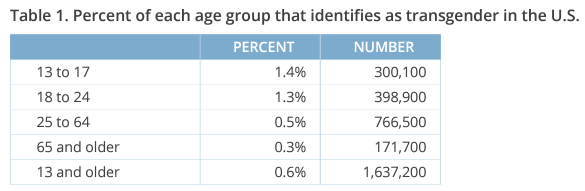
study by the Williams Institute

While there is a great deal more detail in the report, and I encourage you to read it, this and similar results has been used to support claims that our youth are enticed to be ‘trans’. While I believe that nothing could be further from the truth, I am going to focus solely on why using these studies to reach such a conclusion is fallacious.

The “Hidden Denominator”

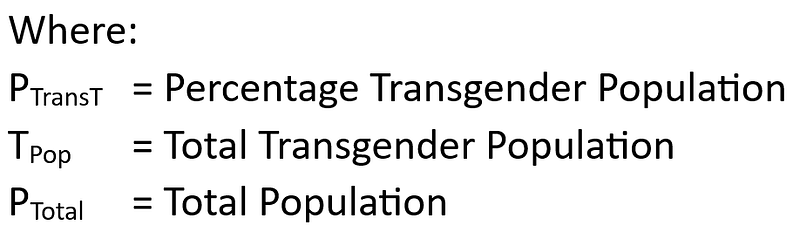
To begin with, how is the percentage of transgender persons in a population calculated?
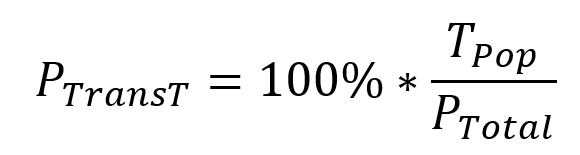
This seems straight forward enough, doesn’t it? So what about when we compare slices of the transgender population grouped by age ranges?

Let’s use a little hyperbole here. Let’s assume that 100% of all children identifying as transgender represent the entire population of transgender children in existence. This assumes that:

  1. All those that identify as transgender are in fact transgender. Admittedly, some may learn as they explore their gender identity that their true identity is something else in the cisgender spectrum.
  2. No child is closeted or hiding. Something I find hard to believe since acceptance and support is not universal in schools, neighborhoods, and society.

Now if 100% of the transgender population of children is being accurately reported, why is the number so large? Why is it so much larger than the percentage of transgender adults?

If I had this kitten, I would name her “Denominator” — Photo by Mikhail Vasilyev on Unsplash

Well, one key factor is this data is collected by questionnaire. This means that people need to report that they identify as transgender. Other obvious factors are how the population is surveyed:

  • What samples are selected?
  • Where are they focused/based?
  • What are the relative sample sizes?

But I will focus on the issue of self-reporting. First, just consider that adults are now coming out as transgender in increasing numbers at late ages. People come out in their 20’s, 30’s, 50’s, even as late as their 80’s or 90's! Do you really think they just woke up one day and identified as transgender? No of course not. They just finally reached a point where they felt secure enough or just couldn’t manage being closeted any longer.

So it is no stretch of the imagination that if we are counting those who identify as transgender in childhood, the population of adults so identified would be naturally smaller than that of children today.

Let’s face reality. Coming out in any decade before 2010 was fraught with danger, risk, and challenges. It seems to be getting harder again, but for a brief while, our youth were allowed to be who they are. So while I am sure that not all transgender children are being counted (I imagine they can only be reported with parental permission), it is reasonable or even likely that children have been far more comfortable coming out due to increasingly accepting environments.

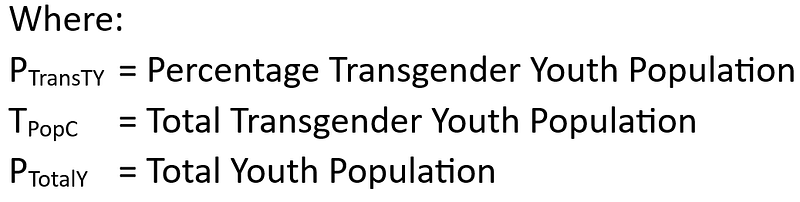
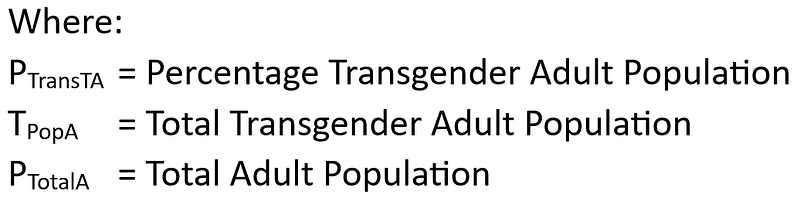
This changes the equation above, doesn’t it? So what we are really doing is comparing:

TO:

The closeted Adult Population is arguably a much larger percentage than the closeted Youth Population. But we cannot easily measure this, because we are not able to identify them with any accuracy.

The Lost

What about the transgender adults who aren’t alive today? The ones who we lost to violence, or self-harm? We are not likely to know all of them, since after death, their biographies are often re-written by families and news media. They will be recorded as the tragic death of “misgendered dead name”. How do you count these people? They made up a percentage of the children in their childhood years.

How much of the heart is missing? Where did they go? — Photo by Jiroe (Matia Rengel) on Unsplash

How do we calculate the population percentages of transgender persons? We take the count and divide by the population and multiply by 100%.

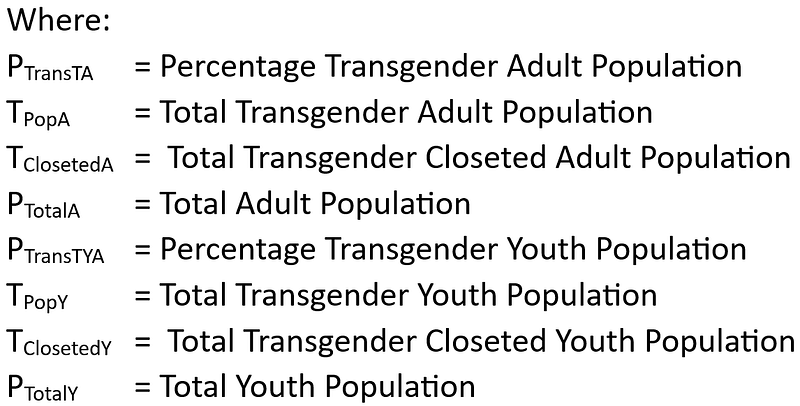
This missing count even further skews comparisons. So now we are comparing:

TO:

Again, the count of transgender youth who are deceased due to violence or self-harm is arguably a lower percentage of the transgender youth population than the same for the transgender adult population.

Mathematicians, Statisticians, and Computer Scientists: I know I am ignoring nuances here. In particular, the groups of non-transgender individuals who mis-identify, or who are lost to violence and self-harm, etc. Studies do show that these numbers are relatively quite small, so my point remains valid if my math is less than comprehensive.

Changing Definitions and Understanding
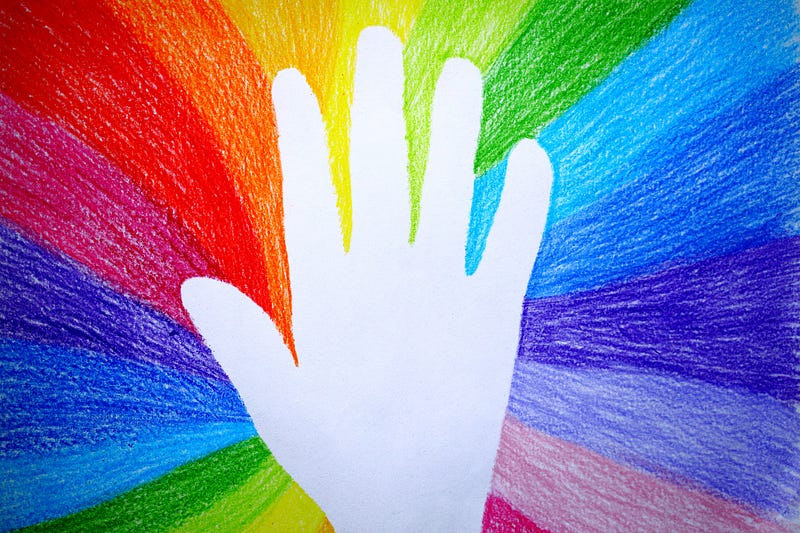
Photo by Katie Rainbow 🏳️‍🌈 on Unsplash

Our understanding of the definition and scope of transgender has changed considerably over the years. If you speak with late transitioning adults, those who only just came out at ages of 40–90+, one thing you will often hear is that they didn’t know that they were Transgender because they didn’t have the concept of what Transgender is. Back in the “not so good old days”, we all had images of transexuals as portrayed in TV and Movies. Transgender wasn’t even a word commonly in use. I will tell you I didn’t and still don’t identify with those caricatures. How could I come out if I didn’t have a name or concept that described who I was?

But today, our understanding of what transgender means and who it includes is more universal. The term has also expanded to include all kinds of gender non-conforming individuals. Being transgender doesn’t mean you need or have to have hormone treatments or gender affirming surgeries. But it does mean that you may need them due to challenges with underlying dysphoria. But in the end, it is and must be the choice of the individual in consultation with their chosen medical providers.

So broader definition naturally means more youth can safely come out as transgender. And, while not all transgender youth need or seek medical affirming care, they should still receive supporting care in the form of recognition, respectful use of their chosen name and pronouns, the ability to dress and present as themselves, and safe access to public facilities.

The broader definition also encourages adults to come out, but not as dramatically. Many of us in the spectrum can happily exist in hiding or with minimal presentation differences without being overtly transgender. For those of us in that situation, coming out or not coming out is a choice. For those of us with dysphoria, there is often no choice.

I won’t write the equations this time. Suffice to say, the out populations are even further skewed by this phenomenon.

OK, So Why Did You Make Me Do This Math?

This is a lot of work to say that the study doesn’t capture a lot of data. But it does capture some significant things. It shows that there is a significant population of transgender youth and adults that should be granted equal rights and safety as is provided for the rest of the population.

It indicates that the population of transgender individuals in existence is likely much larger than we understood, although still quite a small percentage.

It indicates that changes in policies to provide protection and access to supportive care are having a positive effect and more youth and adults are finally being given and taking advantage of this opportunity by coming out.

The idea that there is a massive increase due to social contagion is not supported by the study. The study doesn’t disprove this concept either, but there are numerous studies that do. But that is a discussion for another article.

For now, just take a moment to stop and realize that whenever someone throws out numbers like the number of children coming out as transgender has doubled or even increased by 600% that:

  1. These numbers are likely hyperbole or at least provide an incomplete picture.
  2. The increases can be easily explained in non-alarming terms.
  3. The numbers do not demonstrate anything about “social contagion”.

Let the medical professionals and scientists who study this and other social issues to further appropriate policies for medical care be our guiding post for decisions. Take legislative policies managing healthcare out of the equation. Your representative is not the expert you want deciding if you need a heart transplant, or any treatment, so why would you support them making decisions regarding anyone else’s healthcare?

Stop supporting legislation that leads to discrimination and bullying! How does that make this world a better place for our children and each other? Why waste your energy in fighting something so inconsequential as other people’s gender identities?

Stop acting and focus on getting to know each other. Get to know us. We are all people together; it is time we learned that.
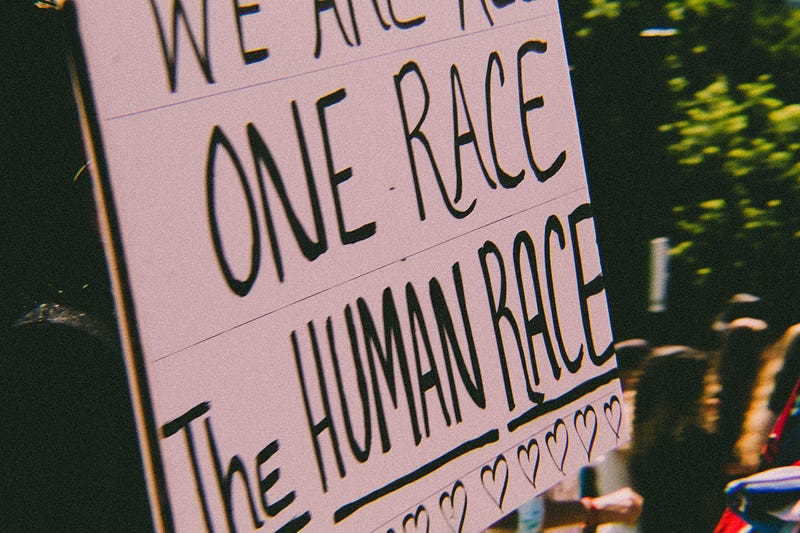
Photo by Janay Peters on Unsplash
LGBTQ
Transgender
Population
Public Policy
Equality
Recommended from ReadMedium