
Wildlife
Close Encounters of the Extraordinary Kind
My manatee experience at the Canaveral National Seashore.
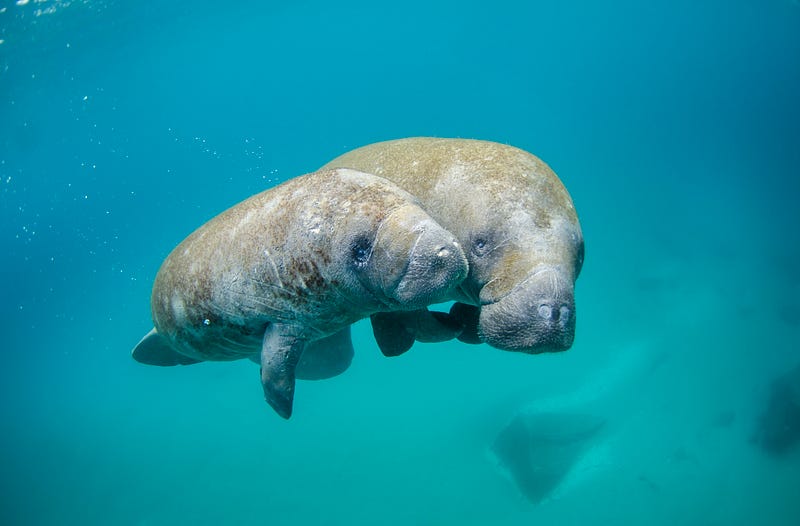
It stood about two feet out of the surface of the grey silver lagoon. It was round and black but only visible for a few seconds before disappearing into the water with no sound. The paddle-shaped tail belonged to a creature that I had never seen before, at least not in the wild.
We were here to film the Artemis space rocket. To get our footage we paid our $20 entrance fee to the Canaveral National Seashore so that we had an unencumbered view of launch pad 39B where the rocket wait for “all system go” — a window that began Monday Aug 29th.
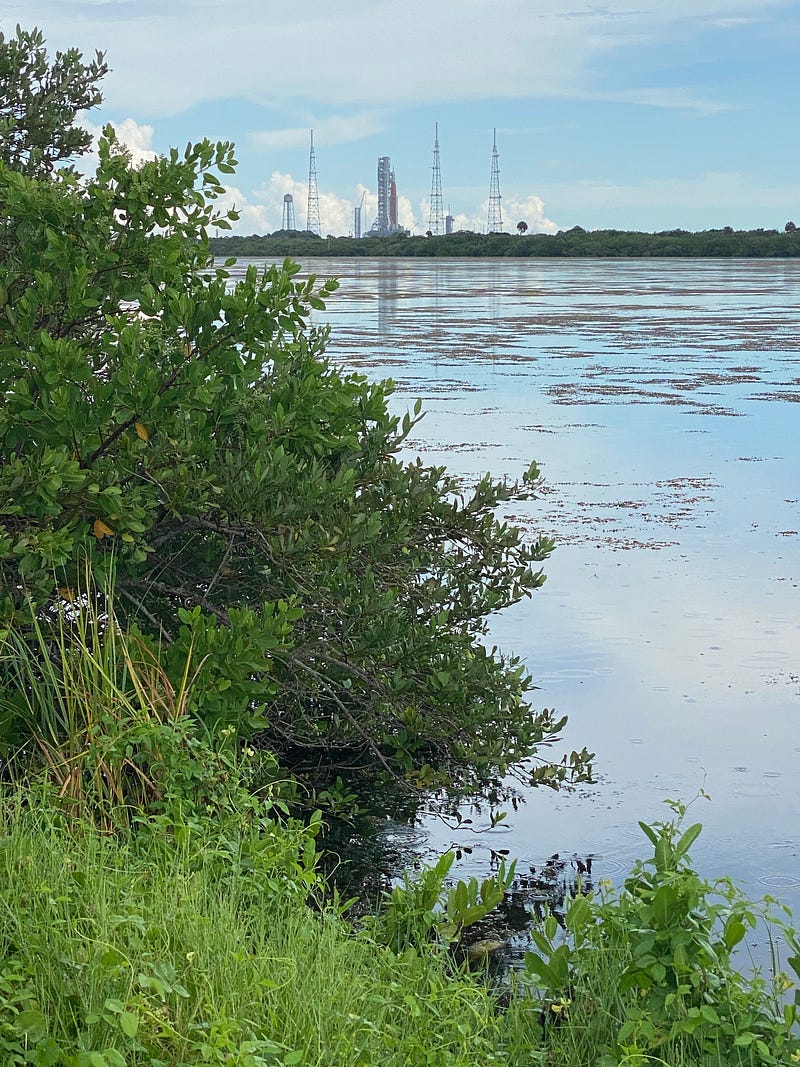
After we got our video of the rocket — including pans, tilts and closeups — we decide to drive around the corner to see if we could see the illusive sea creature that was rumored to live in these parts.
“There they are,” my camera man said quietly just as we stepped out on the Eddy Creek lookout, a small sturdy wooden deck that jetted out into the lagoon about 20 feet. Out in the water were manatees!
What is a manatee?
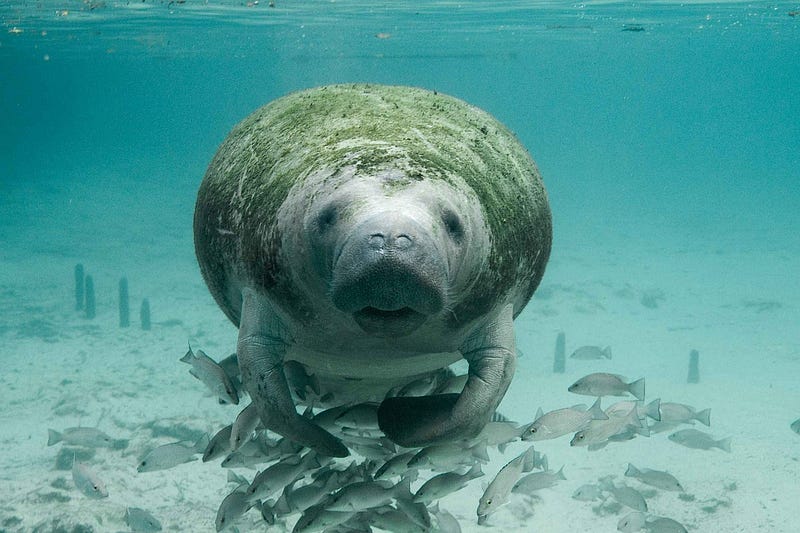
The manatees are marine mammals that make this part of the world their home. They look like elephant seals that mated with a dolphin. They were once on the endangered species list but reclassified as “threatened” in 2017.
I walked to the edge of the deck and looked down. A mother and calf were poking their heads above the water about 15 feet from me. The mother’s loud snort cleared the water from her large grey nostrils, her whispers twitched as she looked up at me. Her eyes were open wide, and I swear she smiled.
My mouth dropped as she arched her back and dove, the long heavy length of her large body covered in barnacles and crusted like and old grey ship in need of a good cleaning. The grace of her movement left little water disturbance as she vanished into the brown silty brackish pool. She was followed closely by her calf.
How many manatees live in the United States?
Between 5000–7000 West Indian manatees live in the waters around the east and west coast of Florida (fewer than 700 live in Puerto Rico). Back in the 1970s, the manatees numbered in the hundreds before being listed as endangered.
I usually can’t contain myself when I witness the rare and magical moments of nature. Just then I wanted to jump up and down and scream, “DID YOU SEE THAT? DID YOU SEE THAT?!!”
I was silent and gave the magnificence of the moment its quiet reverence just like the 5 people standing on the deck with me. We couldn’t believe our fortune to be here with the manatees.
The Artemis rocket, just a stone’s throw away, suddenly didn’t matter. The moon missions became just another silly human folly. Traveling away from this precious planet seemed a waste of time and money when all the magic was right down on earth.
My being here became all about the elegance of a ‘sea cow’ in this lagoon, its slow movements, its bulbous grace, and its happy demeanor, which made space exploration seem small by comparison.
Shivers shot down my spine even as my back, arms, and legs glistened with sweat in the 90% humidity on a 90-degree day in Florida.
The awe cooled me as I watched a paddle-shaped tail kicked up, a nose opened and closed, a grey and white spotted belly twisted out of the surface of the water, a flipper waving up at me, and the hissing snorting kept me riveted to these creatures.
Fun Facts
- Most weigh between 1200–1500 lbs but have no blubber and need at least 65-degree water.
- They can live up to 60 years old.
- 50 % of the time they spend sleeping and surface every 20 minutes for air. The rest of the time they eat.
- In West African tribes they are sacred animals-
In the Serer people of Senegal’s creation myth, the African manatee is viewed as the guardian of the secrets of the future. — OneEarth
Manatee starvation incident 2021
In 2021 about 1100 manatees died of starvation because of a lack of seagrass due to algal blooms. The Fish and Wildlife Service tried to save some by feeding them tons of romaine lettuce. It was just a workaround not a fix.
Common causes of manatee death
Most premature manatee deaths are human-related.
Boats and ships slice them with their propellers, people poison their habitats with fertilizers and toxic chemicals. “Red Tides” make it difficult for the sunlight-loving seagrass to grow. Climate changes fluctuated water temperatures and destroy natural habitats.
“Aren’t they adorable,” my cameraman whispered.
I had no words, only complete and utter appreciation that the manatees let me be there with them without swimming away.
When we went back to our television work I wondered what these animals will think when they feel the shaking of the earth and hear the rumble of the rocket when it lifts off next week.
Will they be bothered by the noise? Will they think about the moon's mission and what it means to them? Will I think of it? Will I care about rockets and astronauts?
Not as much as I care about the manatees and all the other threatened animals struggling to survive.
I will spend my time down here on earth thinking about what we can do to make these adorable manatees happy and healthy, while I thank them for an encounter of the extraordinary kind.
Want to help the manatees? Maybe you would consider joining the Save the Manatees Club!
If you enjoy these stories and you also want to discover millions of other writers on Medium please consider subscribing for as little as $5 a month with the link below. Audrey will get a little slice of the pie if you do. Thank you for your support.
Audrey Stimson is a writer living in a green house with her husband and two dogs. When she is not writing essays and short stories she works as a television news producer. She is currently working on a forthcoming book about a bicycle trip across the United States. More about Audrey on her website .