avatarDr John Frederick Rose

Summary

The text discusses the origins of the terms "clockwise" and "counterclockwise," explaining how they are rooted in the movement of sundial shadows in the Northern Hemisphere and have become universally accepted despite the sun's shadow moving in the opposite direction in the Southern Hemisphere.

Abstract

The concept of "clockwise" direction originated from the rotation of a clock's hands, which in turn mimicked the shadow cast by a sundial in the Northern Hemisphere. Before the invention of clocks, people used the term "sunwise" to describe the direction of the sun's movement across the sky. Sundials, which are the precursors to mechanical clocks, were first used around 1500 BCE in Egypt and Babylon. The direction of the shadow's rotation on a sundial varies depending on the hemisphere. The first mechanical clocks in 13th-century Europe were striking clocks that rang bells for community prayers. Over time, clockmakers developed clock faces with hands that moved in a manner imitating the sun's shadow on a sundial. Although the terms "clockwise" and "counterclockwise" are now widely accepted, they originated from a Northern Hemisphere-centric perspective, independent of the sun's actual position in either hemisphere. The author reflects on how this historical exploration has made them realize the gradual disconnection between society and nature, a process that began with the specialization of labor as societies grew.

Opinions

  • The author acknowledges a personal revelation about the forgotten influence of sundials on the direction of clock hands.
  • There is an appreciation for the historical process that led to the universal acceptance of "clockwise" and "counterclockwise" as directions.
  • The author expresses a sense of wonder about how much of our daily language and concepts are deeply rooted in historical practices and observations of nature.
  • The text suggests that the separation of society from nature has been a gradual process, possibly starting with the advent of specialized roles in larger populations.
  • The author conveys a passion for writing and research, as it leads to insights and realizations about the interconnectedness of historical and modern practices.

Clockwise?

Wondered how directions like clockwise came about.

On the left, an arrow illustrating the clockwise direction. On the right, an arrow illustrating the counterclockwise or anticlockwise direction. By Scott5114 — Own work, Public Domain, https://commons.wikimedia.org/w/index.php?curid=4529712. Copyright holder of this work, released this work into the public domain.

Picture on left, Other on right, Turning this way then that, Feeling giddy, Need coffee, Where did all this come from?

Before clocks and words like “clockwise” and “counterclockwise” People used “sunwise”, Easily understood, “Look up!” Dad told me, Even paranoid me was satisfied.
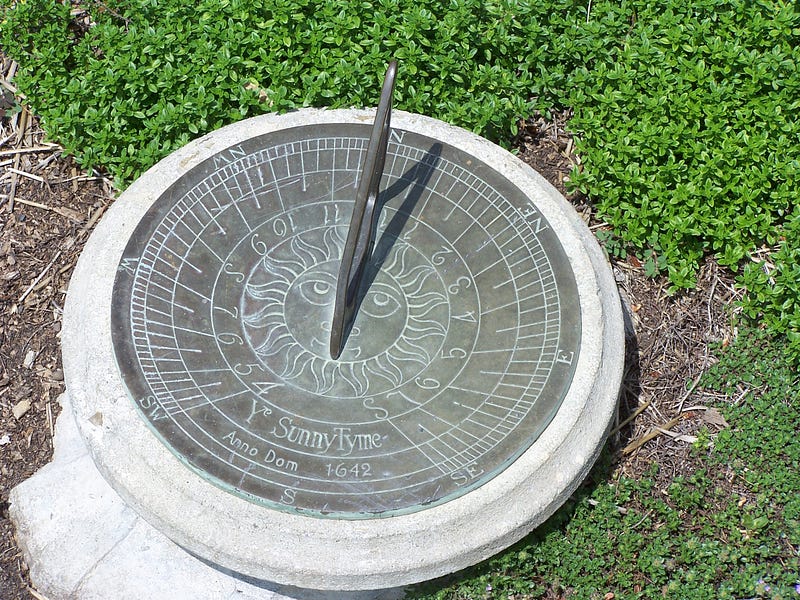
Sundial in thyme garden at Minnesota Landscape Arboretum. The shadow of a horizontal sundial in the Northern Hemisphere rotates clockwise. By SEWilco — Own work, CC BY-SA 3.0, https://commons.wikimedia.org/w/index.php?curid=2263164. Licensed under the Creative Commons Attribution-Share Alike 3.0 Unported license.

Sundials originated Northern Hemisphere, Earliest around 1500 BCE in Egypt and Babylon, Sundial’s shadow rotates different direction depending upon whether viewer is in Northern or Southern hemisphere.
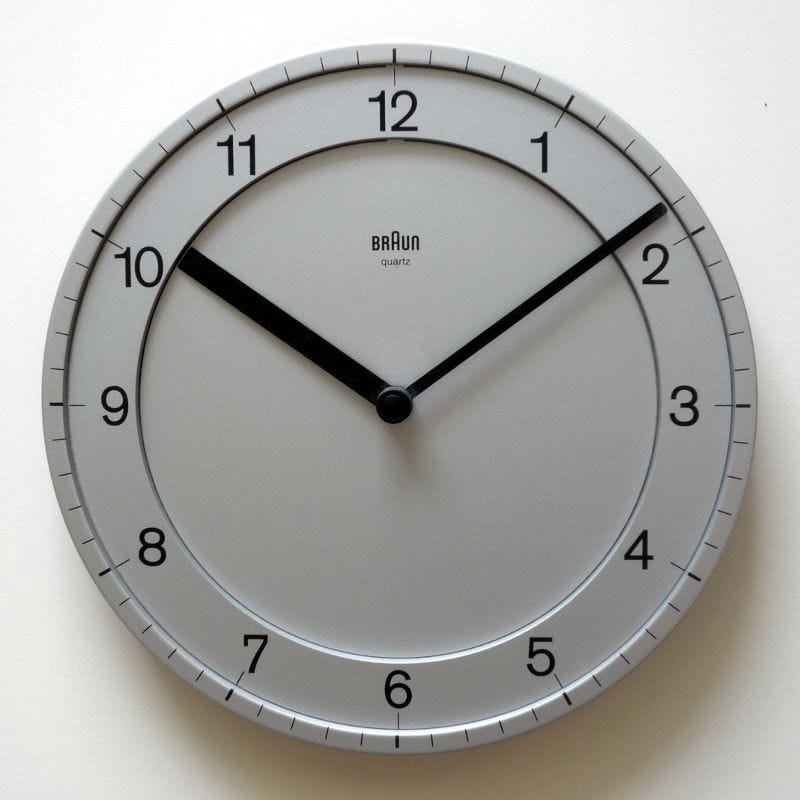
A wall clock showing the time at 10:09. By Phrontis — Own work, CC BY-SA 3.0, https://commons.wikimedia.org/w/index.php?curid=19685380. Licensed under the Creative Commons Attribution-Share Alike 3.0 Unported license.

First mechanical clocks built 13th-century Europe were striking clocks, Ringing bells to call community for prayer.

Clockmakers realized gears could drive indicator on dial mounted outside of clock tower, Familiar clock face with revolving minute and hour hands dates to around 1690 AD.

Direction of clock hands’ rotation evolved in direct imitation of sun’s shadow on sundial in Northern Hemisphere, This rotating direction known as “clockwise” continues to this day, Clockwise and anticlockwise now universally accepted, Completely independent of sun’s position in either hemisphere.

Reflection.

Amazes me, Until writing this story didn’t realise I’d forgotten about sundials and their different shadow motion between Northern and Southern hemispheres.

Demonstrates that gradual separation of society from nature started centuries before modern times, Probably began with population sufficiently large to support specialisation.

All these thoughts spring from simply researching “clockwise”, It’s one reason I love writing.

Blessed be.

Poetry
Clockwise
Sundial
History Of Technology
Timekeeping
Recommended from ReadMedium