avatarRicky Lanusse

Free AI web copilot to create summaries, insights and extended knowledge, download it at here

6405

Abstract

a acceleration generally just gets you to the next red light a bit faster. A better balance between performance and thrift was within reach.</p><p id="8431"><i>The real letdown?</i> <b>If automakers had been pushed to upgrade their fleets annually, we’d be using (and needing) far less oil today — potentially even less than we did in 1973, despite a 56% population surge.</b></p><p id="f612">And, remember, the automotive industry is just one relatable example.</p><p id="fe67">Because, as <a href="https://www.science.org/content/article/meet-vaclav-smil-man-who-has-quietly-shaped-how-world-thinks-about-energy">Vaclav Smil</a> says, our modern world relies on four key materials that fuel our way of life, crucial for everything we do. And they all have one thing in common: they require fossil fuels for their production.</p><p id="2cc6">Advanced societies wouldn’t exist without certain materials. We had Concord before Facebook. But to maintain our quality of life, these four materials stand out as the building blocks of our modern world: <b>cement, steel, plastics, and ammonia.</b> They’re needed more than anything else. Each year, we produce about 4 billion tons of <a href="https://www.greenbiz.com/article/cement-most-destructive-material-world-or-driver-progress#:~:text=In%20recent%20times%2C%20global%20production,than%202%20billion%20in%201995">cement</a>.) (<a href="https://www.bankrate.com/insurance/car/average-car-weight/">2 entire cars-worth</a> of concrete per person), 2 billion tons of <a href="https://worldsteel.org/steel-topics/statistics/world-steel-in-figures-2022/">steel</a> (<a href="https://twitter.com/empirestatebldg/status/1113457377339113472">2700 Empire State Buildings</a>), 400 million tons of <a href="https://www.unep.org/interactives/beat-plastic-pollution/">plastics</a> (more than <a href="https://ourworldindata.org/plastic-pollution">45 kilos per person</a>), and 250 million tons of <a href="https://www.statista.com/statistics/1065865/ammonia-production-capacity-globally/">ammonia</a>. We spend about 17% of our energy to produce these materials, generating 25% of CO₂ emissions from fossil fuel combustion.</p><h1 id="f5b7">The Insanity of Expanding Fossil Fuels: a Collective Suicide Pact</h1><blockquote id="4022"><p><a href="https://www.un.org/sg/en/content/sg/statement/2022-11-07/secretary-generals-remarks-high-level-opening-of-cop27-delivered-scroll-down-for-all-english-version"><b>“Humanity has a choice: cooperate or perish</b></a><b>. It is either a Climate Solidarity Pact — or a Collective Suicide Pact,”</b> <i>the UN Secretary-General told over 100 world leaders reunited for the first official plenary of the UN Climate Change Conference COP27.</i></p></blockquote><p id="bdb8">Right now, it seems like we humans have taken the Collective Suicide Pact, as a <a href="https://productiongap.org/">UN report</a> revealed that major fossil fuel producers are gearing up for expansions that would obliterate the planet’s carbon budget twice over. Experts don’t mince words, labeling these plans as “insanity” that throws “humanity’s future into question.”</p><p id="6934">These grand energy schemes contradict climate policies and pledges. The report forewarns a 460% (!) increase in coal production, an 83% surge in gas, and a 29% in oil by 2030 — numbers that defy the internationally agreed-upon 1.5C temperature rise limit. Even the riskier 2C target would see a 69% excess of fossil fuel production.</p><figure id="de40"><img src="https://cdn-images-1.readmedium.com/v2/resize:fit:800/1*uuVD1EfDerW27Mk3fhIrBA.png"><figcaption>(Source: <a href="https://productiongap.org/2023report">Production Gap 2023 Report</a>)</figcaption></figure><figure id="1133"><img src="https://cdn-images-1.readmedium.com/v2/resize:fit:800/1*00oSV3StsZfB60LWmNArtw.png"><figcaption>(Source: <a href="https://productiongap.org/2023report">Production Gap 2023 Report</a>)</figcaption></figure><p id="919a"><b>About 90% of the upcoming carbon disaster from new oil and gas ventures between 2023 and 2050 can be traced back to just 20 countries. </b>Leading the charge in this carbon emission debacle are India (coal), Saudi Arabia (oil ), and Russia (coal, oil, and gas).</p><p id="970a">Now imagine this: if these 20 governments simply said <i>“no”</i> to their grand plans, we could dodge a massive 173 billion tonnes (Gt) of carbon pollution — that’s like avoiding the emissions of nearly 1,100 new coal plants or more than 30 years of the entire annual carbon output of the United States.</p><figure id="6e46"><img src="https://cdn-images-1.readmedium.com/v2/resize:fit:800/1*_FNNzGrm9ZKrOawMybOVXA.png"><figcaption>(Source: <a href="https://productiongap.org/2023report">Production Gap 2023 Report</a>)</figcaption></figure><p id="1890">Zooming in on the hypocrisy and recklessness, five governments from the global north emerge as the prime culprits and <b>chief <a href="https://priceofoil.org/2023/09/12/planet-wreckers-how-20-countries-oil-and-gas-extraction-plans-risk-locking-in-climate-chaos/">Planet Wreckers</a>: the United States, Canada, Australia, Norway, and the United Kingdom</b>. Despite their considerable economic capacity to swiftly phase out production, they account for 51% of the projected expansion from new oil and gas fields until 2050. And the United Arab Emirates (UAE), despite pledging to use its COP presidency to “keep 1.5°C alive”, is gearing up to be one of the largest amplifiers of oil and gas production.</p> <figure id="37d5"> <div> <div> <img class="ratio" src="http://placehold.it/16x9"> <iframe class="" src="https://cdn.embedly.com/widgets/media.html?type=text%2Fhtml&amp;key=a19fcc184b9711e1b4764040d3dc5c07&amp;schema=twitter&amp;url=https%3A//twitter.com/Neeraj10z/status/1721180438352560262&amp;image=https%3A//i.embed.ly/1/image%3Furl%3Dhttps%253A%252F%252Fabs.twimg.com%252Ferrors%252Flogo46x38.png%26key%3Da19fcc184b9711e1b4764040d3dc5c07" allowfullscreen="" frameborder="0" height="281" width="500"> </div> </div> </figure></iframe></div></div></figure><p id="ef7d">The audacity is staggering — these countries, with economic prosperity, carry a historical burden for triggering the climate crisis but still claim to be climate leaders while preparing for massive drilling escapades. It’s not just unaccep

Options

table; it’s hypocrisy on steroids. These nations need an abrupt halt to expansion, but more importantly, they should lead the charge in phasing out production and footing a fair share for a just global energy transition. Talk about wearing a climate-conscious hat and swinging a wrecking ball at the same time.</p><h2 id="37c6">On top of economic insanity, it is a climate disaster of our own making</h2><p id="c778"><a href="https://www.carbonbrief.org/new-fossil-fuels-incompatible-with-1-5c-goal-comprehensive-analysis-finds/">Scientific studies</a> repeatedly affirm that any new oil and gas fields are incompatible with the 1.5C global heating limit agreed upon in Paris. Yet, the report’s analysis of publicly available data exposes a glaring gap estimated at 20bn tonnes of CO₂, about half of today’s annual global emissions, between planned production and the amount consistent with climate goals. And relying on uncertain future technologies to capture and store CO₂ underground is playing the crystal ball.</p><blockquote id="71b5"><p><a href="https://www.unep.org/es/people/inger-andersen"><i>Inger Andersen</i></a><i>, the executive director of the UN environment program, asserts,</i> <b>“These plans throw humanity’s future into question. Governments must stop saying one thing and doing another.”</b></p></blockquote><p id="95b7">And just to highlight how cynical this is: the planned expansions, if not reined in, could result in colossal losses for fossil fuel producers as the world intensifies efforts to slash CO₂ emissions.</p><h1 id="1dec">How Predatory Capitalism is Taking Us Down The Road of Self-Destruction: A Troubling Equation</h1><p id="e2cf">The reality is paradoxical: our identity is built around consumption, and for that, we are entirely dependent on fossil fuels, no matter if the price we’re paying is the very Earth we inhabit. Because fossil fuels are far too cheap, considering their production and environmental costs.</p><p id="3da6">Globally, they <a href="https://www.imf.org/en/Topics/climate-change/energy-subsidies">received</a> a subsidy of 5.9 trillion or 6.8 percent of GDP in 2020 — and are expected to increase to 7.4 percent of GDP in 2025. The <b>fossil fuel industry <a href="https://www.theguardian.com/environment/2021/oct/06/fossil-fuel-industry-subsidies-of-11m-dollars-a-minute-imf-finds">gets</a> subsidies of 11 million a minute.</b> Or, what is even more disturbing, <b>for every dollar we are investing in climate change, we spend at least five subsidizing what is killing us.</b> Like taking cough syrup while living bare-naked in Antarctica. No wonder things are escalating this rapidly, and carbon emissions <a href="https://www.carbonbrief.org/analysis-chinas-co2-emissions-in-q2-2023-rebound-to-2021s-record-levels/">aren’t dropping</a> as they should.</p><p id="bfb4">There’s no debate — fossil fuels are the root cause of the climate crisis. Even within the fossil fuel industry, there has been a turning point, with companies like Chevron admitting in court that <a href="https://grist.org/article/fossil-fuels-are-the-problem-say-fossil-fuel-companies-being-sued/">“fossil fuels are the problem.”</a> Nevertheless, the forces of climate change denial and inaction persist. They only promote expanding their business while they want the public to think of them as part of a climate solution. In reality, they’re a problem trying to avoid being solved.</p> <figure id="8ff8"> <div> <div> <img class="ratio" src="http://placehold.it/16x9"> <iframe class="" src="https://cdn.embedly.com/widgets/media.html?type=text%2Fhtml&amp;key=a19fcc184b9711e1b4764040d3dc5c07&amp;schema=twitter&amp;url=https%3A//twitter.com/ZLabe/status/1722235240746459511&amp;image=https%3A//i.embed.ly/1/image%3Furl%3Dhttps%253A%252F%252Fabs.twimg.com%252Ferrors%252Flogo46x38.png%26key%3Da19fcc184b9711e1b4764040d3dc5c07" allowfullscreen="" frameborder="0" height="281" width="500"> </div> </div> </figure></iframe></div></div></figure><p id="2a3a">And these companies have become so profitable that they no longer know what to do with their incomes. Their latest trend is the <a href="https://apnews.com/article/chevron-corp-europe-business-8e7d855ee5a072980e7a35b1a6b3b9c6">“stock buyback,”</a> a self-serving tactic to boost share prices, ensuring that hefty bonuses keep rolling in.</p><p id="1e30">We can call that economic model many things, but “Predatory Capitalism” suits just right. <i>What does it mean? </i>That profit is the point of life, shareholders dictate social priorities, and nothing stands in the way of maximizing returns — not even people.</p><p id="6e53">Meanwhile, we as a civilization seem to adopt a <i>“change as little as possible and hope for the best”</i> strategy. We are making minor adjustments while pretending everything will be alright. But the truth is simple: this approach isn’t working, and our planet is paying the price.</p><p id="c201">The solution demands an economic transformation of unprecedented proportions to move away from fossil fuels. It’s glaringly obvious.</p><p id="7f33">But here’s the dilemma: <i>can you see it taking place anywhere?</i> Our current approach to climate change is rendering meaningful progress nearly impossible. Every day, in every community, decisions are being made to perpetuate our dependence on fossil fuels. City governments order new gasoline cars to add to their fleets. Counties order diesel garbage trucks, even though electric models are becoming available. School managers order new diesel buses, barely considering the alternatives.</p><p id="3725">The truth is simple: fossil fuels are sending essential climate goals up in smoke, and our planet is paying the price. And the fossil fuel industry, with a perverse delight, keeps expanding this profound abyss.</p><p id="e05d"><i>Thank you for your thorough reading and support! If you crave more insights into climate change, scientific progress, and geopolitics with a Patagonian twist, subscribe to the newsletter <a href="https://rickylanusse.substack.com/?utm_source=navbar&amp;utm_medium=web&amp;r=271e6q"></a></i><a href="https://rickylanusse.substack.com/?utm_source=navbar&amp;utm_medium=web&amp;r=271e6q"><b>Antarctic Sapiens</b></a> <i>and dive into thought-provoking content weekly.</i></p></article></body>

Climate Suicide: The Insanity of Projected Fossil Fuel Expansions

The Predatory Capitalism Equation We’re Ignoring
(Source: Production Gap 2023 Report)

When you pump gas into your car, you’re probably thinking about getting it moving. You are right, of course, but here’s a harsh reality check: 75–80% of that gasoline’s energy is lost as heat that dissipates in smoke, quite literally. And only 20% is actually doing the job it’s meant to do — move your car.

From an engineering standpoint, this is a downright embarrassment. And this isn’t just a financial headache for drivers who get just 20 cents worth of driving motion for every dollar of petrol. This is a reckless discharge of pollutants, including greenhouse gases, into the atmosphere. With zero payoff.

Now, can we fix this mess? Sure, there are incremental paths to improvement with conventional gasoline engines. But, I repeat, these are incremental.

Everyone’s buzzing about electric cars these days, and rightfully so. But discussing how to fix the world’s transportation system involves not only electric cars: it starts with the ones that still burn gasoline. Because cars stick around for a while, and the transition to an all-electric fleet, even if we go full throttle, will take decades. In the meantime, another two billion fuel-burning cars will be hitting the streets along with 100,000 flights per day and some 180,000 vessels navigating the oceans. This sector alone is responsible for 17% of global CO₂ emissions. We need to do better; there’s plenty of room for improvement.

Yet here we are, spending insane amounts of cash to extract, refine, and waste most of the oil we pump from the ground. That is no way to run a car. Or a planet.

And it’s not only transportation; they are just a handy example. We generate heat in any energy transformations, such as chemical into flame and then flame into motion. And more heat means more energy down the drain. The same principle applies whether you’re talking about a steam engine, an electric generator, a power plant, jet engines, even an oil drilling rig, or anything else turning fuel into motion.

Oh, and just in case you thought that was the epitome of humankind’s contradictions — where we promote inefficient machines at the expense of the planet’s overall climatic homeostasis and our health — a recent UN report has found that the world’s biggest (and greediest) fossil fuel producers are planning expansions that would blow the planet’s carbon budget twice over.

“Insanity” doesn’t even begin to cover it; it’s a blatant threat to the future of humanity.

How Do We Know Transportation Can Be More Efficient? Because It Has Been Done Before.

Rewind to the aftermath of the 1970s oil shock, where US President Gerald Ford didn’t just talk the talk; he pushed Congress to enforce mandatory fuel-efficiency standards. Doubling the mileage performance of new cars within a decade was the goal, and despite automakers insisting it was impossible, the law passed, and they had to comply. The market demand mirrored the legislation, with Americans seeking economical cars amid soaring gas prices.

This era witnessed the entrance of Japanese automakers, who seized a significant chunk of the market from the Big Three in Detroit with their efficient small cars. Engines were revamped, cars shed weight, and aerodynamics took center stage. Each incremental tweak culminated in a substantial shift.

Yes, there were epic failures, like the infamous Ford Pinto, Chevrolet Vega, and AMC Gremlin. Despite their design blunders, the automotive industry focused intensely on fuel economy for over a decade, resulting in a 1982 average new car consuming half as much gasoline as its 1973 counterpart.

But the fuel economy requirements hit a wall in 1985. The 1980s oil bounty, propelled by offshore wells and new Saudi fields, relaxed the pressure on gas prices. Presidents like Ronald Reagan felt no urgency to tighten requirements. For 25 years, efficiency stagnated, and during the late ’90s economic boom, Americans gravitated toward gas-guzzling SUVs with weaker requirements. And this pandemic expanded all over the world.

And here’s the kicker: automotive progress persisted. Engineers continued innovating toward efficiency. These gains could’ve translated to better gas mileage without sacrificing performance. However, lacking government pressure, automakers used the advancements to make cars heavier and more powerful.

Today’s average family sedan accelerates like a sports car from half a century ago. Sure, faster cars have their appeal, but the extra acceleration generally just gets you to the next red light a bit faster. A better balance between performance and thrift was within reach.

The real letdown? If automakers had been pushed to upgrade their fleets annually, we’d be using (and needing) far less oil today — potentially even less than we did in 1973, despite a 56% population surge.

And, remember, the automotive industry is just one relatable example.

Because, as Vaclav Smil says, our modern world relies on four key materials that fuel our way of life, crucial for everything we do. And they all have one thing in common: they require fossil fuels for their production.

Advanced societies wouldn’t exist without certain materials. We had Concord before Facebook. But to maintain our quality of life, these four materials stand out as the building blocks of our modern world: cement, steel, plastics, and ammonia. They’re needed more than anything else. Each year, we produce about 4 billion tons of cement.) (2 entire cars-worth of concrete per person), 2 billion tons of steel (2700 Empire State Buildings), 400 million tons of plastics (more than 45 kilos per person), and 250 million tons of ammonia. We spend about 17% of our energy to produce these materials, generating 25% of CO₂ emissions from fossil fuel combustion.

The Insanity of Expanding Fossil Fuels: a Collective Suicide Pact

“Humanity has a choice: cooperate or perish. It is either a Climate Solidarity Pact — or a Collective Suicide Pact,” the UN Secretary-General told over 100 world leaders reunited for the first official plenary of the UN Climate Change Conference COP27.

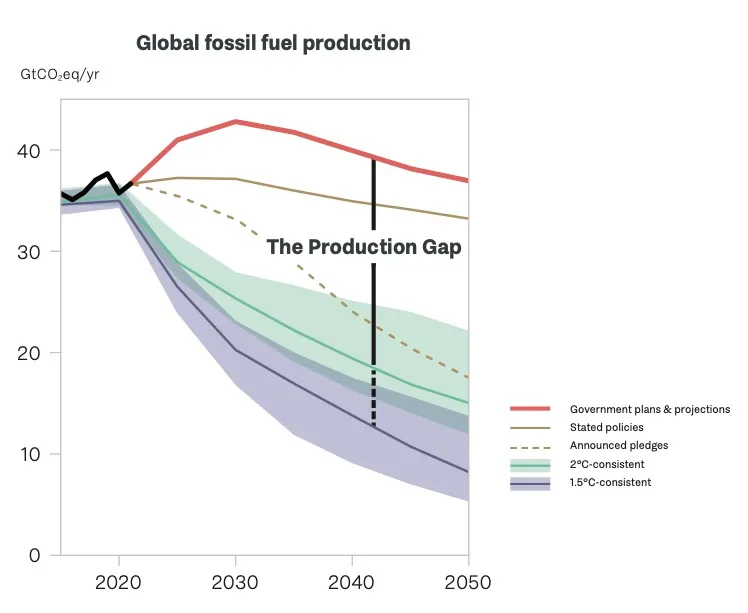
Right now, it seems like we humans have taken the Collective Suicide Pact, as a UN report revealed that major fossil fuel producers are gearing up for expansions that would obliterate the planet’s carbon budget twice over. Experts don’t mince words, labeling these plans as “insanity” that throws “humanity’s future into question.”

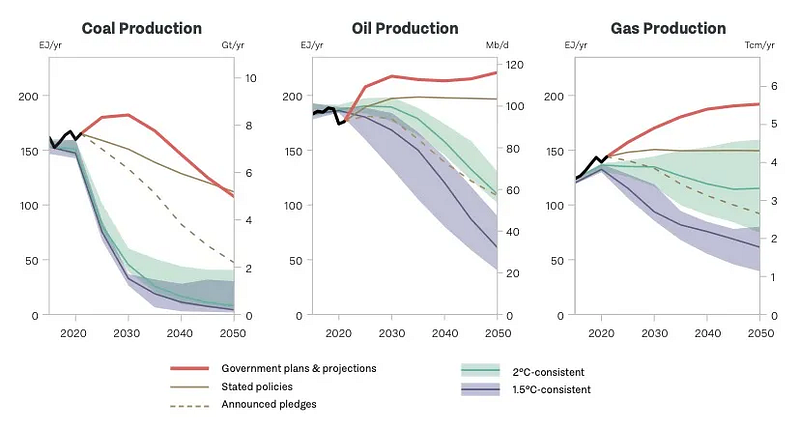
These grand energy schemes contradict climate policies and pledges. The report forewarns a 460% (!) increase in coal production, an 83% surge in gas, and a 29% in oil by 2030 — numbers that defy the internationally agreed-upon 1.5C temperature rise limit. Even the riskier 2C target would see a 69% excess of fossil fuel production.
(Source: Production Gap 2023 Report)

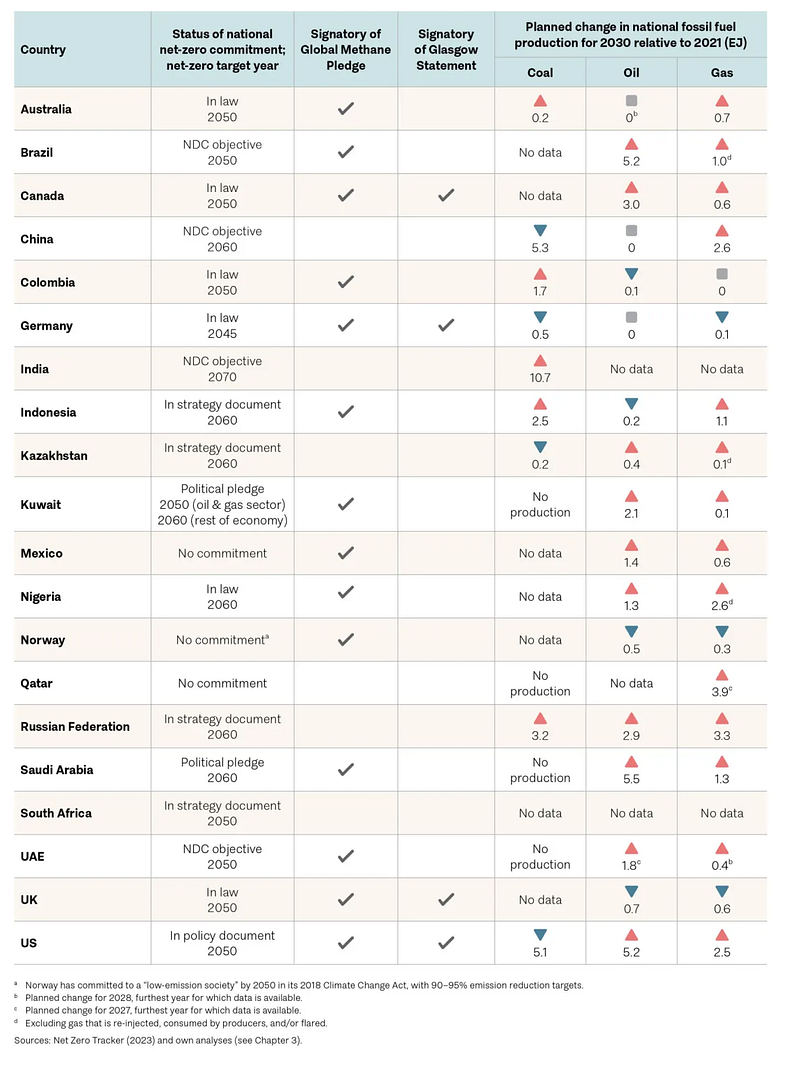
About 90% of the upcoming carbon disaster from new oil and gas ventures between 2023 and 2050 can be traced back to just 20 countries. Leading the charge in this carbon emission debacle are India (coal), Saudi Arabia (oil ), and Russia (coal, oil, and gas).

Now imagine this: if these 20 governments simply said “no” to their grand plans, we could dodge a massive 173 billion tonnes (Gt) of carbon pollution — that’s like avoiding the emissions of nearly 1,100 new coal plants or more than 30 years of the entire annual carbon output of the United States.
(Source: Production Gap 2023 Report)

Zooming in on the hypocrisy and recklessness, five governments from the global north emerge as the prime culprits and chief Planet Wreckers: the United States, Canada, Australia, Norway, and the United Kingdom. Despite their considerable economic capacity to swiftly phase out production, they account for 51% of the projected expansion from new oil and gas fields until 2050. And the United Arab Emirates (UAE), despite pledging to use its COP presidency to “keep 1.5°C alive”, is gearing up to be one of the largest amplifiers of oil and gas production.

The audacity is staggering — these countries, with economic prosperity, carry a historical burden for triggering the climate crisis but still claim to be climate leaders while preparing for massive drilling escapades. It’s not just unacceptable; it’s hypocrisy on steroids. These nations need an abrupt halt to expansion, but more importantly, they should lead the charge in phasing out production and footing a fair share for a just global energy transition. Talk about wearing a climate-conscious hat and swinging a wrecking ball at the same time.

On top of economic insanity, it is a climate disaster of our own making

Scientific studies repeatedly affirm that any new oil and gas fields are incompatible with the 1.5C global heating limit agreed upon in Paris. Yet, the report’s analysis of publicly available data exposes a glaring gap estimated at 20bn tonnes of CO₂, about half of today’s annual global emissions, between planned production and the amount consistent with climate goals. And relying on uncertain future technologies to capture and store CO₂ underground is playing the crystal ball.

Inger Andersen, the executive director of the UN environment program, asserts, “These plans throw humanity’s future into question. Governments must stop saying one thing and doing another.”

And just to highlight how cynical this is: the planned expansions, if not reined in, could result in colossal losses for fossil fuel producers as the world intensifies efforts to slash CO₂ emissions.

How Predatory Capitalism is Taking Us Down The Road of Self-Destruction: A Troubling Equation

The reality is paradoxical: our identity is built around consumption, and for that, we are entirely dependent on fossil fuels, no matter if the price we’re paying is the very Earth we inhabit. Because fossil fuels are far too cheap, considering their production and environmental costs.

Globally, they received a subsidy of $5.9 trillion or 6.8 percent of GDP in 2020 — and are expected to increase to 7.4 percent of GDP in 2025. The fossil fuel industry gets subsidies of $11 million a minute. Or, what is even more disturbing, for every dollar we are investing in climate change, we spend at least five subsidizing what is killing us. Like taking cough syrup while living bare-naked in Antarctica. No wonder things are escalating this rapidly, and carbon emissions aren’t dropping as they should.

There’s no debate — fossil fuels are the root cause of the climate crisis. Even within the fossil fuel industry, there has been a turning point, with companies like Chevron admitting in court that “fossil fuels are the problem.” Nevertheless, the forces of climate change denial and inaction persist. They only promote expanding their business while they want the public to think of them as part of a climate solution. In reality, they’re a problem trying to avoid being solved.

And these companies have become so profitable that they no longer know what to do with their incomes. Their latest trend is the “stock buyback,” a self-serving tactic to boost share prices, ensuring that hefty bonuses keep rolling in.

We can call that economic model many things, but “Predatory Capitalism” suits just right. What does it mean? That profit is the point of life, shareholders dictate social priorities, and nothing stands in the way of maximizing returns — not even people.

Meanwhile, we as a civilization seem to adopt a “change as little as possible and hope for the best” strategy. We are making minor adjustments while pretending everything will be alright. But the truth is simple: this approach isn’t working, and our planet is paying the price.

The solution demands an economic transformation of unprecedented proportions to move away from fossil fuels. It’s glaringly obvious.

But here’s the dilemma: can you see it taking place anywhere? Our current approach to climate change is rendering meaningful progress nearly impossible. Every day, in every community, decisions are being made to perpetuate our dependence on fossil fuels. City governments order new gasoline cars to add to their fleets. Counties order diesel garbage trucks, even though electric models are becoming available. School managers order new diesel buses, barely considering the alternatives.

The truth is simple: fossil fuels are sending essential climate goals up in smoke, and our planet is paying the price. And the fossil fuel industry, with a perverse delight, keeps expanding this profound abyss.

Thank you for your thorough reading and support! If you crave more insights into climate change, scientific progress, and geopolitics with a Patagonian twist, subscribe to the newsletter Antarctic Sapiens and dive into thought-provoking content weekly.

Climate Change
Science
Politics
Technology
Capitalism
Recommended from ReadMedium