
Climate Crisis: Unveiling the Top 15 Warmest Years on Record
You won’t see anything out of the 2000s range…
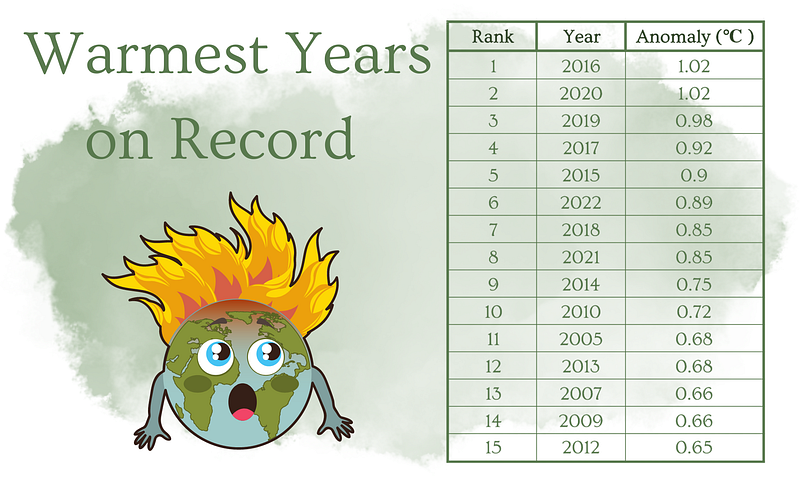
It may come as a surprise, but the fifteen warmest years on record all happened in the last 18 years.
2020 and 2016 are statistically tied as the hottest years since record-keeping began in 1880! But they will likely lose the infamous spot in the next five years.
Last week, I was on holiday at my mother-in-law’s house in Holland. She lives in this small picturesque village — it makes me think I’m in a fairytale story every time I visit. All through the village, there are these stunning canals. A very Dutch thing for sure. And beautiful too.
One day, we were out for a walk, crossing a bridge across the canal closest to her house. For some reason, the conversation arrived at how warm the summer was in Holland nowadays. She told me it’s often warmer where she lives than in northern Spain. And then she told me something even more surprising. She moved to this town (it’s not where she grew up) over ten years ago, and she told me that she never saw the canals freeze. She had never seen ice skating on the canals near her home.
Now, I’m Brazilian! I have never seen a frozen canal or gone ice skating (although, to be fair, we do get artificial ice skating rinks). And perhaps you’re asking yourself why I care.
Well, she explained to me she had gone ice skating on frozen canals often when she was young. And even after moving back to Holland, she had the opportunity to go ice skating on a frozen canal. But she did so in the North of the country, and much before she moved to her town. Some of her friends who lived in that village their whole lives confirm that the canals used to freeze over nearly every winter.
So you see, climate warming is changing our lives in several ways, but the consequences of rising temperatures aren’t always just the lack of an entertainment option. Earth’s global temperature has been rising since records began in 1880.
There was a slight dip in the 50s and 60s when temperatures were mostly below the trend line. But things picked up again in the late 70s, and they haven’t slowed down. Since 2001, most temperatures recorded have been above the trend line. In fact, since 2015, they have been way above the expected. So it’s not a surprise that my mother-in-law has never seen the canals frozen in the town where she lives! Temperatures have been especially hot for the last decade.
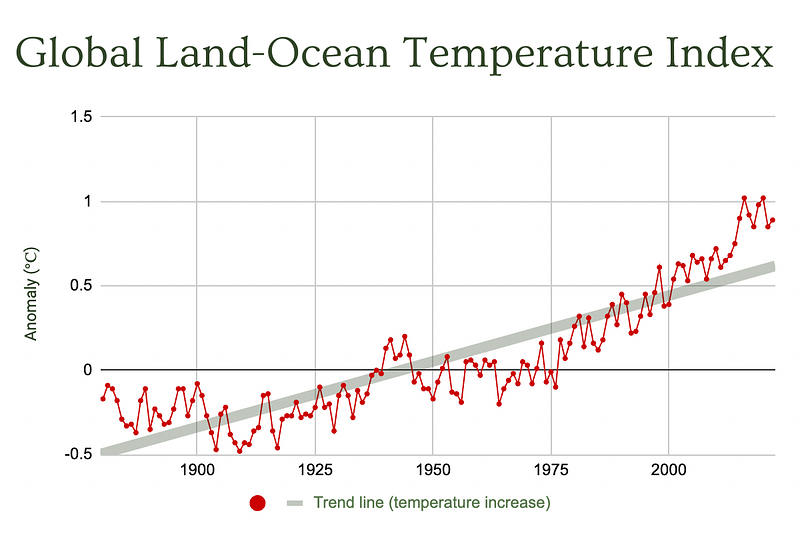
Temperatures are rising, and fast. And since 2008, temperature spikes have been above the trend line, with 2016 and 2020 breaking the 1℃ threshold.
Perhaps you’re like many of my friends who would love an increase in temperature, especially if you live in a place like Ireland, where summer lasts five days. Or maybe you’re thinking: there are artificial skating rings. Why is it a problem?
But it’s important to remember that climate isn’t the same as the weather. A lovely sunny day is still nice, and you’re welcome to enjoy it — I will.
Problems arise when the overall global temperature is on the rise everywhere, most of the time. That’s when we see a change in climate, as opposed to weather. Climate change is no joke or something to be celebrated.
With many temperature records being broken around the globe this year — from the hottest April ever in the southern hemisphere to Siberia experiencing temperatures close to 40°C (100°F) — 2023 could become the hottest year on record.
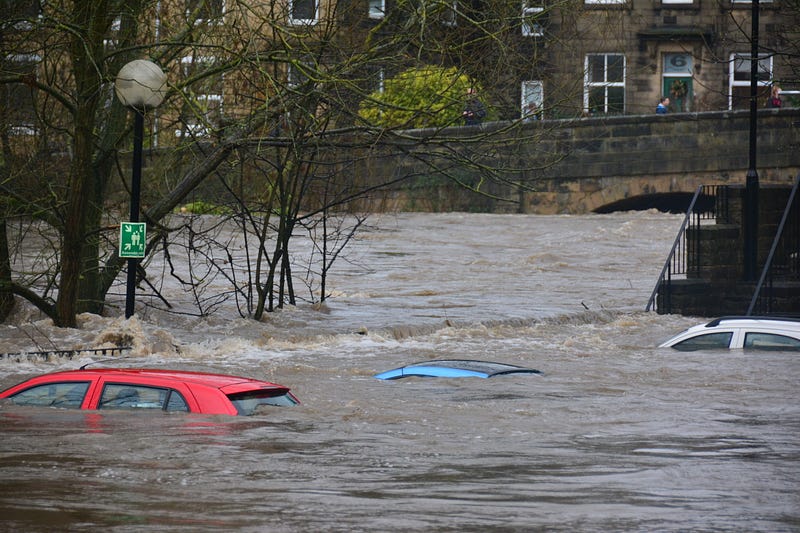
Severe weather events, such as floods, will happen more often and intensely as global temperatures keep rising. If temperatures rise above the 1.5°C threshold (the one mentioned by the Paris Agreement), we could face several complications:
- severe weather events, such as floods and droughts, happen more often and with more intensity;
- sea levels rise more, affecting an extra 10 million people;
- species extinction intensifies, with biodiversity and habitat loss for insects, animals, and plants more than doubling.
- Climate-related risks increase sharply, including health risks, food security, and water supply.
- all of these problems result in limited economic growth, affecting people’s lives even more strongly.
All these risks are explained in depth and backed up by studies on the IPCC (Intergovernmental Panel on Climate Change) “Global Warming of 1.5°C” report. So, even though it might seem that there’s not a lot of change happening, we’re all going to be affected by the shift in global temperatures.
Our kids deserve a future too. As I come back to real life after a lovely holiday, I watch my two young girls playing in our backyard. They’re just small, they don’t understand what the world is going through. But they’ll soon learn.
They won’t be able to go ice skating on the canal close to their granny’s house because that ship has sailed. But there’s still time to help make this world a better place for them to live in and to grow old in. That’s why sustainability is so important to me, and why I try to do all I can to reduce my impacts on the planet.
My mother-in-law is doing her part too. From attending climate strikes at The Hage, fighting her local council for more rewilding on the town’s public lawns, and becoming vegan alongside her partner. These are just some examples of how activism has no age limit.
You don’t need to be an activist to care, though. You can start with small steps to live more sustainably— from having plant-based meals, spending your money on sustainable products, supporting environmentally aware companies, and voting for candidates and parties willing to make sustainability a priority.
Your actions can help curb the steep rise in temperatures and keep the global temperature spike below the critical 1.5°C threshold.
Even if you enjoy hot sunny days and don’t care about ice skating, it’s beyond time that we all start doing our best to live a more sustainable life.



