
Clear-Cut Fault or Inferred Blame? Exploring Negligence Per Se and Res Ipsa Loquitur
Nuances of liability when direct evidence eludes us.
In the field of negligence law, two doctrines, Negligence Per Se and Res Ipsa Loquitur, offer efficient methods for establishing liability. Each serves a distinct purpose in the legal process and represents a practical approach to handling negligence cases.
Negligence Per Se applies when a defendant’s actions violate a specific law. This legal concept makes the process of proving negligence easier by automatically establishing a duty and its breach when a statute is violated. It directly links legal violations to liability, making it easier for plaintiffs to prove damages resulting from such violations.
Res Ipsa Loquitur, which translates as “the thing speaks for itself,” comes into action when the nature of an accident strongly suggests negligence, even without specific evidence of the defendant’s actions. This doctrine often shifts the burden to the defendant to prove that they were not negligent, a significant difference from the usual requirement that the plaintiff prove negligence.

Negligence Per Se
Imagine you are driving and you see a stop sign. You know you have to stop — it’s the law. But why? Because the law is there to prevent accidents, especially the kind that happen when someone runs a stop sign. This everyday scene is a simple example of how the legal doctrine of negligence per se works. It’s a matter of connecting the dots between the violation of a particular law and the harm that law was designed to prevent.
Breaking Down Negligence Per Se
- Statutory Violation. It is just like the stop sign example above. If someone breaks a specific law, that is the first clue. We are not just talking about any law, but one that is meant to prevent a certain type of harm.
- Protected Class. The law is not just there as a general guideline; it is there to protect a specific group of people. For instance, speed limits near schools are there to protect students.
- Statute’s Intent. Here we look at the injury. Did the harm that occurred match the type of harm the law aimed to prevent? If a speeding car near a school leads to an accident, this element lines up.
When Negligence Per Se Doesn’t Apply
However, life is complex, and there are times when this straightforward application of Negligence Per Se might not fit. For example:
- More Harm than Good. If following the law would cause more harm in a particular situation, then it might not apply.
- Impossible Compliance. Sometimes, despite best efforts, complying with the law is not possible.
- Incapacity. If someone could not comply due to a sudden, unforeseeable health issue, the law takes that into account.
- Emergencies. Unpredictable situations can lead to law-breaking that might not be counted as negligence.
- Unawareness. If you did not know you had to follow the law, such as unknowingly driving with a broken taillight, it might be considered.
- Exclusion in Tort Cases. Sometimes, the law itself says it should not be used to determine negligence in civil cases.
- Vagueness. If a law is too unclear, it’s unreasonable to hold someone to it.
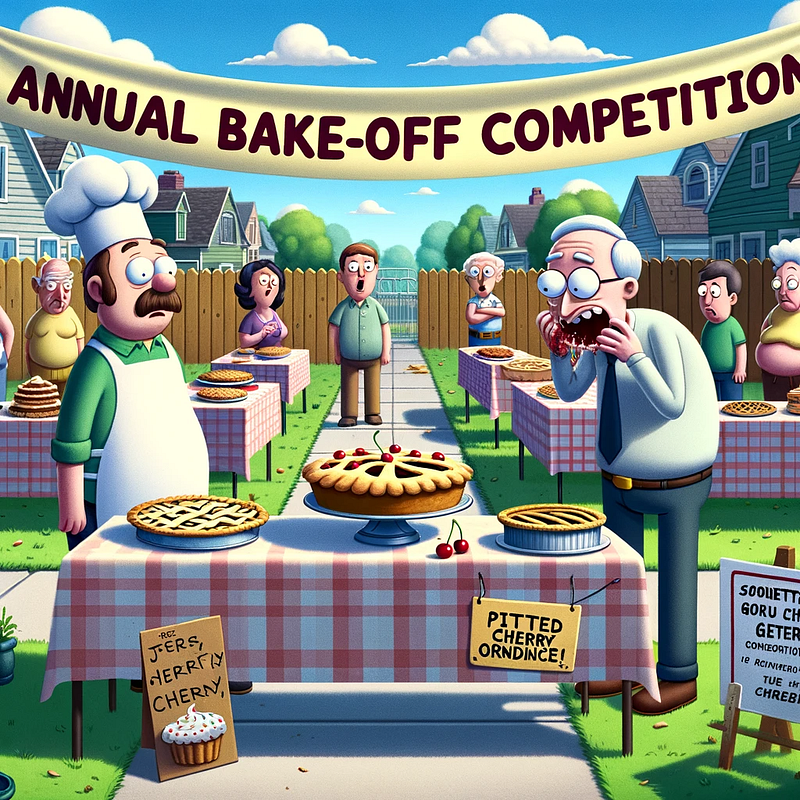
Humorous Example of Negligence Per Se 😉 There is a peaceful, sunny Saturday in the suburbs. The neighborhood is buzzing with excitement over the annual bake-off competition, a cherished tradition full of friendly rivalry and delicious treats. Among the contestants is Jerry, a well-intentioned but somewhat absent-minded baker. Eager to impress, Jerry decides to make his grandmother’s famous cherry pie. But in his excitement, he forgets one crucial detail — checking that his cherries are pitted. Unbeknownst to him, each cherry is a dental hazard with a hard pit in the center.
Now, let’s add a detail: there is a little-known, but very specific, local health ordinance that requires all cherries used in public baking contests to be pitted. This law was passed after a number of unfortunate dental incidents at previous public events (including last year’s infamous “Pecan Pie Toothache Pandemonium”).
The bake-off is in full swing, and the judges are making their rounds. The mayor, a known cherry pie aficionado, takes a hearty bite of Jerry’s pie and — crunch! A visit to the dentist is suddenly in his immediate future.
Here’s where negligence Per Se comes in. Jerry’s failure to pit the cherries, though inadvertent, is a direct violation of the local health regulation. This violation is not merely an oversight; rather, it’s a violation of a specific law designed to prevent exactly this type of incident. Under negligence Per Se, Jerry’s oversight is more than just an innocent mistake; it is a legal misstep. So, what started as a quest for culinary glory ends with a toothache and a legal lesson. Jerry learns the hard way that in baking, as in life, it’s the small things — like cherry pits — that can lead to big consequences. And the neighborhood? Well, they got a memorable bake-off story and a renewed appreciation for the importance of reading the fine print, both in recipes and local ordinances. 🍰🍒⚖️
In the end, Jerry’s cherry pie misadventure serves as a humorous yet telling illustration of negligence Per Se. It shows how breaking a specific law, even unintentionally, can lead directly to the harm that the law was designed to prevent. In legal terms, Jerry’s pie did not just fail the taste test; it also failed the test of compliance with an important safety regulation, making this a textbook (and tasty) case of Negligence Per Se.
Res Ipsa Loquitur
Have you ever heard of a situation where something went so wrong that it seemed obvious that someone must have screwed up, even if you could not put your finger on exactly what they did? Well, that is where Res Ipsa Loquitur comes into play in the practice of law. Its name, a Latin phrase meaning “the thing speaks for itself,” perfectly captures its essence. This doctrine allows a judge or jury to presume negligence from the mere fact that an accident has occurred, provided that it is the kind of accident that would not normally occur without someone’s carelessness.
Breaking Down Res Ipsa Loquitur
- Nature of the Accident: Think of an event that usually screams “someone messed up.” For instance, if a piano falls from a building window, it is a fair guess that something negligent happened up there.
- Elimination of Other Causes: This is about excluding other possibilities. Did the piano fall because of a freak gust of wind, or because someone did not secure it properly? If the evidence suggests that the wind was not to blame, the scales tip toward negligence.
- Control of the Instrumentality: Who had the piano last? If it was in the hands of a moving company, they might be the ones responsible. The key here is linking the mishap to the party who had control over the object or situation that caused the accident.
Multiple Defendants
When an incident involves multiple potential responsible parties, determining who is at fault can become complicated. Take a situation like a construction site accident. Several contractors are working together and a piece of equipment fails, causing an injury. It is not clear who exactly is responsible — was it the equipment owner, the operator, or the company responsible for maintenance?
In such cases, Res Ipsa Loquitur acts as a legal remedy to suggest that, given the nature of the accident, negligence occurred. This doctrine implies that the accident likely would not have happened without someone’s negligence. However, when multiple defendants are involved, it becomes their responsibility to show that they were not negligent. Each party — the equipment owner, the operator, and the maintenance company — must provide evidence that they followed safety and due diligence standards.
This shifting of the burden of proof under Res Ipsa Loquitur means that in the absence of clear individual responsibility, each defendant must prove its non-negligence, adding a layer of complexity to the case.
Let’s paint a picture of a weird scenario that perfectly illustrates Res Ipsa Loquitur 😉 Imagine yourself relaxing in your backyard, enjoying a warm afternoon. Suddenly, out of nowhere, a garden dwarf plummets out of the sky and lands with a thud right next to your lemonade stand, startling you and sending lemonade flying everywhere.
Now, garden gnomes do not typically engage in aerial acrobatics, so you’re left wondering: How did it get airborne? You look around and see that your neighbor, an eccentric inventor, has been working on a DIY drone project. His backyard, just a stone’s throw away, is filled with various flying contraptions. However, there’s no clear evidence that his drone carried the gnome, or that he was even operating a drone when the gnome made its unexpected descent.
This is where Res Ipsa Loquitur comes in. The principle allows you to argue that the flying gnome incident probably would not have happened without someone’s negligence. Given the proximity of your neighbor’s hobbyist drone lab and the unusual nature of the incident, this implies negligence on the part of your neighbor. It then becomes his task to prove that his drones were not responsible for giving the gnome its wings.
In this very hypothetical scenario, the gnome’s unexpected flight illustrates the essence of Res Ipsa Loquitur: sometimes the circumstances of an accident are so unusual and unlikely to occur without negligence that they speak for themselves — even if, thankfully, the gnome does not. 🧙🏻♂️⚡️

Curious Case of Byrne v. Boadle: A Barrel of Lessons
Once upon a time in Liverpool in 1863 (yes, in good old England), a bizarre accident occurred that would become a cornerstone of negligence law. This is the story of Byrne v. Boadle, a case that sounds more like a scene from a slapstick comedy. Mr. Byrne was walking down the street, probably thinking about the mundane concerns of the day, when fate took a turn — literally from above. A barrel of flour fell from the second-story window of Mr. Boadle’s warehouse and struck him. This was no small fall; Mr. Byrne suffered serious injuries. But who was to blame for this airborne barrel of misfortune?
In most accidents, one would expect that there would be some evidence of what exactly went wrong and who was at fault. But here, no one witnessed the actual fall of the barrel, and there was no testimony that could directly place the blame on the warehouse’s personnel or practices. The court was faced with a conundrum: a barrel does not just spontaneously fly out of a building. Under normal circumstances, barrels remain fairly stationary. The mere occurrence of the accident implied some form of negligence. And since the barrel came from Mr. Boadle’s warehouse, it was inferred that the warehouse must have been negligent.
Byrne vs. Boadle set a precedent that the burden of proof can shift in certain situations. It is no longer just about what the plaintiff can prove, but what the defendant can prove in their defense. This shift is monumental in cases where direct evidence of negligence is hard to come by.
Your Takeaways
As we conclude our discussion of Negligence Per Se and Res Ipsa Loquitur, perhaps it may be helpful to summarize the practical insights these doctrines offer. Whether you are a legal professional, a student, or simply someone interested in how the law works, here are your key takeaways for today:
- Negligence Per Se simplifies proof. When a law is broken, and that violation directly results in harm, negligence per se allows for an easier path to establishing liability. Remember the cherry pie example? It shows how the violation of certain safety laws can automatically imply negligence.
- Res Ipsa Loquitur fills in the gaps. This doctrine is used when there is no direct evidence of how the negligence occurred. Think of the falling barrel scenario-sometimes the nature of the accident itself points to someone’s fault, even if the specific act is not clear.
- Useful for plaintiffs. Both doctrines can be powerful tools for plaintiffs in civil litigation. They help establish liability when direct evidence of negligence is difficult to obtain, leveling the playing field for those injured by the actions of others.
- A Call to Defense Diligence. For defendants, these doctrines underscore the importance of maintaining strict safety standards and being prepared to demonstrate diligence in activities, especially in industries such as healthcare or construction, where these principles are often applicable.
Disclaimer: The information provided in this article is for informational and educational purposes only and is not intended to serve as legal advice or as a substitute for legal counsel. While efforts have been made to ensure the accuracy and completeness of the content herein, it is important to note that legal principles and regulations can vary significantly based on jurisdiction and specific circumstances. Therefore, this article should not be used as a definitive legal resource or as a basis for making legal decisions. Readers are strongly advised to consult with a qualified attorney for advice on legal issues or matters, as each individual case may require detailed and personalized legal analysis.
Reliance solely on the information provided in this article without seeking professional advice from an attorney may lead to unintended legal consequences or misinterpretation. The author or publisher of this article do not accept responsibility for any potential errors or omissions, nor will they be responsible for any losses, injuries, or damages arising from its display or use. The information provided here does not create an attorney-client relationship between the reader and the author or publisher.