
The Steps of Reparation
Cleaning the Closet
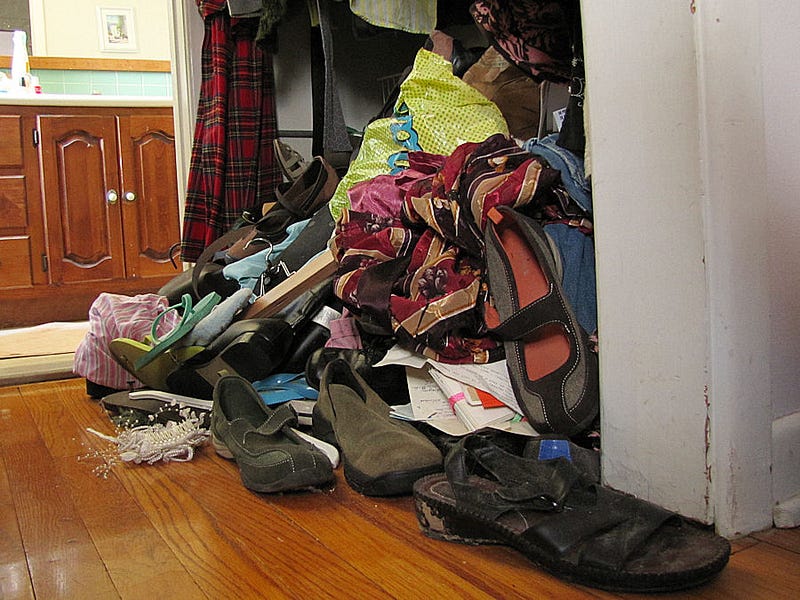
Everyone’s got a closet where they put whatever they don’t want people to see. There’s some bad stuff in that closet. There’s things you’re ashamed of. Memories of what you’ve done, words you’ve said, people you’ve hurt. You cram that closet full. It gets to be that you can’t even open the door to cram anything more in. You also can’t open the door to get anything out. You’re afraid that when you open the door, the bowling ball you perched atop the pile will fall on your head. You’re afraid if you open the door, you’ll never be able to shut it again. It’s too full, so you never open the door.
Most of the time you can live with that. So, you have closets that you never open, stuffed to the gills with junk you can’t throw out. You have more than one closet filled like that. You might have garages, attics, cellars, extra rooms; all filled. Some of us have years of our past that we can’t permit ourselves to remember, but are unable to forget, entire regions of our selves we don’t want to let people see.
That’s fine, until something happens.
Some other person could open the closet door by mistake; looking for the bathroom. The bowling ball, the wooden tennis racquets, the regrets, the disappointments, and the shame all come crashing to the floor. It’s embarrassing. It all comes out and you can’t cram it back in.
That’s how it feels when someone brings up your guilt, confronts you with your behavior. An intervention feels this way. So does the kind of fight where your partner says all the things she’s been meaning to say. It also feels this way when she leaves, when she’s had enough and can’t take it anymore. You’re left alone with a closet full of recriminations cascading around you.
There could be something in that closet that’s starting to smell. Maybe something’s died in there. You may have to clean out the closet and go through everything until you find it.
That’s what it’s like when there something evil growing in you, a rage, an addiction, a resentment, an anxiety, a trauma, a need. You may not even know what it is. You only know there must be something there. It is there, buried in your closet.
Maybe you want to move, trade up to a bigger, or better, house. Then it’s time to clean out the old closet. You collect boxes, start with the books in the living room, move on to the kitchen, save the closet for last, not because it’s more efficient that way, but because you’re dreading it. You finally get to the closet and go through it, not because you want to, but because you have to, so you can move on.
That’s what it’s like when you’re ready to change; when you’re tired of living the way you’ve been living. You’re sick and tired of being sick and tired. You’re ready to look at your past, so that you can make sense of it. You decide it’s time to move ahead, learn some lessons. If you had awful things happen to you, you might have put the memory away in this closet so that you could deal with it later, after you acquired the knowledge, skills, resources, coping mechanisms, and supports that you needed. Perhaps it’s time, and you are ready.
Sometimes you clean out the closet because you have to, not because you want to; because you can’t shut the damn door anymore.
Once you decide to clean out the closet, there’s nothing left to do but to buckle down and go through the junk. Sift through it and sort out what to keep, what to throw away, what to give away, and what to display on the coffee table. You might be surprised. There could be stuff in that closet that you need, that you haven’t been able to find. You could have put something in the closet to protect it, away from prying eyes, because it’s so valuable you can’t let it go.
That’s what it’s like when people look at their past, their regrets, and their losses, and find capabilities they didn’t know they had, choices they forgot they ever made, insights they never knew, feelings they thought they had lost. A sense of wonder that’s been neglected, an ability to play that’s been deserted. For, buried under all that junk, the mistakes, the resentments, and the losses, is a child. That child is you, you as a child. You locked that child, with all his spontaneity and innocence, in the closet and buried her under stuff, partly to control her, partly to protect. When you clean the closet, you set the child in you free.
It may be time to clean out your closet. Let’s begin.
Keith R Wilson is a mental health counselor in private practice and the author of The Road to Reconciliation: A Comprehensive Guide to Peace When Relationships Go Bad, from which this article is adapted.


