Claude Shannon’s - A Symbolic Analysis of Relay and Switching Circuits - Explained So Simple A 6th Grader Would Get It Part 1
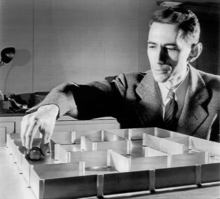
Claude Shannon might not be as famous as Alan Turing or John von Neumann.
But he is just as important!
In fact, some have called him the "father of digital circuit design theory."
Published in 1938 and still studied by computer scientist and electric al engineers today, “A Symbolic Analysis of Relay and Switching Circuits" laid the foundation for modern digital logic.
This is the first article in a series where we will explore Shannon’s paper and the significance of its contribution to the computer and AI revolution.
But first, we’re going to talk about Claude Shannon, the man.
Who was Claude Shannon?
Claude Shannon was born in Petoskey, Michigan in 1916.
As a child, young Claude was interested in electrical gadgets and spent much of his time tinkering with radios and telephones.
Later, he attended the University of Michigan, where he earned a bachelors in electrical engineering and mathematics before going on to earning his masters and then a PhD in electrical engineering from the Massachusetts Institute of Technology (MIT).
From early on Shannon showed a penchant and an interest in applying mathematical concepts to engineering problems.
At MIT, he worked under the legendary Vannevar Bush, a prominent inventor, engineer, and science administrator, most famous for his work in analog computing and his invention of the Differential Analyzer, a mechanical computer used to solve differential equations.
After completing his graduate work, Shannon went to work for Bell Labs, where he worked on developing the first digital computer, the Model I Relay Calculator, the first computer to use binary digits, or bits, to represent data.
Shannon’s work at Bell Labs also led to Claude Shannon was born in Petoskey, Michigan in 1916. As a child, he was interested in electrical gadgets and spent much of his time tinkering with radios and telephones. He attended the University of Michigan, where he earned a bachelor's degree in electrical engineering and mathematics. He went on to earn a master's degree and PhD in electrical engineering from the Massachusetts Institute of Technology (MIT).
Shannon’s early academic life was marked by his interest in applying mathematical concepts to engineering problems.
The Differential Analyzer
His graduate work at MIT was heavily influenced by his mentor, Vannevar Bush, who was a prominent inventor, engineer, and science administrator. Bush was known for his work in analog computing and his invention of the Differential Analyzer, which was a mechanical computer used to solve differential equations.
After completing his graduate work, Shannon went to work for Bell Labs, where he worked on developing the first digital computer, the Model I Relay Calculator, the first computer to use binary digits, or bits, to represent data. Shannon’s work at Bell Labs also led to the development of the first electronic switching system, which revolutionized telecommunication.
What is "A Symbolic Analysis of Relay and Switching Circuits"?
Shannon’s paper "A Symbolic Analysis of Relay and Switching Circuits" was published in the Transactions of the American Institute of Electrical Engineers in 1938. In the paper, Shannon introduced the concept of Boolean algebra, developed by English Mathematician George Boole, used to simplify and analyze logic statements.
The paper was significant because it showed how Boolean algebra could be used to simplify complex relay and switching circuits, thus opening the door for the modern digital computing age!
Father of Information Theory
Claude Shannon is widely considered the father of information theory, a branch of mathematics that deals with the quantification, storage, and communication of information.
In his seminal paper "A Mathematical Theory of Communication," published in 1948, Shannon introduced the concept of entropy as a measure of information content and the maximum amount of information that can be transmitted over a communication channel with a given bandwidth and noise level. He also developed the concept of channel capacity, which refers to the maximum amount of information that can be transmitted over a channel in a given amount of time. Shannon’s work on information theory has had far-reaching applications, including the development of modern communication systems such as the internet and digital data storage technologies. His contributions to the field have been recognized with numerous awards, including the National Medal of Science and the Kyoto Prize.
Cybernetics
Later in his career, Shannon turned his attention to the field of cybernetics, which is the study of control systems and communication in machines and living organisms. He developed the concept of the "ultimate machine," which was a machine that would turn itself off once turned on, and he also created a electro-mechanical robot mouse, named Theseus, after the Greek hero, that could navigate through a maze using feedback control.
When I was a kid in the early ’80s, any books on robots or computing from the ‘60s on had a picture of Claude Shannon and that robot mouse. I thought it was pretty cool back then too.
Conclusion
Claude Shannon’s paper "A Symbolic Analysis of Relay and Switching Circuits" is an important milestone in the development of modern digital logic.
Shannon’s influence on computing, electronics, cybernetics and information theory has been profound, with many scientists, engineers, and mathematicians building off his work, including Alan Turing, John von Neumann, and Norbert Wiener.
Shannon’s ideas, and his work on digital logic and information theory laid the foundation for modern computing, artificial intelligence and machine learning.
Next
In the next article of this series, we will explore the concepts of Shannon’s work: digital logic and its relation to electronic circuits.