avatarJono Burcham

Free AI web copilot to create summaries, insights and extended knowledge, download it at here

3258

Abstract

e joy bucket further.</p><figure id="020a"><img src="https://cdn-images-1.readmedium.com/v2/resize:fit:800/0*nIroY84bFidnsm1g"><figcaption>A Joy Bucket. Photo by <a href="https://unsplash.com/pt-br/@switch_dtp_fotografie?utm_source=medium&amp;utm_medium=referral">Lucas van Oort</a> on <a href="https://unsplash.com?utm_source=medium&amp;utm_medium=referral">Unsplash</a></figcaption></figure><p id="94a1">When I see these types of applications come in for positions I’m trying to fill in my team, it’s disheartening. The overwhelming vibe is <b>“Get me out of here!”</b> with little to no thought of where else they want to be.</p><h1 id="bb9f">Reflect</h1><p id="07f5">I think the key to overcoming this difficult position is to step back and ask some serious questions about what you want before you apply for the next job. A simple SWOT analysis will more than do the trick to help clarify your thoughts and focus in on your career goals. When I say simple I mean it’s not complicated, but it will take some <i>time and effort </i>to get to the honest truth.</p><figure id="8f98"><img src="https://cdn-images-1.readmedium.com/v2/resize:fit:800/1*tK0K6Pi4GJDUblQXt3ESzQ.png"><figcaption>My version of a SWOT analysis for nursing career planning</figcaption></figure><p id="bbf1">Be really specific, maybe you love interacting with patients but you don’t enjoy the night shifts. Maybe you find satisfaction in seeing students or graduates find their feet and thrive in the clinical environment. Maybe you are sick of being in a busy tertiary hospital and want the adventure and independent decision making remote work provides.</p><p id="ceae">Take your time with this process and try to get to the root of the issue. If it’s all still a bit nebular and surface level you could add in some root cause analysis tools to help process these questions. Two that I’ve used in the past that are simple but effective are:</p><ul><li><b>The 5 Why’s: </b>For each question you want to get to the bottom of, ask why? Then consider your answer and ask why again. Repeat 5 times or until you get to the cause of the issue. <a href="https://augustbirch.medium.com/the-five-whys-strategy-to-uncover-your-life-s-work-2e0f2b7e273a">Read this piece to find out more </a>about applying the 5 why’s to career planning.</li><li><b>The Fish Bone:</b> Start by drawing the fish head and label it with your problem statement. Then starting with the spine branch off into cause statements. Go deeper by adding further branches that are labelled with factors contributing to each cause. <a href="https://www.indeed.com/career-advice/career-development/what-is-a-fishbone-diagram">This piece explains the fish bone process well</a>.</li></ul><p id="e1dd">What you want to end up with through this process is a clearer understanding of what you want from your nursing career, what you can bring to the table and areas you can work on to get there.</p><h1 id="0253">Identify The Next Step</h1><p id="d898">Now that you have focused in on where you are now and where you want to go it’s time to identify a clear next step. The next step is only the next step, its not the destination but it’s the start of a new career journey. A more focused one that is purposeful and strategic. It’s

Options

unique to each of us but it starts with a goal statement.</p><blockquote id="6d7b"><p>I define a career goal statement as a single, concise, definitive statement that clearly sets the target for your future career.</p></blockquote><figure id="4d4b"><img src="https://cdn-images-1.readmedium.com/v2/resize:fit:800/1*SaYyAbu7obVZRwYqx7NaLA.jpeg"><figcaption>SMART career goals. Image from <a href="https://lattice.com/library/how-to-write-goals-the-s-m-a-r-t-way">Lattice.com</a></figcaption></figure><p id="faf9">Remember, goal statements should be Specific, Measurable, Achievable, Relevant and Time-Based (SMART). Then for each goal statement you can break down the SNART steps to get there.</p><p id="8850">Here are some examples to get you thinking:</p><p id="26ae"><i>“Within the next year I will never work another night shift again.”</i></p><ul><li>Brainstorm roles that do not require night shift (eg. outpatient clinic, research nurse, discharge coordinator, nurse manager)</li><li>Talk to nurses filling those positions that do not require nightshift and their manages, be sure to ask them questions that help you identify if they align with your skill set, the work life balance you hope for etc.</li><li>Review the job description form for these positions highlighting areas you could work on and book in that professional development to make you job ready.</li></ul><p id="c2b7"><i>“In 4 years I want to work for the aeromedical retrieval service”</i></p><ul><li>Contact your local aeromedical retrieval service and ask them what they’re looking for. Usually broad critical care experience on top of midwifery and exposure to independent clinical leadership roles.</li><li>Map out your skills and experience to what is required and make a plan to fill the deficits. This might mean a midwifery degree. Maybe it’s getting exposure to critical care settings outside of big metropolitan centres.</li></ul><figure id="cfe4"><img src="https://cdn-images-1.readmedium.com/v2/resize:fit:800/1*LdsWKHk7Nb3wYpYiGhMYyA.jpeg"><figcaption>Aeromedical retrieval service. Photo used with permission</figcaption></figure><h1 id="310b">Persistence, humility and courage</h1><p id="b258">Changing your career direction is difficult at any time but when you’re burnt out and discouraged it can be even harder! My hope for you is that this article helps you take a step back, reflect on how far you’ve come and focus in on where you want to go. Nursing really is your passport to the world but it will take persistence, humility and courage to get to where you want to go.</p><p id="d769"><i>This article is the first in a series of career development articles just for nurses. If you would like to be notified when I publish others please <a href="https://jonoburcham.medium.com/subscribe"><b>subscribe to my email list and follow me here</b></a>. I’d love to hear about your nursing career in the comments and any suggestions you might have for future posts.</i></p><p id="7629"><i>Are you new to Medium.com? You can join for $5 a month and have access to every article on the site including everything I ever write. If you <a href="https://medium.com/@jonoburcham/membership"><b>join with my link</b></a> you will be supporting my content</i></p></article></body>

Clarifying Career Goals For Nurses

How To Land The Nursing Job Of Your Dreams — A Series

As nurses we are great at advocating for patients but often not ourselves. This series will help you to clarify your career goals, stand out from the crowd and get that job of your dreams.

Nurse gets the job. Photo from Clipboard Health

Nursing is a fantastic career and after 15 years I love it even more than when I started. I’ve experienced a lot of different roles from student nurse, registered nurse, clinical nurse, staff development nurse, research nurse, hospital nurse manager and now clinical nurse manager for research. In each role I’ve had the opportunity to care for a diverse range of patients and have worked alongside amazing, selfless, dedicated nurses from all walks of life.

Of course that also means that I’ve applied for a lot of jobs and now have the privilege and responsibility of employing nurses to work in our department. There have been many life lessons along the way, not least of all persistence, humility and courage.

In this series I want to share with you tips for landing the nursing job of your dreams including one that you may not have considered!

Focus in on your dream job

A nursing degree is your passport to the world. I’ve met nurses who work on cruise ships, aeromedical retrieval services, from their home office, in schools, community clinics and of course hospitals big and small. Nurses who just do night shifts, just weekends, fly-in fly-out and everything in-between.

Nursing is your passport to a world of opportunity. Photo by Fateme Alaie on Unsplash

The world is truly your oyster but with such vast opportunity it’s often hard to focus in on what is important to you.

I’ve met hundreds of nurses who have never considered their career goals. They may have been in the same hospital, on the same ward, doing the same job for a decade. There’s nothing wrong with that if you’ve found your niche and that role brings you joy and fills your bucket.

However, I’ve often observed that for many nurses, the joy left a long time ago and they feel stuck or burnt out. Having eventually ‘had enough’ they throw their hat into the ring for every promotional opportunity that comes their way but their lack of direction and drive makes success unlikely. Seeing the younger, less-experienced nurse jump ahead is difficult, discouraging and drains the joy bucket further.

A Joy Bucket. Photo by Lucas van Oort on Unsplash

When I see these types of applications come in for positions I’m trying to fill in my team, it’s disheartening. The overwhelming vibe is “Get me out of here!” with little to no thought of where else they want to be.

Reflect

I think the key to overcoming this difficult position is to step back and ask some serious questions about what you want before you apply for the next job. A simple SWOT analysis will more than do the trick to help clarify your thoughts and focus in on your career goals. When I say simple I mean it’s not complicated, but it will take some time and effort to get to the honest truth.
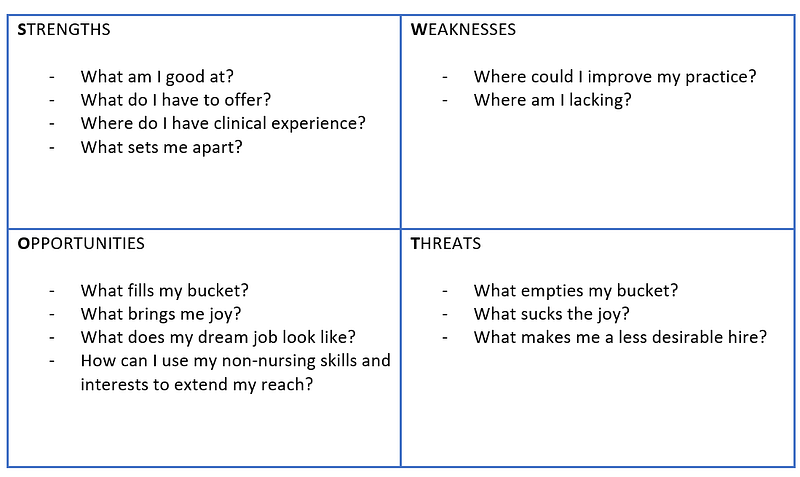
My version of a SWOT analysis for nursing career planning

Be really specific, maybe you love interacting with patients but you don’t enjoy the night shifts. Maybe you find satisfaction in seeing students or graduates find their feet and thrive in the clinical environment. Maybe you are sick of being in a busy tertiary hospital and want the adventure and independent decision making remote work provides.

Take your time with this process and try to get to the root of the issue. If it’s all still a bit nebular and surface level you could add in some root cause analysis tools to help process these questions. Two that I’ve used in the past that are simple but effective are:

  • The 5 Why’s: For each question you want to get to the bottom of, ask why? Then consider your answer and ask why again. Repeat 5 times or until you get to the cause of the issue. Read this piece to find out more about applying the 5 why’s to career planning.
  • The Fish Bone: Start by drawing the fish head and label it with your problem statement. Then starting with the spine branch off into cause statements. Go deeper by adding further branches that are labelled with factors contributing to each cause. This piece explains the fish bone process well.

What you want to end up with through this process is a clearer understanding of what you want from your nursing career, what you can bring to the table and areas you can work on to get there.

Identify The Next Step

Now that you have focused in on where you are now and where you want to go it’s time to identify a clear next step. The next step is only the next step, its not the destination but it’s the start of a new career journey. A more focused one that is purposeful and strategic. It’s unique to each of us but it starts with a goal statement.

I define a career goal statement as a single, concise, definitive statement that clearly sets the target for your future career.

SMART career goals. Image from Lattice.com

Remember, goal statements should be Specific, Measurable, Achievable, Relevant and Time-Based (SMART). Then for each goal statement you can break down the SNART steps to get there.

Here are some examples to get you thinking:

“Within the next year I will never work another night shift again.”

  • Brainstorm roles that do not require night shift (eg. outpatient clinic, research nurse, discharge coordinator, nurse manager)
  • Talk to nurses filling those positions that do not require nightshift and their manages, be sure to ask them questions that help you identify if they align with your skill set, the work life balance you hope for etc.
  • Review the job description form for these positions highlighting areas you could work on and book in that professional development to make you job ready.

“In 4 years I want to work for the aeromedical retrieval service”

  • Contact your local aeromedical retrieval service and ask them what they’re looking for. Usually broad critical care experience on top of midwifery and exposure to independent clinical leadership roles.
  • Map out your skills and experience to what is required and make a plan to fill the deficits. This might mean a midwifery degree. Maybe it’s getting exposure to critical care settings outside of big metropolitan centres.

Aeromedical retrieval service. Photo used with permission

Persistence, humility and courage

Changing your career direction is difficult at any time but when you’re burnt out and discouraged it can be even harder! My hope for you is that this article helps you take a step back, reflect on how far you’ve come and focus in on where you want to go. Nursing really is your passport to the world but it will take persistence, humility and courage to get to where you want to go.

This article is the first in a series of career development articles just for nurses. If you would like to be notified when I publish others please subscribe to my email list and follow me here. I’d love to hear about your nursing career in the comments and any suggestions you might have for future posts.

Are you new to Medium.com? You can join for $5 a month and have access to every article on the site including everything I ever write. If you join with my link you will be supporting my content

Nurse
Nursing
Careers
Career Development
Persistance
Recommended from ReadMedium