
Due Diligence
Citing Sources, pt. II: The Mental Health Edition
“40% of the American people don’t think there is such a thing as mental illness, do they?”

Let’s continue talking about giving credit and citing sources. This is to be the second entry in my groundbreaking series about the importance of giving credit and citing sources. This article will be my fourth attempt at this…uh…article. I’ll quote myself from attempt 3 –
“This my (sic) third attempt at a follow up to my groundbreaking EXPOSITION ON GIVING CREDIT AND CITING SOURCES. Attempts one and two, like Narcissus, were so in love with themselves and the promises they held that they withered into obscurity. But their fate was not in vain. I now stand atop the raggedy bones of those two ill-fated dispatches to bring you this… “
That’s right, rather than correct the error, I “sic” myself — what is the past tense of “sic”?
Moving on…Naturally, this led me to Lewis Black, a funnyman to boldly denquare (“declare” + “inquire”) “40% of the American people don’t think there is such a thing as mental illness, do they?” (Black, 2017)
The first big takeaway from Mr. Black’s remark affirms that numbers and figures are powerful, you might have pictured a room with 10 people and four of them belching platitudes like “everybody gets sad every now and again” or “they just need to get out more”.
Black (2017) goes on to declare,
“That’s 40%, and I just made that number up.”
Why did you make it up Lewis Black?
“…because I’ve watched politicians for a whole year making numbers up every fucking day, and they’re not supposed to be making numbers up. I’m a comic, I’m supposed to make shit up!” (Black, 2017)
Listen, I mentioned this quip from Lou (or should it be “Lew”?) to demonstrate the point(s) that –
1. Numbers and figures are powerful.
2. Numbers and figures are easy to fudge.
3. Numbers and figures are not valid and reliable unless they have a credible source.
Inspired as I was, I set off on a research binge to find out how close Mr. Black’s figure was. This search didn’t turn up much of anything useful. Then, El Paso and Dayton happened, and Trump has tried to shift the focus from guns to mental health.
That said, the following analysis was conceived and is presented only as a lens through which we can examine the importance of citing sources.
That said, I believe this puts me in an optimal position to take a closer look at the issue of mental health as it relates to firearms; a topic that I will address in the coming days.
That s… I’m going to stop that now. Here is a summary look at two studies about the prevalence of mental illness. Predictably, a report from the National Institutes of Health was one of the first items to show up on my search query.
The NIH finds that 18.9% of U.S. adults have gotten or will get a little crazy (to be sure, “we’re never going to survive unless we get a little crazy”)
Next, I came across a meta-research study published in February 2017, by Brainiac JD Schaefer and nine of his super friends, examining the outcomes of eight other studies. In one particular study conducted on a cohort of 988 New Zealanders stretching from 1972–1973 to 2010–2011 to (age 38 for the cohort), about 171 individuals (17.3%)
“experienced enduring mental health (i.e., met diagnostic criteria at 0 waves) …The remainder of the cohort were Study members who had met criteria for one or more mental disorder diagnoses at 3 waves(N 408).” (218)
Allow me to clarify a few things. First, New Zealand is a country north of Australia. Australia is both a country and a continent (a “countrinent”). Second, here is a picture of Australia.
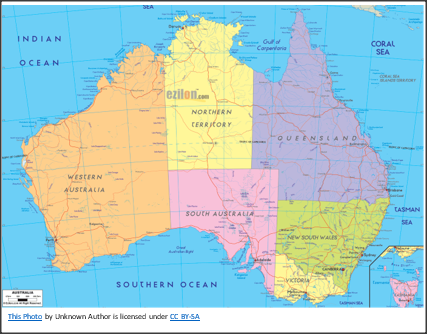
Third, a “wave” is a battery of mental health tests administered to this cohort at various intervals starting at the age of alive and ending at age 38. This study analyzed six of those “waves” from ages 11 to 38. The above-quoted data (that’s “day-tuh”, not “dadduh”, btw) indicates that less than one in five people in this study go through life WITHOUT being at least grazed by crazy (i.e. experience a mental health disorder). By a tiny majority, 42% (409) experienced one or two waves of crazy. The remaining 408 members of the cohort (41%) dealt with crazy for three or more “waves”. (Schaefer et al., 2017, p. 217)
That adds up to 408+409=408,409 instances of crazy. That an increase of 408,409/988= 413%!
I jest. 408+409=817 study members experiencing either chronic or episodic crazy. That comes out to about 83%.
Again, 83% of this cohort experienced some kind of mental illness.
This number is also much higher than the figure reported by the National Institutes of Health. The good, freakishly tall people at “NIH!”, in their bear pelts and helmets with antlers, declare that roughly one in five (~19%) Americans suffers from a mental illness.
That divergence is quite staggering. Let’s find out why…
Defining Mental illness
Listen, I know that I’m digressing with my detailed analysis of mental health, but I assure you, I know where I’m headed.
That said, the National Institutes of Health says
“mental illnesses include those that are diagnosable currently or within the past year; of sufficient duration to meet diagnostic criteria specified within the 4th edition of the Diagnostic and Statistical Manual of Mental Disorders (DSM-IV); and, exclude developmental and substance use disorders.”
Meanwhile, Schaefer et al got to choose any definition they wanted as long as it followed the New Zealand study’s parameters. More specifically, the diagnoses came from a team of “trained interviewers with tertiary qualifications and clinical experience in a mental health-related field such as family medicine, clinical psychology, or psychiatric social work (i.e., not lay interviewers)” (Schaefer et al., 2017, p. 217).
This intrepid collection of credentialed mental health professionals would interview study members. Don’t worry, these weren’t the “lay interviews” given by those obnoxious “lay interviewers”. The results of each interview were checked against the most up to date version of The Diagnostic and Statistical Manual.

Representativeness
One thing about these special interviewers, they were all from New Zealand. You see, that is where the study was conducted and, consequently, where the study members lived. Therefore, the question of application arises. Specifically, the racial/ethnic population is far more diverse in MURICA(!). A concern they address and admit is a limiting factor. Schaefer et al. (2017)[jw1] assert the validity of the results due to the fact that similarities in the occurrence of mental illness between the cohort and surveys conducted in New Zealand and MURICA(!). (p.222)

I’ve never been to New Zealand, but I assume it’s much different than the cozy conveniences and decadence that we Muricans(!) loathe…(enjoy?). I think it’s time for some fun facts about New Zealand. Observe las mesas I’ve produced –
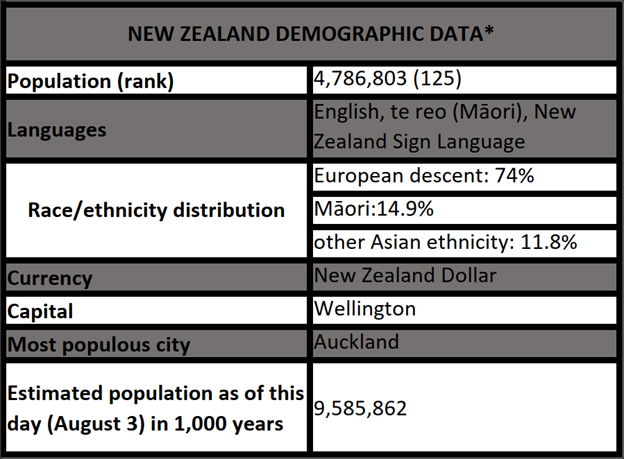
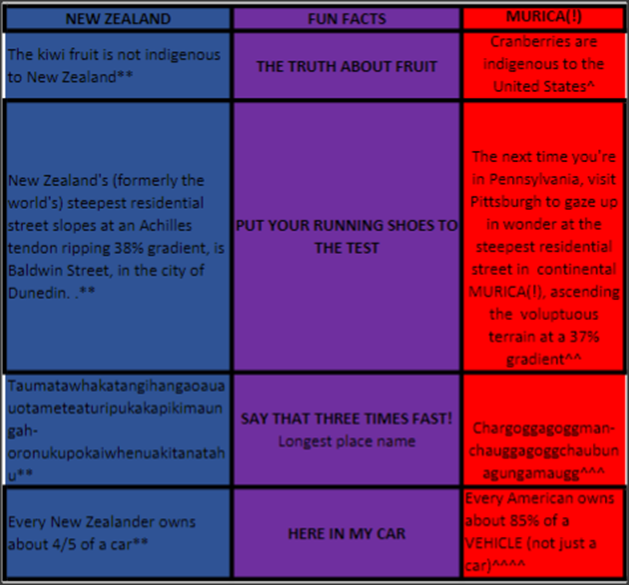
**https://www.globotreks.com/destinations/new-zealand/33-quirky-facts-new-zealand/
***https://www.newzealand.com/us/article/fun-facts-about-new-zealand/
^^https://www.atlasobscura.com/places/canton-avenue
^^^https://www.nytimes.com/2004/11/20/us/whats-the-name-of-that-lake-its-hard-to-say.html
^^^^https://hedgescompany.com/automotive-market-research-statistics/auto-mailing-lists-and-marketing/
Validity and Reliability
A few things before I dig into why diligence and rigor are so important. The second table was my ham-handed way of pointing out some of the key differences between MURICA(!) and Australia’s little brother. In case your curious ”Taumatawhakatangihangaoauauotameteaturipukakapikimaungah-oronukupokaiwhenuakitanatahu” is the native name for a hill in Hawke’s Bay. At 85 characters, it is among the longest place names in the history of forever. If you’re not into brevity, you could refer to it by it’s English translation — “the place where Tamatea, the man with the big knees, who slid, climbed and swallowed mountains, known as the land-eater, played his nose flute to his loved ones”.
And haven’t you always wanted a single word to tell others that you just want to fish by yourself? Here’s one! “Chargoggagoggmanchauggagoggchaubunagungamaugg”, which is the way the Nipmuck Indians told those who thought to encroach on their honeyhole “You fish on your side, I fish on my side and nobody fishes in the middle.” Chargoggagoggmanchauggagoggchaubunagungamaugg’s 45 characters are but an acorn compared to the mighty oak that is “Taumatawhakatangihangaoauauotameteaturipukakapikimaungah-oronukupokaiwhenuakitanatahu” 85 characters. Clearly, MURICANS(!) are not as committed to gratuitously long place names. That being the case, could the crazy of New Zealand really be representative of the crazy in MURICA(!)
What’s more, one of New Zealand’s trademarks isn’t even native to it. It’s also green and fuzzy and can’t be turned into a delicious snack whose form factor was pioneered by the cranberry’s heady cousin, the grape (I’m talking about the raisin and the “craisin”, people).
Oh, but wait! The space cadets who built Baldwin Street with its ludicrous grade of 38% must’ve been channeling the bozos who sloped Canton Avenue in Pittsburgh at a 37% grade. You see, 38 and 37, as percentages, characters making up really long place names…or whatever, are very, very close. Similar to the proximity you’d expect when contemplating 95 and 96, even 13 and 14!
I am suggesting that there are some similarities and differences. Are the similarities sufficient to extrapolate conditions and outcomes from one to the other?
This, dear reader, is the essential question behind the notion of validity. This issue becomes critical when the outcomes are used to make informed decisions. For instance, an agent acting on behalf of Trump could report, in his/her haste to produce results for that most orange of world leaders, might report that about 83% of the people are mentally ill.
That same flustered executive lackey could have also come across the NIH numbers first and told his Golden-haired commander-in-chief
that only 19% of Americans have a mental illness.
Now, put yourself in Trump’s shoes (be careful, they’re “yuge”) and you have to make a decision about gun control in a country with a population that includes as few as 62.7 million or as many as 274 million people with a mental health issue.
Trump might ask if the results of the New Zealand study could be reproduced in the United States; that is, are the results reliable? The anxious aide would have to explain that, not only will Trump have to live to the age of 121 years to find out, but he would have to get re-elected a constitution shattering 10 more times.
What if the numbers are found to be reliable? Are they relevant for my purposes? Am I understanding them the way the author intended? I would point out that the New Zealand study was intended as an exploration of the characteristics of “enduring mental health”.
Still, would a rabid gun control advocate see a study of “enduring mental health” or an eye-grabbing headline “83% of Americans have some sort of mental illness”?
Conclusion
Returning to my thesis — in this article, I’ve sought to demonstrate that
1. Numbers and figures are powerful. The notion that more than 8 out of 10 of humans walking this earth have had some sort of mental disorder is a striking figure. I find 2 out of 10 to be questionable. Thing is, Internet, I am writing about mental health as an anecdote — musing, inconsequential. What about policies and decisions regarding treatment and medication? Which data should they rely upon?
2. Thanks to Lewis Black’s quip, we know that facts and figures are easy to fudge. Perhaps more dangerously, they are much easier to misinterpret. If you are not willing to put in the due diligence to make sure that the numbers gel, your information is tainted (“informtaintion”) …
3. … Meaning that your numbers and figures may or may not have a credible source and, therefore, are not valid and reliable.
The point is, giving credit is sort hard, but oh so important!
Ø Please know that when I use the word “crazy” to describe mental illness, I am saying it with endearing good humor. Having been diagnosed with a condition found in the DSM IV I feel that I’m allowed to make such a statement; or, if you’d rather, I’m merely calling myself out.
Black, Lewis. 2017. Mental Illness. On Black to the Future [CD]. New York: Stark Raving Black Productions, Inc.
Schaefer, J. D., Caspi, A., Belsky, D. W., Harrington, H., Houts, R., Horwood, L. J., … Moffitt, T. E. (2017). Enduring mental health: Prevalence and prediction. Journal of abnormal psychology, 126(2), 212–224. doi:10.1037/abn0000232
FIN
@JarrettLWilson


