
Circadian Rhythm: What Is It and How You Can Use It to Your Advantage
Unlock your biological clock.
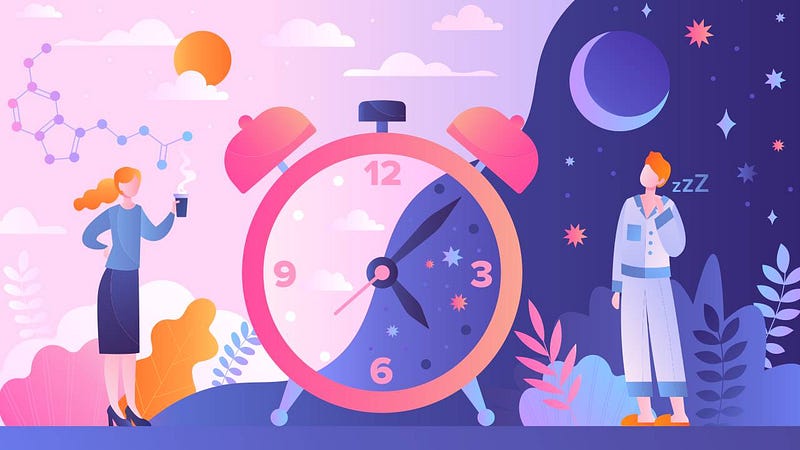
Let’s start off with what is the Circadian rhythm.
Circadian rhythm is the 24-hour internal clock in our brain that regulates cycles of alertness and sleepiness by responding to light changes in our environment.
This system has developed over time to help us adjust to shifts in our surroundings, such as light, temperature, and meal times. This built-in biological clock is crucial for us to manage our energy levels and keep our body functions in sync.
Without it, humans wouldn’t be able to efficiently use energy or maintain their internal balance.
The Circadian rhythm develops postnatally during the first 4 months of human life as the newborn experiences rapid physiological changes and adapts to the environment.
Why is the Circadian rhythm important?
It’s important because it affects multiple organ systems including the immune, reproductive, gastrointestinal, skeletal, endocrine, renal, and cardiovascular systems.
If something affects the circadian rhythm we can see some serious health implications when it comes to these aforementioned systems.
For example, this study shows that when the Circadian rhythm is disrupted people are predisposed to developing metabolic disorders such as obesity and type 2 diabetes.
Another study shows that there’s a strong interaction between major depressive disorder and circadian processes. Another study shows that there’s a correlation between anxiety and poorly regulated Circadian rhythm.
Still not convinced?
There’s a study that shows that a poorly regulated Circadian rhythm (that goes for people who are “night-owls”) has higher rates of cancer (breast and prostate), cardiovascular disease, and neurodegenerative diseases.
Finally, this study proposes that endogenous circadian control, diet, time of feeding, and other factors can all lead to an altered microbial community structure and altered microbial activity. So your gut health is also at risk.
So in conclusion, the Circadian rhythm is something that, if it’s not well regulated, can have serious health implications.
How does the Circadian rhythm function?
Well, this is a very complex topic but let’s make it very simple.
First of all, here’s the Circadian rhythm a bit more detailed.
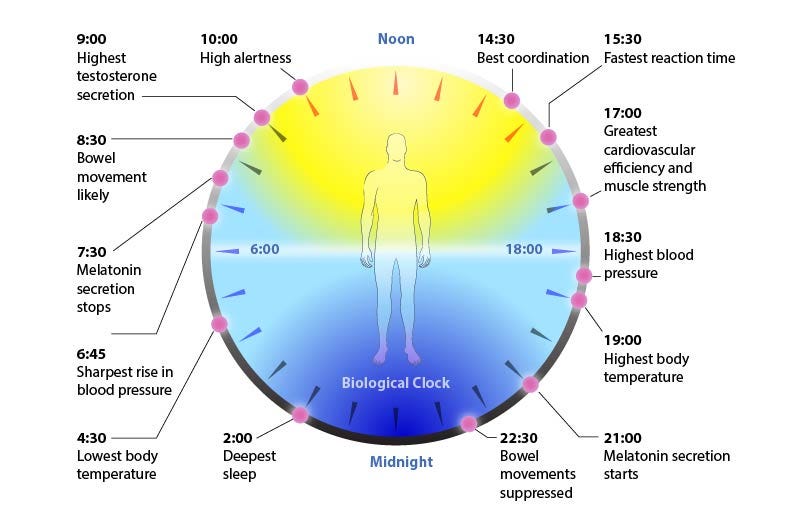
Our brain has a very complex structure called the hypothalamus. The hypothalamus is like the traffic police in a very busy intersection on a Monday afternoon. He helps manage the traffic. In our body, it helps manage our body temperature, hunger, thirst, sex drive, and of course the Circadian rhythm.
There’s a small structure in our hypothalamus called the suprachiasmatic nucleus (SCN) which has special sensors that can tell if it’s bright or dark outside.
When the SCN senses light, it tells the brain, “Hey, it’s bright out there! Time to wake up and be active!” And when it gets dark, it says, “Okay, it’s nighttime now. Time to get ready for sleep.”
So, during nighttime time when there’s not a lot of light, this structure sends a signal to our pineal gland, again a small part of our brain that releases melatonin, which helps us go to sleep. It stops releasing melatonin to our circulation when there’s light again.
This is not the full deal, but this complex relationship between many structures in the brain is how your Circadian rhythm functions and it’s truly mind-blowing!
This is how you can use this information to your advantage
When I was younger, I didn’t know about this inner clock that humans have and I thought that I could study at night, or workout before sleeping. That was extremely idiotic.
Yes, some humans prefer working out, studying, or sleeping at specific times, but our body is designed differently.
Our body is designed to synch with the Circadian rhythm and we should learn how to use that to our advantage.
See the picture above, and look at when our testosterone reaches peak secretion. You can use that to synch your body with your workout to optimize the results you’re getting. Pay attention to when melatonin is starting to release into our circulation. After 21:00 turn off every device that emits blue light — like your phone or TV screen — and use red light to your advantage so you can go to sleep easier and wake up refreshed.
Ad finem
There’s a lot of misconception online when it comes to what’s healthy and not. People talk a lot about the “good” and “bad” foods, or what’s the best exercise for you, or how it helps you to use one specific cream five times a day for your entire life, but the reality of the situation is different.
We should learn how to be in sync with our bodies both mentally and physically and this mostly comes from being in sync with our nature.
Understanding and learning how to use the Circadian rhythm to your advantage is a great way to start your journey toward a healthier and more balanced lifestyle.
👉 Join the SMD movement and learn how to start living your life without Social Media.