
Cicadas: The Beautiful Bugs Using Prime Numbers to Stay Alive
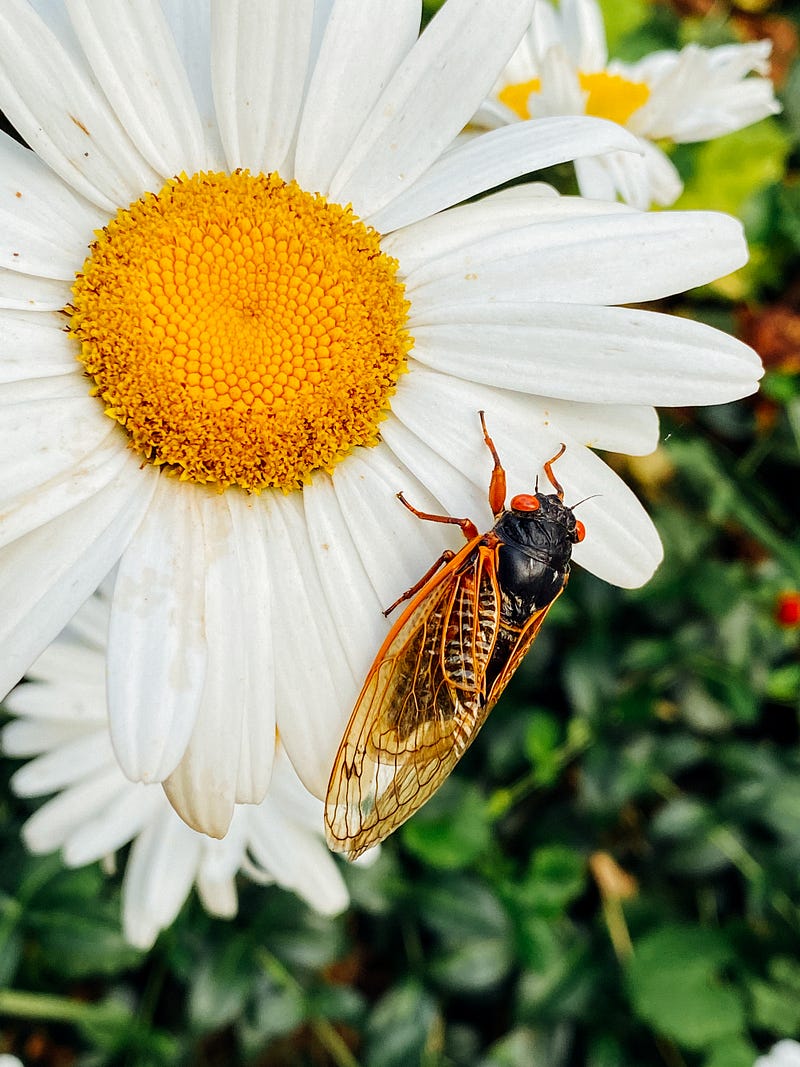
It was the weekend, and my wife had taken the kids to go shopping. Wanting to rest a little, I stayed home, made myself some coffee with a side of dried mangos, and started watching a documentary I had come up on about cicadas. When I finished the documentary, I was amazed by how these bugs use math to stay alive and saddened about how unfairly I treated these innocent bugs.
Yes, the most misunderstood and unjustly treated creatures on this planet are cicadas, and this mistreatment stems from the fairy tales we grew up with, written by Jean de La Fontaine. In one of his stories, La Fontaine speaks about the friendship between a cicada and an ant, making the latter look like a lazy, useless being. In the story, the ant works all summer gathering food and preparing. Meanwhile, the cicada spends his time playing the guitar and singing recklessly, occasionally pranking the ant. Come winter, the cicada is desperate for even a piece of bread and some water and desperately knocks on his friend, the ant’s, door.
In reality, this is far from the case. Since La Fontaine never bothered to research why the cicada spends his summer singing, he doesn’t understand the details of the situation.
This beautiful bug that we call the cicada comes out of hiding underground around July. He spends the remaining six weeks of his life singing, playing the guitar, and hanging with his girlfriend. Yes, the cicada does not live past August. In Turkish, cicada translates to August Bug, which is ironic because they die by the end of July.
So, La Fontaine, how can it make sense for a creature with only six weeks left to live, who won’t even see the winter, to prepare like a laborer for the season?
Now that we have cleared the name of the cicada, let’s get to our real topic: the incredible connection between cicadas and prime numbers.
Female cicadas lay their eggs in the cracks of trees, close to the ground. When the eggs hatch, the newborn cicadas dig straight underground, where their rest period will begin. While the exact rest period of cicadas changes from one species to another, on average, this period takes years to finish.
In America, the time for Magicicada septendecim and Magicicada tredecim rest are 13 and 17 years, respectively. While these numbers may seem random initially, they are special as they are prime numbers. Furthermore, the rise of the same species every 13 and 17 years cannot be a coincidence, and there must be an explanation for this phenomenon.
According to Vanderbilt University mathematician Professor Glenn Webb, cicadas use these prime numbers to continue their species. More specifically, by coming out every 13 to 17 years, the cicadas bring the number of times they encounter animals that will devour them on sight to a minimum. How does this work, though?
Firstly, cicadas aren’t predatory in any way. They do not bite, sting, or run away. They are also not poisonous, making them an excellent food source for many animals.
Back to the mathematics of the matter: Let us imagine an animal waiting eagerly for the cicada to come. Assuming this animal's life cycle is two years, it will be around for the cicada every 2, 4, 6, 8, 10, 12, …, 34, and 36 years. However, the cicada only appears every 17, 34, 51, … years. This means the cicada and its enemy will only meet every 34 years.

Now let’s imagine another animal who wants a cicada snack with a life cycle of 5 years. In that case, this versus will only happen once in 85 years, almost a century.
The question of why the cicada doesn’t go extinct if it will eventually come out and be devoured may arise. The answer is simple. The cicada breeds rapidly; therefore, when they meet their enemy, their population has already made up for their loss. In other words, the predator can’t possibly eat that many cicadas, and the population remains in balance.
The question now is, how can a cicada calculate the perfect 13 or 17-year time span? Researchers curious about this found that the newly hatched cicadas that go underground grow by sucking on tree and plant roots.
To explore this, the researchers genetically modified the plants in an area where cicadas were underground to blossom twice a year. After this, they found that the cicadas had appeared above ground exactly one year early. From this, they surmised that the cicada determines the time based on the flow of nutrients from the plant roots. A truly incredible discovery indeed.
In short, let’s give cicadas the love and justice they deserve, and let’s not let La Fontaine’s stories plague the minds of our children any longer.
Note 1: Beyond Euclid! is my weekly newsletter that brings you only high-quality math and science stuff to ensure you are having a good week.  Please do yourself a favor by subscribing to Beyond Euclid and enjoy it!  And if you can be a member and support my work, that would be awesome! Thank you!

Note 2: I get commissions for purchases made through Amazon links in this post.


