
BE YOUR FUTURE SELF NOW
Choose Your Trajectory
There’s one sustainable way to beat your competition every time

One day many years ago, I opened up some old code of mine that I wrote four years before. As I tried to decipher those verbose, inefficient blocks (without comments, of course), I yelled at myself, “Who wrote this crap?!?”
In the four years prior to that walk down memory lane, I had taken classes, attended conferences, followed YouTube tutorials, and kept up with the latest R language updates. And my code-writing skills improved tremendously. There wasn’t a specific day that marked the end of my not knowing what the hell I was doing and the beginning of achieving mastery.
At that time, I worked with two other people on my team at that company. One person’s code stayed exactly the same from when I started working there. In fact, her professional growth was nonexistent. The other person tried new things, but with disastrous results because he hadn’t learned how to do those new things well and couldn’t understand what his mistakes were.
Some people don’t do the work to achieve greatness.
This is what you need to take advantage of to achieve renown in your line of work. The trajectory of choosing to do the same thing day in and day out, with the occasional stroke of luck or minor increase in knowledge, is a straight arrow toward mediocrity.
Choose if you want to survive, maintain, or thrive.
Keep reading because I will tell you the exact steps you need to take to see exponential growth.
Have a realistic timeline
Grab some graph paper, a pencil, a calculator, or anything else you have at your disposal. With whatever data you have right now, do the math.
For example, if you are a writer on medium, every month keep track of:
- How much you earned that month ÷ number of lifetime stories you’ve published
- How much you earned that month ÷ number of views that month
- How much you earned that month ÷ number of followers you have
Keep in mind that these numbers will fluctuate due to seasonality, changes in Medium’s payout rules, and other things outside of your control. Don’t get fazed by your calculations, they’re just information to understand how you are growing. Also note in which months you’ve tried different tactics, like choosing a niche or writing more for a publication.
With a few months of data, graph the following:
- Your earnings per month
- The % change in your earnings from the previous month
It’s good to know the percentage change, because you’ll see if you have level growth or if you’ve just hit a steep uptick.
In my opinion, the number of followers by itself is a vanity metric, so I would recommend not judging your growth based on that. Care more about how people have reacted to your work, even when they interact with your non-Medium products.
Let’s say last month you made $50 just from Medium earnings. You have a total of 200 published stories, and 2,000 followers. That works out to:
- $0.25 per story and $0.025 per follower.
If up to that point you’ve written 15 articles every month and gained an average of 300 followers each month, you will want to calculate how long it will take before you make your next milestone, like $500.
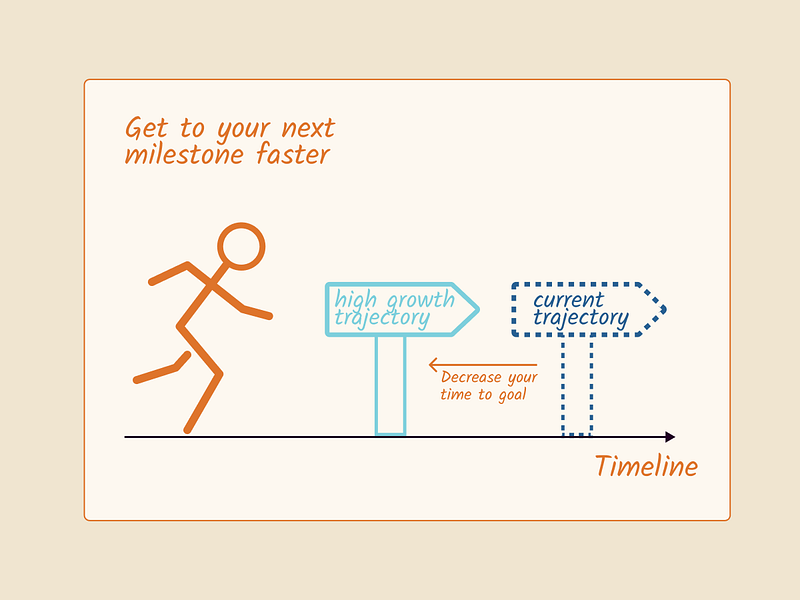
That’s how long it will take if you keep doing the same old, same old that will keep your trajectory on a straight line.
Take that timeline and challenge yourself to achieve your next milestone in 25% less time. (Don’t be silly and believe you’ll go from $50 to $5,000 in one month.) It will take a lot of hard work, but it’s doable.
Be warned: don’t jump to spurious, or unsustainable, conclusions, like writing 100 articles per month, or spamming for followers. A decrease in quality is a surefire way to tank your earnings per. You have to do what other people want.
Have an objective view of your skills and flaws
What are skills you have that the people around you envy? Or better yet, what do talented people pay you good money for?
If you have a talent for innovating, but can’t convince others to buy what you’re selling, then you know what you have to learn next.
Likewise for people who are great at sticking to a formula — you will have to work on deviating from your comfort zone.
Don’t just identify the symptoms, but put your ego aside to dig down deep to get to what the real problem is.
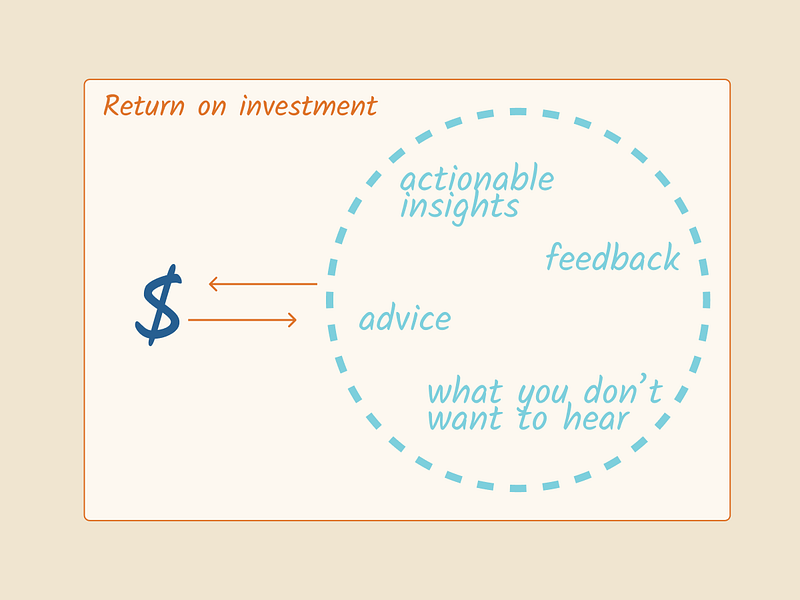
Be willing to pay for an objective third party — a coach. It’s a monetary sacrifice, but think of it as an investment in yourself.
If you are like me, then sometimes it takes years to finally learn a lesson that the universe keeps bashing you over the head with. Earlier this year, when I booked a session with a coach who specializes in Chinese metaphysics, he told me exactly what I need to focus on — teaching other people what I know.
I didn’t see what he saw. And because of him, I had a strategy. I’ve even got a group session with him in December that I’m very much looking forward to!
Book a session with someone (or their protégés) whose advice has helped you in the past. You know, those people who seem to talk straight at you through your computer screen. An astrologer, a marketing guru, a writing coach, it doesn’t matter. Take a deep breath and put in your credit card info.
Have a plan for your education
When you learn new things, you must also experiment in putting them into practice. This might be a little painful because it’s a time for mistakes. Remember that mistakes made early, and the lessons they provide, will pay off in the future.
The easiest way to craft your learning plan is to identify a mentor whose trajectory you admire and do what they’ve done. If they’ve got the cheat code to success then you better be paying attention.
But I don’t mean copying their work — they are already light years ahead of you, so you would just be regarded as a cheap copy. Read the books that they recommend. Consume all of their content. Apply their techniques to your own work.
After that, learn from your current competitors. Most people follow a formula — either an industry standard, or their own paradigm. And then they never stray.
That’s where your opportunity lies. Look at the current formulas that work, and innovate on them. Add your own twist by bringing in skills from somewhere unexpected. The pianist Arthur Rubinstein incorporated the way a singer breathes into his playing. That is how he became one of the most-loved in history.
Your job is to be undeniably great at what you do (and how to sell what you do) and to have a wider basket of resources than anyone else. Other people are just sticking to what they know. Be better than them.
Create a strategy where you make improvements to your skills at least every month, because when you become more knowledgeable, solutions start to show themselves more readily.
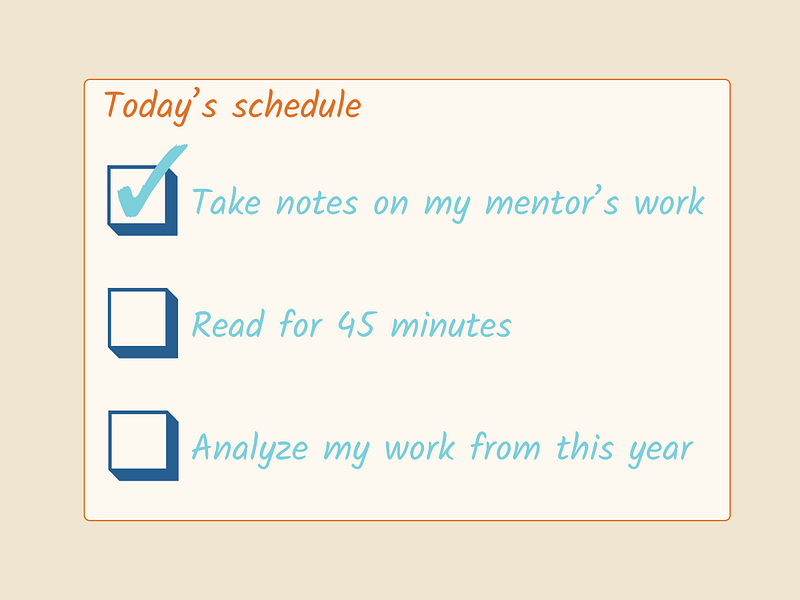
On the first of every month, review your focus and schedule your tasks. Be specific.
If you are a YouTuber, perhaps you will experiment with shortening the scripts in your YouTube videos by 25%. Monday through Friday at noon you will read a book on body language for an hour. Every Saturday you will go see a play.
Upgrade your mindset
Wanting to change your circumstances without changing what got you there in the first place is not a thing.
Does the following line of reasoning work?
If I increase the quantity (of the same crap I’ve been producing so far), then people will just start throwing money at me!
Nope.
Especially if you are a beginner at whatever it is you’re doing. However, if you’ve got a firm base with high, steady income, then yeah, sure, get into Cash Cow Mode.
Right now, you are at least lucky enough to have the access to learn new skills and the opportunity to change yourself. With this positive outlook on your future, you also have to be hard on yourself. Why is it so difficult for me to do things differently?
This is a personal journey you must make on your own, but you can get assistance from books, coaches, and maybe a few astute friends. A common self-sabotaging trap I see people fall in is to think that it’s everyone else’s fault. Instead, think about how to learn the market, or how to find your niche.
Journaling is a great way to track your growth. Every month, or every week, write a few answers to the questions your future, more successful self will want you to reflect on now.
Do your thoughts and outlook get better over time? Are you complaining less often? Do you come to a new realization about yourself every once in a while? Are things starting to get easier? Where are you gaining traction? What tangible sacrifices have you made to get what you want? What paradigms no longer serve your idea of success? What’s separating you from your goal? What does your future self need you to change now?
Good luck with reaching your goals and don’t let your mind stand in your way.
Do you have a problem you are struggling with? First, look through my previous articles to see if they help you. If not, schedule a consultation session with me so I can help you personally.