
Was Chinedu Okobi Killed For Jaywalking?
Another Tragic and Absurd Police Killing Lost In Time
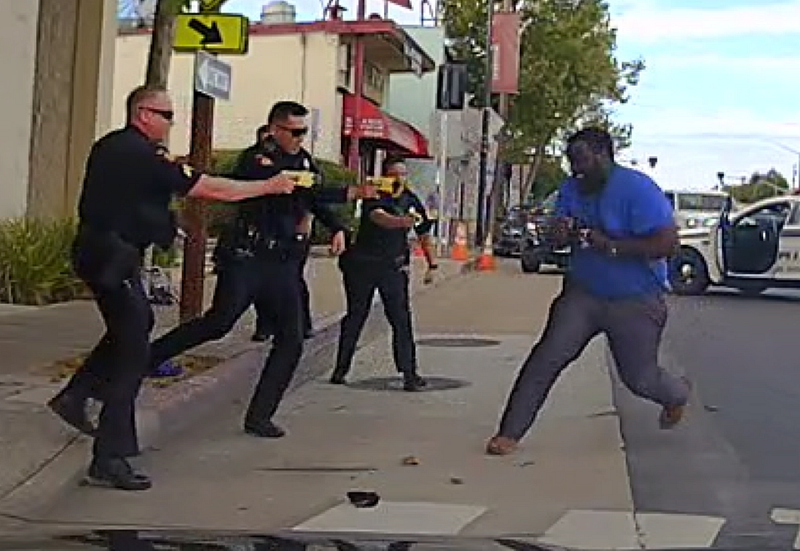
On October 3, 2018, Chinedu Okobi was killed by officers of the San Mateo County Police Department (CA). He was tased seven times, sat on, and at some point he went into cardiac arrest and died.
His sister, Abele Okobi, an executive and lawyer for Facebook, said her brother was “electrocuted to death.”
While there are various details for Mr. Okobi’s death, the only one that ever mattered to me is he was originally stopped for jaywalking. Without that overreach by the police — stopping a man on the street for jaywalking — nothing bad ever happens.
Mr. Okobi, when he was killed, was suffering from a mental health episode (it is pretty obvious on the video), and the encounter with the police for jaywalking escalated into an already delicate situation.
In the police investigation report of the incident (video link of the police stop is below) compiled by the department, the beginning of the incident is described as follows:
“On 10/3/18 at approximately 1300 hours, Deputy Joshua Wang of the San Mateo County Sheriff’s Office (SMCSO) was on duty, wearing a full patrol uniform and driving a fully marked patrol SUV. His radio identifier was 2B62. While driving south on El Camino Real (ECR) in the number one southbound lane and passing Santa Helena Avenue and the Tri Counties Bank, he noticed a man, subsequently identified as Mr. Chinedu Okobi, walking across ECR from the north side of Millwood Ave.2 Furthermore, Deputy Wang could see that the signal for southbound ECR at Millwood Avenue was green, meaning the vehicular and pedestrian traffic from Millwood Avenue had a red signal. Due to the observed violations, Deputy Wang decided to stop Mr. Okobi. (Decker Report Supplement 12, p. 2; Wang MAV AFN Exhibit)”
The report of the killing of Mr. Okobi is comprehensive in nature and is 55 pages. The report clears the officers of wrongdoing and does not really discuss the mental health issues central to the case.
It is an internal report designed to keep the officers out of the system and not criminally charged.
The report also renders Mr. Okobi a violent criminal. In the conclusion of the report, the following is noted:
“In this case, the objective was to apprehend and restrain Mr. Okobi as soon as possible using objectively reasonable force under the totality of the circumstances. This is because, the longer such incidents last, the chances of serious injuries occurring — to both officers and subjects — increase. And while Mr. Okobi’s size, strength, and agility would pose a tremendous challenge to restrain regardless of approach, the multiple attempts at chasing Mr. Okobi’s hands and feet were clearly ineffective. Instead, the contemporary approaches train officers to control entire limbs or sections of bodies, using most of the officers’ bodies.”
Should the objective have been to “apprehend and restrain” an unarmed person who had allegedly jaywalked and who was suffering a mental health crisis?
The Policing Project of New York University Law School would likely greatly object to what the officers did in Mr. Okobi’s case. The project is specifically devoted to finding solutions to how communities are policed and work towards accountability on the front end of policing.
Professor Farhang Heydari, who directs the project likely would flag stopping someone on the street for jaywalking as wildly suspicious and overreach by law enforcement.
This is basically the old “broken window“ ”policing theory that was used to expand police repression. It also did not necessarily reduce crime.
Mr. Okobi was an alleged jaywalker. How does a jaywalker with a mental illness find himself soon surrounded by a group of armed police officers?
In the video of Mr. Okobi’s death, he can be seen crossing the street like anyone else. He has some belongings with him. He even stops on the median strip to let a car pass before he finishes crossing.
The first police car makes a u-turn to track him down and confronts him. It is a useless, waste of a police stop that results in the death of an unarmed Black man who might have benefited from their help for his mental illness rather than their confrontational acts.
In his book, The End of Policing, Sociologist Alex J. Vitale asserts that typical police training and approaches are usually bad for persons suffering from a mental illness. Vitale contends that “studies show that standard police approaches actually tend to escalate and destabilize encounters.” In addition, “yelling commands and displaying weapons may cause a mentally ill person to flee or become more aggressive.”
Persons “having delusions or a psychotic episode may be unable to hear, understand, or comply with police orders,” according to Vitale. “This can have tragic consequences.”
In the killing of Mr. Okobi, this is exactly what happened. The police officer uses confrontation, command, and control techniques when he approaches Mr. Okobi. It is obvious Mr. Okobi is not understanding why he is being confronted or what is going on.
The officer summons more officers and a bad outcome for Mr. Okobi was assured. He is killed for jaywalking and for his mental illness.
The ACLU of Northern California released a statement of the killing of Mr. Okobi after the officers were exonerated by a department internal investigation. Their statement gets to the heart of the matter:
“The decision by the district attorney not to prosecute the officers doesn’t erase the fact that racial profiling and unnecessary force led to Okobi’s death. The actions by the San Mateo County Sheriff’s Office deprived Okobi of his fundamental constitutional rights. The deputies involved should be held accountable.
We must look at why these deputies were so fearful of an unarmed Black man. Statements made in the videos show that they assumed he was full of drugs. Toxicology reports disprove this assumption. The officers commented that Okobi had “super human strength” saying they “had to dogpile on him just to contain his strength.”
These comments are infected with racism and show that racial stereotypes motivated the officers’ decisions to create a conflict, and then continue to escalate the situation until Okobi lay dying in the street. Racially-biased policing undermines public safety and has disastrous impacts on people of color. (ACLU of Northern California)
Eventually, the Okobi family filed a lawsuit for the killing of their family member, Mr. Okobi. Their facts differ greatly from the 55-page internal report issued by police.
Most notably, the initial encounter is described as follows:
“On the afternoon of October 3, 2018, 36 year-old Mr. Chinedu Valentine Okobi was in downtown Millbrae, California, carrying bags and walking down a sidewalk on or near the 1300 block of El Camino Real. He was unarmed, not on probation or parole and had no wants or warrants for his detention or arrest. In fact, Mr. Okobi was a father and graduate of Morehouse College.
As Decedent was walking along the sidewalk, Defendant Wang pulled his patrol car toward the curb and shouted at the Decedent to tell him what Decedent was doing. Defendant Wang then told Decedent that he wanted to question Decedent on the sidewalk. Decedent quietly answered Defendant Wang then walked to the intersection, looked out for traffic, and crossed the street. At some point while following Decedent, Defendant Wang requested additional officers to come to the scene. Shortly thereafter, Defendants Weidner, DeMartini, Lorenzatti, and Watt arrived on the scene in response to Defendant Wang’s call for emergency back-up.” (John Burris, Attorney at Law)
Mr. Okobi’s sister, Ebele Okobi described the episode — the killing and the report — as follows with respect to her deceased brother:
“They painted a picture of my brother as a wild, aggressive person, that they had no choice but to kill him. And because he’s dead, he can’t speak for himself. So that’s the image that lodges in the public.”
It is not known yet if the lawsuit filed by the family has been settled.
References and Sources
Jeffrey A. Martin, Investigation Report into death of Chinwedu Okobi, found at https://da.smcgov.org/sites/da.smcgov.org/files/Martin%20Report.pdf
ACLU of Northern California, Statement on Exoneration Of Police Officers In Chinwedu Okobi case, March 1, 2019, found at https://www.aclunc.org/news/aclu-northern-california-statement-decision-not-charge-deputies-chinedu-okobi-case
The Policing Project, Policing Project website, found at https://www.policingproject.org
Law Offices of John Burris, Esq., Complaint — Chinwedu Okobi case, found at https://johnburrislaw.com/chineduokobi/