
US vs China
China’s Rising Patent Figures Indicate Challenging US Quantum Supremacy: An Analysis
Unraveling China’s Patent Boom: Threat to US Quantum Supremacy?
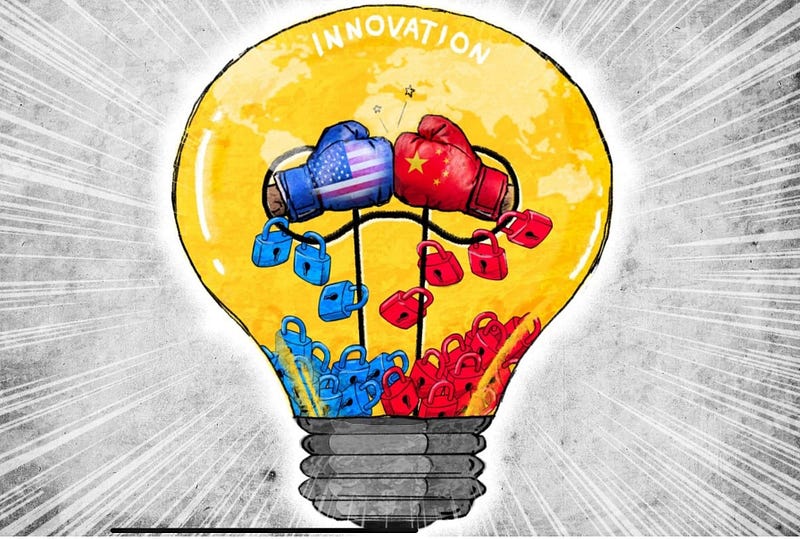
Imagine this — you’re in a race, and your fiercest rival is gaining on you rapidly. That’s the scenario we’re observing in the world’s quantum race. China and the United States, the two superpowers, are vying for the ground-breaking potential of quantum technology, pioneering the swift advances and frontier discoveries of this technological realm. If you thought the U.S. had a safe and untouchable lead, hold on to your hats because China is closing the gap faster than you might think.
According to recent patent application figures, China’s progress in quantum science and technology could shock you. It’s a startling development that paints an intriguing portrait of the global balance of quantum research power. So let’s delve into the numbers, shall we?
“Quantum technology promises to be the next technological revolution, transforming industries and economies. The unfolding quantum race between China and the U.S. is not just about national pride, but about who will dominate the fourth industrial revolution.”
Stick around, and you’ll discover the thought-provoking insights behind these hard-hitting facts. You’re about to find out how close China is to bridging the quantum gap with the United States.
Adjust your anticipation, because the often-reported rivalry in the quantum arena is much more interconnected than many realize. Let’s tackle this complex sphere of quantum tech, where two giants, the U.S. and China, are in a high stakes race. A contest not for brute dominance but to unlock quantum’s boundless potential. It’s an investiture of intellectual and financial resources that’s not only intense but also rich in nuances and intricacies.
Diving deeper into quantum technological domains, an interesting pattern emerges. The U.S. is seemingly walking ahead in quantum computing and quantum sensing, the cutting-edge domains that are reshaping the very way we perceive reality and interpret information.
But don’t be too hasty in brushing off China; the country is making notable strides, particularly in quantum communications. This technology exploits quantum physics’ unique laws to transfer data through signals that are, indeed, impossible to intercept. The promise of unbreachable security is a quantum leap not lost on anyone, least of all China, which has embraced the challenge with gusto.
By 2024, as quantum becomes less abstract theory and more applied science, the U.S. and China are, almost surprisingly, running neck-and-neck. But here’s the twist: both nations follow distinctly different strategies in approaching quantum development. As you can see, it’s a tale of two quantum superpowers, not universes apart, but converging and diverging in exciting ways.
In a recent episode of The China Power Podcast, Dr. Edward Parker, a recognized physical scientist at the RAND Corporation, lent his voice to the dialog around China’s quantum advancements. According to him, and other experts in the field, predictions about the future of quantum technologies are fraught with uncertainties — but one fact is crystal clear. The United States and China lead the quantum computing race, with many considering America holding a slight edge. Yet, the conclusion is far from written, providing much food for thought for those keen on these unfolding technological narratives.
Concerns about Chinese quantum supremacy? They’re real and valid. But remember, we’re witnessing a high-stakes game in progress, and the endgame is far from clear. So, let’s sit back, observe, and revel in this unparalleled techno-scientific rivalry that’s as enthralling as it is consequential.
Some Facts
- Quantum computing, unlike classical computing, can process complex and large volumes of data significantly faster. This revolutionary technology allows information to be stored in quantum bits, or qubits, that can seamlessly exist in multiple states, providing advantage in areas like pharmaceutical research, weather modelling, and machine learning.
- In recent years, China has dramatically increased its investment in quantum research and development. The nation’s patent figures are a clear testament to this dedicated focus, showing a deep commitment to narrowing the gap in quantum dominance with the United States.
- The United States and China are currently the global front-runners in the development of quantum technology, with both countries possessing rich ecosystems of private companies, universities, and government labs all striving for advancements in this revolutionary field.
- The competition for quantum supremacy has raised several concerns about potential exposure of military secrets, intellectual property theft, health record breaches, financial data vulnerabilities, and the overall risk to sensitive data.
- The United States has accused China of executing sophisticated data harvesting operations on a grand scale. On the other hand, China continues to argue for international cooperation and transparency in the development of quantum technology, asserting that science should be universal and should serve the common good of humanity.
- Those advocating for scientific exchange argue that open lines of communication fostered among nations, especially between the United States and China, can facilitate a shared quest for knowledge, encourage trustworthy cooperation and mitigate the risk of potential theft or misuse of intellectual property rights.
Conclusion
In summation, it is crystal clear that the tide is slowly but surely turning in the world of quantum technology. China’s skyrocketing patent figures starkly highlight its accelerating quest for quantum dominance, positioning it as a rising powerhouse inching closer to the United States. Such shifting dynamics underscore the intertwined narrative of human communication and our common quest for knowledge, transcending national boundaries.
The relentless pursuit of quantum technology isn’t just a race for prestige. Quite the contrary, this cutting-edge field harbors enormous potential for catalyzing economic advancement and fortifying national security. Harnessing the countless possibilities demands concerted research and development efforts, actively mitigating any accompanying security risks.
Between the United States and China, the specter of data harvesting allegations has cast a cloud of uncertainty. Yet, it’s crucial that we don’t lose sight of the bigger picture — the universality of science. In this shared endeavor to unlock quantum technology’s potential, our focus should be on fostering scientific exchanges and cultivating science diplomacy.
In the grand tapestry of human progress, the rise and fall of technological supremacy is a narrative we’ve witnessed time and again. As China inches closer to quantum dominance, it’s instead an opportunity to underscore the collective aspects of our quest for knowledge and leap ahead toward a promising future.
A Personal Reflection From Jason

As we delve deeper into the ever-evolving landscape of quantum science, it’s fascinating to witness a new titan in the field — China. These recent advancements in quantum technologies suggest not only strides in scientific research, but also the shifting power dynamics of the world. I can’t help but recall the excitement of Scott Aaronson, a heavyweight in the field of quantum computing, when discussing these advancements. His enthusiasm served as a stark reminder that knowledge, in its purest form, transcends national borders and political affiliations.
But, I also find myself pondering on a graver note — the words of National Security Advisor Jake Sullivan who views quantum technologies as pivotal in shaping our future. His concerns around ways our sensitive data might be exposed truly gives pause, and makes me ponder the implications of these technological advancements on not just economy and infrastructure, but also on a more personal level. The questions it raises around security of our health records, financial data, or even military secrets, are simply staggering.
Yet, amidst these thoughts, I draw reassurance from the stance of Dr. Edward Parker from the RAND Corporation. His emphasis on cooperation and transparency in the technological race holds out hope — a hope that this quest for knowledge would not just be an arms race but a mutual journey towards betterment. After all, in the great tapestry of humanity, our shared pursuit of knowledge has always defined us.
In light of China’s significant patent figures in quantum science, I view it not as a threat but an inspiring demonstration of humanity’s relentless quest for knowledge. The code of quantum dominance is yet to be cracked, and as we eagerly watch this story unfold, let’s remember that a world united in the pursuit of knowledge is invariably a world moving forward.
