China’s Controversial Strategy to Stop The Japanese Advance in 1938
And how they killed hundreds of thousands in the process
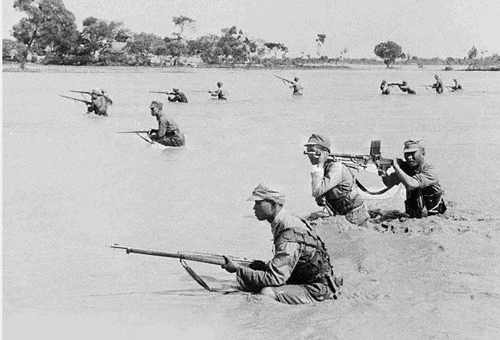
In 1938, while most of the world’s attention was focused on Europe, the Imperial Japanese Army was advancing swiftly through northern China. While the government in Tokyo was hoping to fortify its current positions on the Chinese mainland, rogue generals on the ground continued to press forward into new regions. The Imperial Japanese Army (IJA) was hoping to secure the hub city of Wuhan before attempting to corral and crush the Chinese nationalist forces remaining in the area. From Wuhan, the Japanese would have a clear path into the Sichuan Basin and the capital of Chengdu.
The Chinese were dismayed. They didn’t have enough force to stop the Japanese advance. If the Japanese made their way into the Sichuan Basin, there was a very real possibility that organized Chinese resistance would collapse. In order to stop the Japanese, the Chinese came up with an audacious and destructive plan. If the Chinese Army could not stop the Japanese advance, maybe the Yellow River could.
In a desperate ploy, the Chinese decided to destroy their system of carefully designed levees and dykes around the Yellow River and flood the whole region. The Yellow River is one of the largest and fiercest in the world, and letting it slip its banks would lead to untold destruction, but it would also provide an effective blocking force.
The results were both effective and harrowing. The Yellow River Flood of 1938 remains one of the most drastic and forgotten moments of warfare in the 20th century.
Breaking The Dams
In June 1938, Chiang Kai-shek ordered the destruction of the levees along the Yellow River after he was defeated at the Battle of Xuzhou. Tunnels were dug under key levees, which caused them to collapse. The effects were immediate. Millions of gallons of water began pouring from the river into the surrounding lands. The land around Wuhan is largely flat and rural. This is why the Japanese would have had a straight shot across the region if they had managed to take the city.
The region was also home to a network of strategic railroads that would have allowed the Japanese to ship in reinforcements quickly and supply the army in Wuhan. They would all soon be underwater.
The Chinese strategy for using the river as a blocking force was called “using water as a substitute for soldiers.”
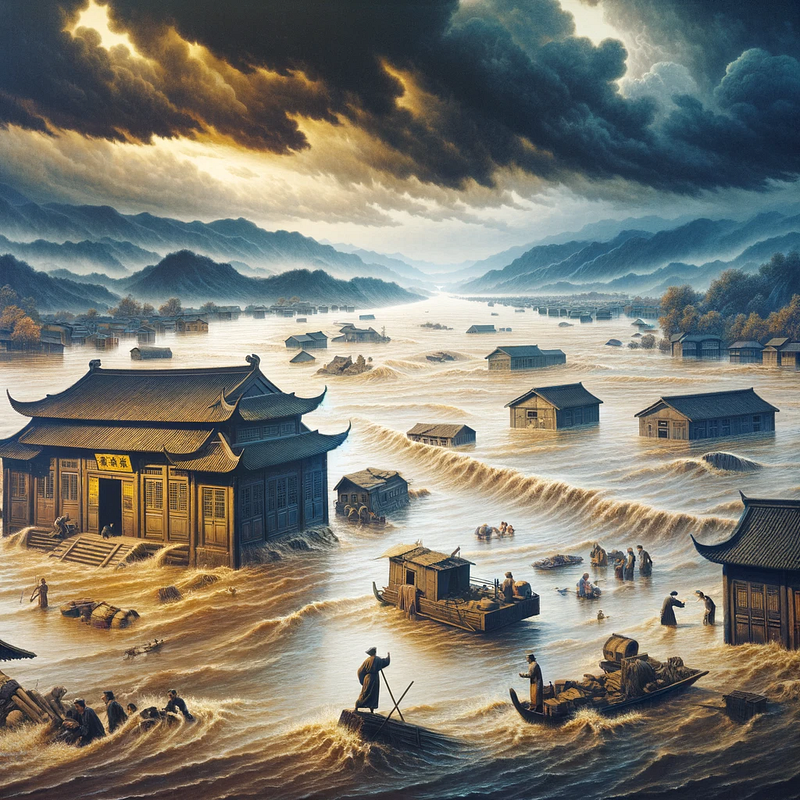
Over the course of a week in early June, the whole region was inundated. Thousands upon thousands of square kilometers of agricultural land and infrastructure were flooded. Some areas saw the water rise as high as eight feet. In most places, the water sat between two and three feet deep. It was enough water to drown the rail lines, hide the roads, and make topographical maps nearly worthless.
The plan was an immediate strategic success. Japan watched helplessly as their plans disappeared under the waters of the Yellow River. Troops could not move. The railroads were rendered useless. Bridges were washed out, and the Chinese nationalist army quickly surrounded the region and prevented the Japanese from moving or reacting to the disaster.
The Japanese advance ground to a complete halt, but at what cost?
The Human Cost
Unfortunately, the lands that were quickly submerged underwater were home to hundreds of thousands of agricultural peasants. People’s homes and livelihoods vanished in a matter of days. Thousands died in the initial floods, with many of them drowning in their houses. But the human tragedy would become much more expansive in the coming months.
Famine erupted in the area due to the fact that all of the agricultural ground and animals drowned in the floods. Markets were destroyed. Roads were gone. The waters also provided ample breeding grounds for pests and diseases.
Unsurprisingly, intentionally flooding a major region of their own country was not a popular move. At this point, China was still engaged in a civil war, even though it had been put on hold in order to stop the Japanese. The communist Chinese under Mao quickly used the tragedy to recruit the peasants to the communist side. The whole basin would rapidly transform into a breeding ground for communist guerillas, which would help turn the war in the Reds’ favor after World War II.
Casualties
There are two groups of numbers used to describe the casualties from the Yellow River Flood. The first group of numbers puts the total death toll at between 400,000 and 500,000, with 30,000 to 89,000 being directly related to drowning. The second group of figures puts the number of dead between 800,000 and 900,000.
The first numbers were compiled by the communist Chinese after the war and are considered to be mostly accurate. The second set of figures was compiled by the nationalist Chinese. The second set of figures has been used by the communist Chinese to show how inhumane and brutal the nationalist regime was even though official statistics still land around 400,000 total dead.
Either way, hundreds of thousands of innocent Chinese peasants lost their lives in the flood, with tens of thousands of them drowning in the raging torrents days after the levees were destroyed by Chiang Kai-shek’s forces.
Conclusion
The audacious plan to intentionally destroy dams and levees around the Yellow River in 1938 was a strategic success. Using the water as a substitute for soldiers stopped the Japanese in their tracks, but it also came at the cost of hundreds of thousands of lives. Millions of acres of farmland were destroyed. Dozens of bridges and hundreds of miles of track were wrecked. It would take another decade before the region started to recover from this man-made tragedy.
Due to these actions, the people around Wuhan would become communist sympathizers. The Japanese never landed their killing blow in China and became bogged down in an increasingly unwinnable quagmire, which prevented them from fighting World War II effectively. In these ways, the Yellow River Flood worked, but the human cost of such a strategy is sickening.